





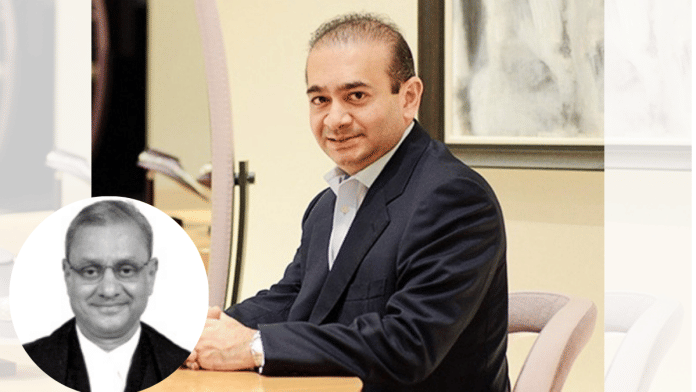



New Delhi: Retired Supreme Court judge Deepak Verma, who appeared as expert witness in the United Kingdom court in the Nirav Modi extradition case, told the court that it was “inevitable” the fugitive diamantaire would face prolonged custodial interrogation and is prone to the risk of “custodial torture” in India.
His statements, in favour of Nirav Modi’s plea to reopen his appeal against extradition to India, ran completely counter to a list of assurances given by the government of India, including that the investigative agencies will not arrest and interrogate the fugitive diamontaire.
However, the UK High Court (King’s Bench Division) found India’s sovereign assurances “reliable” and “cognisable”.
Justice (retired) Deepak Verma, who testified before the high court as an expert witness, said it was “inevitable” that Modi would have to face prolonged custodial interrogation and was prone to the risk of custodial torture.
Justice (Retired) Verma made his submission in written before the high Court.
“In the specific case of NM,” he said, “The statutory framework permitting custodial interrogation of economic offenders, when juxtaposed with the entrenched and judicially recognised problem of custodial violence, makes it inevitable to conclude that NM faces not only the certainty of prolonged custodial interrogation by multiple agencies, but also a substantial and ongoing risk of custodial torture.”
In his submission, Justice (retired) Verma informed the High Court that he was roped in by the Boutique Law LLP, the law firm representing Modi’s case, to offer expert comment on reopening the appeal against extradition before the High Court.
He submitted three statements, virtually casting doubt on the sanctity and authenticity of the assurances given by India.
But, the High Court found the assurances given by the Indian government reliable, and cognisable at the diplomatic level, considering the long history of bilateral and diplomatic relationship between India and the UK.
When ThePrint reached out to Justice (retired) Verma through a call for a comment on his statement in the UK court, he said, “I don’t have anything to say. Thank you very much.”
Nirav Modi is wanted in several cases by the Central Bureau of Investigation and the Enforcement Directorate, linked to fraud orchestrated against Punjab National Bank amounting to Rs 13,500 crore.
Also Read: ‘Maintenance cost would be more than value’—Court allows ED to auction Nirav Modi’s twin Mercedes
Bhopal tragedy cases & Nirav Modi’s defence
Having completed his LLB from Jabalpur University, Justice (retired) Verma’s legal journey began in 1972, when he was enrolled as an advocate. He rose through the ranks and served as an administrative judge in Indore till August 2005.
He was appointed as a Judge of the Madhya Pradesh High Court and as Welfare Commissioner for the rehabilitation of victims of the Bhopal Gas tragedy. “Almost all the victims have been awarded compensation during his tenure except for those who are not traceable despite notices,” his details on the Supreme Court of India website say.
Later, he became the senior most judge at the Karnataka High Court before his elevation as the Chief Justice of the Rajasthan High Court in March 2009. He was elevated to the post of judge of the Supreme Court of India in May 2009 and served until his retirement in 2012.
In the case of Modi, justice (retired) Verma further submitted that he was consulted by the law firm on the five broader questions, including about “degree of likelihood” that Modi will be questioned by the CBI or ED as part of cases for which his extradition has been sought, or other agencies such as the Directorate of Revenue Intelligence (DRI) and the Serious Fraud Investigation Office (SFIO) for which the extradition has not been sought.
Additionally, he was also requested to submit an opinion on the questions of the circumstances in which Nirav Modi will have to be produced before the court every fortnight, judicial records related to custodial torture cases, and laws governing the powers of the Indian agencies to interrogate Modi in offences for which he has not been sought by the government of India.
Justice (retired) Verma countered the affidavits filed by the CBI and the ED, through which the agencies submitted that Modi would not be interrogated by them because the chargesheets had already been filed in their cases and the court was already presiding over the matter.
“Since the Special Court, CBI, is yet to frame charges against NM in accordance with Section 240 of CrPC, in my view, it can be safely concluded that the CBI proceedings are still at the stage of inquiry and have not yet transitioned to the stage of trial,” Justice (retired) Verma told the high court.
Moreover, he said that at least three open-ended warrants were issued against Modi by courts in Mumbai and Surat, and their execution has a serious bearing on the government’s assurances that Modi would not be arrested.
“It, therefore, follows that NM’s arrest will occur upon arrival in Mumbai and that he will be produced before the Special Court within twenty-four (24) hours. Upon production, the Court will consider the request by CBI and will either remand NM to CBI’s custody (i.e., for interrogation by CBI) for a period of a maximum of fifteen (15) days or to judicial custody (i.e., ARPM or Arthur Road Prison, Mumbai) in accordance with Section 167 of the CrPC, after due consideration of all relevant facts,” he submitted.
He further said that a similar move is likely to be adopted by the ED, which too has an open-ended warrant issued by a special PMLA court.
He also submitted that the Indian government has not addressed whether the non-bailable warrants will be cancelled or withdrawn upon extradition, and requested that the UK High Court treat the government’s assurances with “considerable caution.”
He said that the assurances made by the government sat “uneasily” alongside the procedural and factual records of the cases against Modi.
“In these circumstances, the continued pendency of the non-bailable warrants and the proclamation order casts a serious doubt on the credibility and reliability of the undertaking given by the Gol. Accordingly, the presence of subsisting arrest warrants materially undermines the credibility of the assertion of the Gol that custodial interrogation is not required,” he further submitted.
On the question of the degree of likelihood of his arrest and interrogation by the other agencies, Justice (retired) Verma raised a “near-certain likelihood” that he would be interrogated separately by each investigating agency, such as the DRI, SFIO and the Income Tax Department.
Justice (retired) Verma also raised a question mark over India’s guarantee that Nirav Modi would be lodged in barrack number 12 of the Arthur Road jail in Mumbai, where he will be allowed access to legal and medical counsel when required.
Justice (retired) Verma argued that the aspect of judicial custody is governed by the courts of India, which operate independently of the government, and hence the government’s assurances in the UK will not be binding on the Indian courts, which may order his judicial custody. To be specific, Justice (retired) Verma said the government of India is “conspicuously silent” on the court proceedings in Surat in the case probed by the DRI.
“It is of particular concern that the assurances furnished by the Gol do not contain any explicit undertaking that NM shall not be removed from ARPM (Arthur Road prison) for the purposes of investigation. The absence of such a categorical assurance gives rise to a reasonable apprehension of the possibility of his being transferred elsewhere for the purpose of interrogation,” he further submitted.
A ‘more combative witness’
A key argument Modi gave in a bid to reopen his appeal in the High Court was the judgment of the same court staying the extradition of the fugitive arms dealer Sanjay Bhandari.
Justice (retired) Verma had appeared as an expert witness in the case as well. The High Court had, in February last year, upheld Bhandari’s appeal, predominantly on the grounds that he was at the “real risk of extortion, accompanied by threatened or actual violence, from other prisoners and/or prison officials”.
Justice (retired) Verma submitted the details and statistics related to overcrowding in the Tihar jail, where Bhandari was supposed to be lodged in case of extradition, along with the number of natural and unnatural deaths of the Tihar inmates.
In the Judgement passed last February, the UK High Court had made a startling remark about Justice (retired) Verma’s extensive advocacy for the defendant (Bhandari). However, the court had not disputed the statistics submitted by him, citing the data of the National Crime Records Bureau.
“The District Judge found that Justice Verma, a former Justice of the Supreme Court of India, was ‘a more combative witness’ than Dr Mitchell, and ‘on occasions he became an advocate for the defendant rather than an objective independent expert witness’. But this evaluation does not affect the statistics that he provided,” the UK High Court judgment had said last year.
Before Modi and Bhandari, Justice (retired) Verma had also appeared as an expert witness in the case of another fugitive businessman, Vijay Mallya, calling the plea of a consortium of Indian banks to declare Mallya bankrupt as illegal. Justice (retired) Verma had reportedly told a UK court in 2020 that Indian banks cannot seek prosecution against Mallya at two places simultaneously.
“They can’t give up security in India and do a complete turnaround and take advantage of the laws in England. The fact that public money is involved is important. There is public interest as well. The banks have always been contending they are secure creditors,” Times of India had quoted him arguing before a UK Court in June 2020.
“They cannot prosecute in two places simultaneously. They need to give up in one of the courts and relinquish their rights. Banks have already exercised their rights in the Indian courts and realised an amount from Mallya by selling his shares and pocketing a few thousand cores.”
(Edited by Ajeet Tiwari)
Also Read: What’s stalling India’s efforts to bring back fugitive white-collar criminals? The state of prisons