





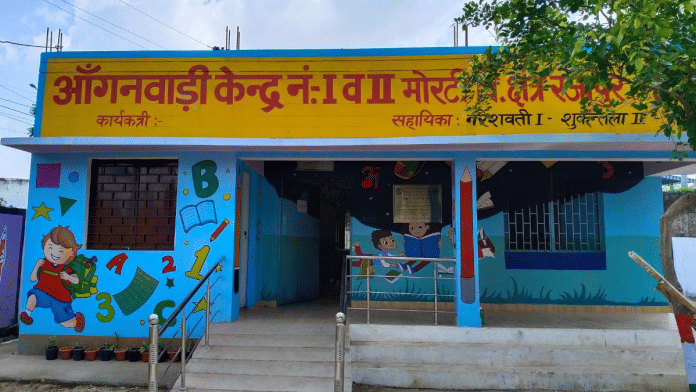



New Delhi: For two decades, Anganwadi construction in rural India drew on a predictable source of financing: the Mahatma Gandhi National Rural Employment Guarantee Act (MGNREGA). Anganwadi construction was explicitly listed as a permissible activity under the rural employment guarantee programme.
States would caliberate their building plans around the Rs 8 lakh per centre that the MGNREGA contributed — by far the largest single source in a three-part funding model that also included Rs 2 lakh from the Ministry of Women and Child Development and Rs 2 lakh from the 15th Finance Commission.
In December 2025, Parliament passed the Viksit Bharat—Guarantee for Rozgar and Ajeevika Mission (Gramin) Act, known as VB-G RAM G, replacing the MGNREGA, 2005. The new law came into effect from 21 December.
The department-related Parliamentary Standing Committee on Education, Women, Children, Youth and Sports, chaired by Congress leader Digvijay Singh, has said that the replacement has created an unresolved financing question for anganwadi construction that the Ministry of Women and Child Development has not yet addressed.
The committee has flagged the issue in its 377th report presented to both Houses of Parliament on Wednesday.
“Since MNREGA has been replaced by VBRAM-G in December 2025, there is an urgent need to relook at the funding pattern because under the new Act, the funding pattern has undergone a change,” the committee stated.
It has suggested the ministry act on two fronts. “The Committee recommends that the Ministry should take necessary steps to work out the modified funding pattern for the Mission (Mission Saksham Anganwadi and Poshan 2.0) and till the issue is resolved, the Ministry should seek funds for the smooth functioning of the Mission.”
The Mission Saksham Anganwadi and Poshan 2.0 is the umbrella mission under which anganwadi construction is financed. The Rs 8 lakh MGNREGA contribution was specifically for construction of anganwadi centres under this mission.
Also Read: Ghaziabad Anganwadi got a digital blackboard. Nobody is late to class
What new law changes
The VB-G RAM G does not exclude anganwadi construction. The new law organises permissible works into four priority verticals—water security, core rural infrastructure, livelihood-related infrastructure, and climate adaptation—and anganwadi construction sits within the core rural infrastructure vertical.
What has changed is the financing architecture around it.
Under the MGNREGA, the Central government bore 100 percent of unskilled labour wage costs and up to 75 percent of material costs. Anganwadi construction was demand-driven—a gram panchayat could identify the need, it would appear in the labour budget ratified by the gram sabha, and funds would flow accordingly.
The VB-G RAM G alters this in several ways. The Central government will now provide 60 percent of the total fund requirement, with state governments covering the remaining 40 percent—a significant increase in the financial burden on states for most of the country. Only northeastern and Himalayan states retain the earlier 90:10 split mandated under the MGNREGA.
Beyond cost-sharing, works under VB-G RAM G must originate from Viksit Gram Panchayat Plans, consolidated upward through block and district levels and integrated into a national platform called the Viksit Bharat National Rural Infrastructure Stack, aligned with the PM Gati Shakti Master Plan.
Under VB-G RAM G, every gram panchayat is required to prepare a Viksit Gram Panchayat Plan which is a multi-year development plan that identifies infrastructure works to be taken up under the new act. These plans are to be ratified by the gram sabha, then consolidated at block and district levels before being fed into the national Viksit Bharat Rural Infrastructure Stack.
Where the MGNREGA allowed gram sabhas to plan and ratify works based on local needs, the new framework requires local plans to fit within a nationally coordinated infrastructure planning system, essentially meaning they should align with centrally-designed plans.
State-wise allocations will be determined annually by the Central government based on normative parameters (fixed criteria), constraining states from expanding construction activity purely in response to local demands.
The new act also empowers states to pause employment works for up to 60 days during peak agricultural seasons — a provision absent in the MGNREGA. How this interacts with construction timelines for anganwadis, which are community infrastructure rather than agricultural works, is a question the committee report does not address and the ministry has not answered.
What the committee is pointing to is this: even if anganwadi construction remains permissible under VB-G RAM G, the specific funding architecture that made it practically deliverable — the combination of demand-driven planning, central wage cost absorption, and predictable per-unit contributions — no longer exists in its previous form. No replacement arrangement has been put in place.
Already strained programme
The committee’s warning arrives at a difficult moment for Mission Saksham Anganwadi and Poshan 2.0, the government’s flagship nutrition and early childhood programme.
The scheme operates through a network of over 14 lakh anganwadis across 36 states and union territories, serving 8.86 crore registered beneficiaries — children up to six years of age, pregnant women, lactating mothers, and adolescent girls in aspirational districts and northeastern states.
The Budget Estimate for 2026-27 is Rs 23,100 crore, a 5.2 percent increase over last year.
The construction pipeline was under strain even before the VB-G RAM G transition.
The committee noted a second financing gap running in parallel: the Rs 2 lakh per centre contribution from the 15th Finance Commission has also not been received by the ministry. With two of the three external funding sources now either absent or in flux, the per-unit construction financing for rural anganwadis is reduced to the Rs 2 lakh the ministry itself contributes.
In urban areas, land acquisition remains a persistent obstacle. The committee recommended the ministry explore co-location with schools or consider acquiring ready-built structures, and called for urban-specific cost norms for metro cities.
Vacancies & financing gaps
The committee found that 2,348 out of 7,075 sanctioned posts of Child Development Project Officers—the field-level supervisory functionaries who oversee anganwadi operations—were lying vacant as of meetings held in February-March 2025, a vacancy rate of 33.18 percent.
The sanctioned strength for CDPOs has not been revised since 2008-09, when 7,075 projects were first sanctioned.
“The Committee recommends that the Government should undertake a review of sanctioned strength of CDPO expeditiously in light of current programme requirements and fill the vacancies,” the report stated. It also recommended state-wise vacancy mapping and flexibility for states in cadre restructuring or contractual appointments to prevent programme disruption.
Anganwadi workers are paid Rs 4,500 per month and anganwadi helpers Rs 2,250 per month as honorarium. The committee described this as “very meager,” particularly given what it called “the expanded scope of work of the Anganwadis”.
A revision of these rates was announced by the Finance Minister during the Union Budget presentation for 2025-26. The Expenditure Finance Committee proposal for revision was subsequently sent to the Department of Expenditure, which suggested incorporating it into the 16th Finance Commission framework. The revision has not been implemented.
“The Committee recommends that the Government should expedite the revision of Anganwadi cost norms, particularly for Supplementary Nutrition, and ensure its implementation before the 16th Finance Commission cycle commences,” the report said.
The crèche programme
The committee also examined the Palna scheme, which converts anganwadis into Anganwadi-cum-Crèches to provide childcare for working mothers. The target for the 15th Finance Commission cycle was 17,000 such centres. As of January 2026, 2,820 are operational.
Between May 2023 and January 2026, 132 net new centres were added. The scheme’s budget was reduced 80 percent from Budget Estimate to Revised Estimate in 2025-26, from Rs 125 crore to ₹25 crore.
Twelve states and union territories, including Maharashtra, West Bengal, Tamil Nadu, Gujarat, and Madhya Pradesh, have zero operational crèches under the scheme. The committee recommended a fast-track approval window for states with nil coverage.
“The Committee further recommends that the design of the Palna crèches may be revisited. Many women need childcare that matches actual work patterns rather than only standard office timings. Longer operating hours, half-day and flexible enrolment, child pickup support, and partnerships with NGOs or local operators would make Palna far more usable for women in shift work, gig work, domestic work, retail, and low-end service jobs,” the report noted.
The committee’s report identifies the VB-G RAM G transition as requiring resolution on a priority basis, alongside the broader set of financing, staffing, and implementation gaps in the Mission.
Its direction to the ministry is specific: work out the modified funding pattern, and until that is done, seek separate funds to keep the programme running.
(Edited by Ajeet Tiwari)
Also Read: Revamp anganwadi model for Viksit Bharat. Workers should be seen as frontline educators