





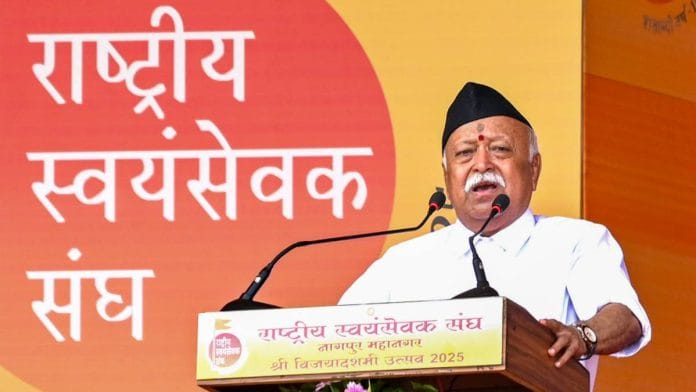



Mumbai: Rashtriya Swayamsevak Sangh (RSS) chief Mohan Bhagwat Saturday called references to “Hindu–Muslim unity” as misleading and conceptually flawed, asserting that unity does not need to be forged between communities that are “already one”.
Addressing members of civil society at a two-day conclave titled ‘New Horizon’ at Mumbai’s Nehru Centre in Worli as part of the RSS’s centenary-year events, Bhagwat argued that such phrases wrongly assume separateness within Indian society.
“When there are two separate entities, you talk about unity. But those who are already one, why do you want to talk about their unity,” he asked.
The event, which follows similar conclaves in Delhi, Bangalore and Kolkata, was attended by actors Salman Khan, Ranbir Kapoor, Boney Kapoor and Hema Malini, industrialists Radhakrishna Damani and Ajay Piramal, and diplomats from Israel, the UK and Italy.
Bhagwat asserted that “Hindu is not a noun but an adjective” and described India’s inclusive national character as rooted in the Hindu idea of vasudhaiva kutumbakam (world is our family). He said Indians had only “forgotten that unity, which now needed to be reminded”.
“We were united and that is why we saved the rashtra (country) multiple times together,” he said, adding that divisive tendencies could be overcome through dialogue, discussion and debate rather than confrontation.
On ties with politics, Bhagwat asserted that the Sangh was not a political party, and while many of its volunteers are BJP members, “it is not our party”.
Also Read: RSS at 100 — ‘No permanent enemies’, flexible ideology, Bollywood embrace
Hindu as civilisational descriptor
Explaining the Sangh’s view of Hindu identity, Bhagwat said Hindu should not be seen as a noun or the name of a religion or a particular community. “Hindu is an adjective, not a noun,” he said, arguing that it described the civilisational nature of the people of Bharat.
He traced the popular use of the term to historical interactions after Babur’s invasion of Punjab, when the word entered common usage. “We do not have a Hindu dharma shastra; we have manav dharma shastra,” he said.
Bhagwat mentioned several terms — Bharatiya, Hindavi and Hindu — which he claimed were essentially synonymous. He added that saints and reformers had adopted such words because they communicated with people in the language they understood.
He noted that the word Hindu or Hindustan was first used by saint Guru Nanak in his writings after Babar’s invasion.
Vasudhaiva kutumbakam and forgotten Hindutva
Speaking of what he described as sections of Hindus who had “forgotten Hindutva”, Bhagwat referred to four broad categories: some lived their identity with pride, some followed it naturally without assertion, some were influenced by other ongoing cultural streams, and a fourth group that he claimed had lost touch with its civilisational roots.
“Those who have forgotten Hindutva must remember that there is a guarantee of their safety and security in Hindutva alone,” he said.
Linking this idea to the subcontinent’s political history, Bhagwat said, “Pakistan separated and called itself a Muslim country. Bangladesh split from Pakistan and eventually became a Muslim country too. Bharat declared itself a country for everyone because we are Hindu.”
He said this inclusive approach “flowed from the Hindu idea of vasudhaiva kutumbakam, even though some had later described it as a mistake”.
Expanding on this theme, Bhagwat said the idea of vasudhaiva kutumbakam was central to the Sangh’s understanding of Hindu identity and nationhood. He argued that Hindu should not be seen as a narrowly defined religion but as a civilisational descriptor that inherently accommodates diversity. This, he said, explained why India did not define itself on the basis of a single religious identity after Independence.
He said the unity of Indian society had existed historically and had only been obscured by political and ideological disruptions, not erased.
Bhagwat also said that Muslims and Christians in India were culturally different from their counterparts elsewhere because they had evolved within the broader Indian civilisational framework. According to him, repeated references to “Hindu–Muslim unity” created the false impression of two opposing entities, whereas the real challenge was to restore a sense of inherited togetherness.
He said destructive tendencies sought to break this unity, but the response, he argued, lay not in confrontation but in dialogue, discussion and debate, backed by social strength. “We have only forgotten that unity, which needs to be reminded,” he said.
RSS and politics
On the Sangh’s relationship with politics, Bhagwat reiterated that the RSS was not a political party.
“The BJP has many of our swayamsevaks, and very able in their jobs, but it is not our party,” he said, adding that the Sangh does not seek power or popularity and did not control its (BJP) members.
Bhagwat also spoke about the functioning of the RSS, describing it as a unique organisation rooted in daily grassroots activity rather than formal structures of power.
He said the Sangh functions through nitya shakhas or training centres, where swayamsevaks or volunteers come together for about an hour under the saffron flag to engage in physical exercise, discipline and collective activities aimed at strengthening the body, mind and intellect.
Stressing that the RSS is neither a paramilitary organisation nor a pressure group, Bhagwat said its work is carried out without opposing anyone and is focused solely on organising society through example, not command or control.
Bhagwat underlined the centrality of daily shakhas to what he described as preparation for the nation, saying consistent participation was essential to the Sangh’s method. “If you want to prepare for the country, you have to come to the nitya shakhas. That is the only way,” he said. He added that the RSS did not operate through issue-based mobilisation but through disciplined collective effort.
Bhagwat said the Sangh’s focus was on building committed individuals who could work together with a shared sense of purpose rather than rallying around temporary agendas.
Explaining what he meant by “preparing for the country”, Bhagwat said it involved selfless action carried out with integrity, using one’s body, mind and resources for the larger good. He defined this preparation as working “with honesty and selflessness, dedicating tann, mann and dhan to the protection of dharma, sanskar and sanskriti, and for the all-round progress of society”.
While he said such values could ideally be cultivated at home through the right upbringing and social environment, Bhagwat added that shakhas provided a space for those who were unable to do so. “If that cannot happen at home, one can come to the shakhas. That is the only correct way,” he said.
Tracing the history of the organisation, Bhagwat said the RSS was founded in 1925 by Dr Keshav Baliram Hedgewar, who later became its first sarsanghchalak (chief) in 1929. He referred to Hedgewar’s early involvement with groups such as the Anushilan Samiti in Kolkata before he turned to what he described as a long-term social project.
Also Read: Bihar Bhumihars ask ‘Who are we?’ Brahmin or OBC, zamindar or oppressed
The usual platitudes. But sadly actions speak louder than words. And actions point to increased disunity within country since 2014. Maybe RSS should introspect why it is so.
When are you bringing UCC? First do that!