





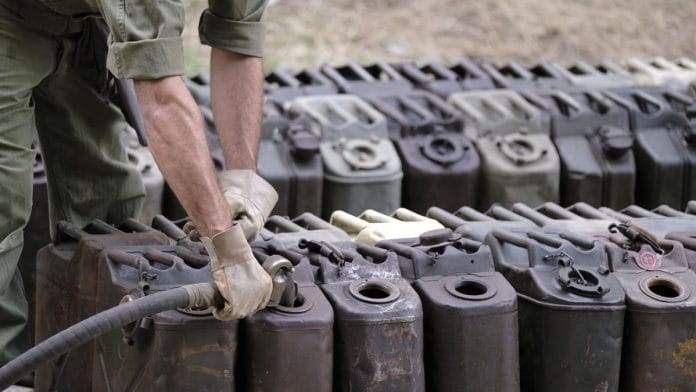



New Delhi: Citing global energy uncertainties driven by the prevailing geopolitical situation, the Centre has allowed the supply of kerosene to states and Union Territories that had previously declared themselves “kerosene-free”.
A gazette notification issued Sunday by the Ministry of Petroleum and Natural Gas permits distribution of superior kerosene oil under the Public Distribution System (PDS) to 21 states and UTs. The move is aimed at supporting cooking and lighting needs in areas, where kerosene had been phased out under normal conditions.
“This notification is specifically intended for those states that have previously declared themselves ‘kerosene-free’. Consequently, this Gazette Notification outlines the mechanism for supplying kerosene in such regions should a need for it arise,” Sujata Sharma, joint secretary at the ministry, said at an inter-ministerial press briefing Monday.
Under the notification, up to two fuel stations per district—preferably company-owned outlets of public sector oil firms—can store up to 5,000 litres of kerosene for distribution. The arrangement applies only to household use for cooking and lighting, and will remain in force for 60 days or until further orders.
The move follows the government’s earlier decision to allocate an additional 48,000 kilolitres of kerosene to states and UTs over and above their regular quarterly allocations.
The government also flagged a spike in LPG demand, attributing it to panic bookings. “In the last two days, about 1.04 crore LPG bookings were made, against which nearly 92 lakh cylinders have been delivered,” Sharma said.
On commercial LPG, the government said availability has been ramped up significantly. “As for commercial LPG, as you are aware, the Government of India has increased its availability by around 70 per cent. Priority is being given to dhabas, restaurants, industrial canteens and migrant labour,” Sharma said.
Following a relaxation in distribution thresholds, supply of commercial LPG has risen to 41,000 tonnes as of Sunday, up from 30,000 tonnes reported on 26 March.
Also read: Modi govt on LPG: No supply crunch, domestic production up & 10 days’ worth of daily demand en route
Fertiliser output hit but stocks in place
Meanwhile, the Department of Fertilisers said domestic urea production has taken a hit due to the West Asia conflict. Joint Secretary Aparna S. Sharma said the disruption led to an initial decline of 30,000 to 35,000 tonnes per day in output.
Despite this, the government maintained that overall availability remains comfortable ahead of the Kharif season.
“Overall requirement for the upcoming Kharif season as projected by the Department of Agriculture stands at 390 lakh tonnes. In comparison the actual sales during the Kharif season last year amounted to 361 lakh tonnes,” Sharma said. She added that current stock levels stand at 180 lakh metric tonnes, compared to 147 lakh tonnes last year, indicating a “healthy” position.
The government noted that April and May are typically lean months used to build inventory, and said it is diversifying fertiliser sourcing beyond the Gulf. “Government is taking proactive measures to diversify sourcing of fertilizers from beyond Gulf region countries like Russia, Morocco, Australia, Indonesia, Malaysia, Jordan, Canada, Algeria, Egypt,” Sharma said.
Incoming LPG cargo
Amid ongoing regional tensions, two Indian-flagged LPG vessels—BW Tyr and BW Elm—carrying around 94,000 metric tonnes are expected to arrive in India on 31 March and 1 April, docking at Mumbai and New Mangalore respectively.
However, shipping disruptions continue to persist. Rajesh Kumar Sinha, Special Secretary, Ministry of Ports, Shipping and Waterways, said 18 Indian-flagged vessels with 485 Indian seafarers are currently stranded west of the Strait of Hormuz.
In addition, Sinha said that three foreign-flagged LPG vessels bound for India, along with four crude oil vessels and three LNG carriers, are also stranded in the strait.
(Edited By Nardeep Singh Dahiya)
Also Read: Govt hikes commercial LPG allocation to 70% of pre-war levels, in sign of easing supply constraints