








Gurugram: Forgot to put a leash on your dog? From now on, you’ll just pay Rs 500 instead of risking jail time. Can’t produce your liquor licence when the excise inspector shows up? That’s a maximum Rs 1 lakh fine now, not three months behind bars.
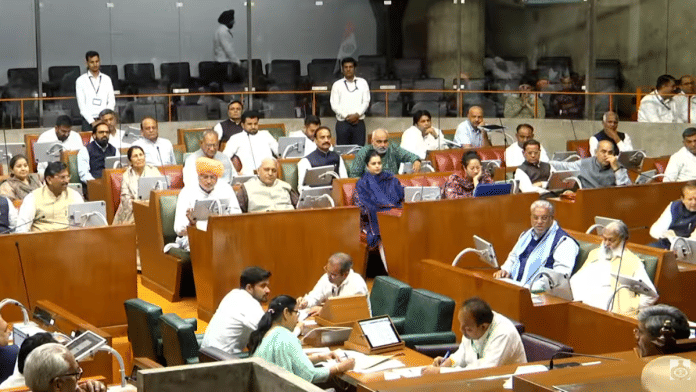
The Haryana Assembly Monday passed the Jan Vishwas (Amendment of Provisions) Bill, 2025, which takes the handcuffs off 164 minor offences across 42 state laws and replaces prison sentences with monetary penalties.
The bill, moved by Industries and Commerce Minister Rao Narbir Singh, is Haryana’s version of the Centre’s Bill by the same name passed in 2023.
The Union government’s Act, notified on 11th August 2023, decriminalised 183 provisions in 42 central acts administered by 19 ministries/departments.
Haryana’s proposed legislation would touch almost every aspect of daily life in the state. Village watchmen who don’t help catch criminals, a criminal offence mentioned in a 1872 law, now face up to Rs 50,000 penalty instead of prosecution.
Farmers planting paddy before the notified date to save groundwater will pay Rs 25,000 per hectare and lose access to government schemes for two years, but won’t get a criminal record.
The Haryana Municipal Act, 1973 saw some of the biggest changes. Putting up unauthorised advertisements, tethering animals on roads, footpaths, pavements, or other public places, keeping swine in ways that create health hazards—all these would now attract penalties ranging from Rs 500 to Rs 2,000 instead of jail time.
Property dealers operating without licences will now pay Rs 50,000 as individuals or Rs 1 lakh as companies. Earlier, they faced criminal prosecution that could drag on for years.
For businesses, several pain points have been addressed. Money lenders operating without registration face a fine of Rs 50,000 for the first violation, and double that amount for the second. Cotton ginning factories that water cotton or mix adulterants can be fined Rs 25,000 to Rs 1 lakh, depending on whether it’s a repeat offence, and their licences can be suspended for two years if they keep at it.
Warehouse operators acting without proper licences face penalties up to Rs 5 lakh. Private coaching institutes violating regulations, a hot topic given recent controversies, can be fined Rs 25,000 for the first violation, Rs 50,000 for a repeat offence, and eventually lose their registration.
In-built escalation
The bill has an interesting feature. The penalties automatically increase 10 per cent every three years to keep pace with inflation and maintain deterrence. Most offences also follow a doubling pattern—the first violation carries the base penalty, the second violation doubles it, and continued violations can lead to license suspension or cancellation.
Every penalty imposed can be appealed against within 60 days. Most appeals go to deputy commissioners or divisional commissioners depending on the offence. The bill mandates appeals must be decided within 180 days.
More importantly, no penalty can be imposed without following principles of natural justice, meaning the accused must get a hearing. This was often missing in the old laws.
What stays criminal
The government was careful to keep serious offences in the criminal domain. False declarations to grab land allotments, furnishing wrong information to grab evacuee property, violations threatening public safety, these would still invite prosecution under the Bharatiya Nyaya Sanhita along with the penalties.
The Haryana Development and Regulation of Urban Areas Act still sends people to jail for up to one year if they violate Section 7 provisions, though other violations under that act have been decriminalised.
Section 7 prohibits advertising, sale and transfers and execution of documents for plots or flats in a colony until a licence has been granted by the Town and Country Planning Department.
Co-operative society frauds, medical establishments endangering patients, and offences involving professional misconduct also retain their criminal character.
Similar Central acts
The bill follows the Centre’s Jan Vishwas Act, 2023. The central government had advised all states to undertake similar exercises.
Building on that, Union Minister for Commerce and Industry Piyush Goyal introduced the Jan Vishwas (Amendment of Provisions) Bill, 2025 in Lok Sabha on 18 August this year.
The Union government’s 2025 bill expands the reform agenda to cover 16 Central acts administered by 10 ministries/departments. A total of 355 provisions are proposed to be amended—288 decriminalised for ease of doing business, and 67 proposed to be amended to facilitate ease of living.
The statement of objects for the Haryana government’s Bill reads, “The ‘Haryana Jan Vishwas (Amendment of Provisions) Bill, 2025’ seeks to promote trust-based governance by ensuring a balanced and pragmatic legal framework that emphasises facilitation over penalisation.”
“It aims to enhance Ease of Living and Ease of Doing Business in the State through reduction of unnecessary criminal provisions, simplification of compliances and establishment of a transparent, efficient and citizen-centric administrative environment,” it adds.
The state bill covers 17 departments and touches laws dating back to 1872. Some other pre-independence era laws being amended are Punjab Acts that Haryana inherited after reorganisation in 1966.
The newest law being amended is the Haryana Registration and Regulation of Private Coaching Institutes Act, 2024, which is getting amended within months being enacted.
If someone doesn’t pay the penalty, it will be recovered as arrears of land revenue, meaning the revenue department’s machinery kicks in. This is usually more effective than waiting for courts to enforce payment.
The bill also specifies that any amount recovered goes to the department concerned, not into a general pool. This gives departments an incentive to actually enforce the penalties rather than letting violations slide.
(Edited by Ajeet Tiwari)
Also Read: How Haryana brought in law to take over Rs 2,400-cr Gurugram ashram set up by ‘Indira’s Rasputin’