





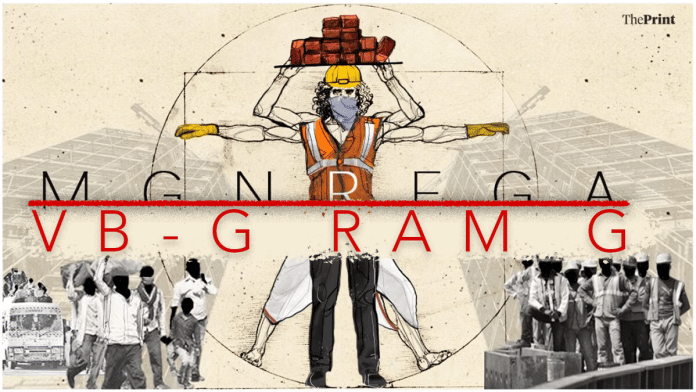



New Delhi: Set to replace the Mahatma Gandhi National Rural Employment Guarantee Act, 2005 (MGNREGA), the Viksit Bharat- Guarantee for Rozgar and Ajeevika Mission (Gramin) Act, 2025 has been allocated a whopping Rs 95,692 crore under the Union Budget.
Overall, the budget for the Department of Rural Development increased from Rs 187754.53 crore in 2025-26, to Rs 194368.81 crore in 2026-27— a jump of 3.52%. However, the revised estimates had seen a drop to Rs 186995.61 crore in 2025-26. The VB-G RAM G budget now forms 49.18% of the total budget allocated to the Department of Rural Development.
At the same time, the budget allocation for MGNREGA has been reduced from Rs 86,000 crore in 2025-26 to Rs 30,000 crore in 2026-27— slashed to about one-third of last year’s amount. The revised budget estimate for the scheme had actually increased in 2025-26 to Rs 88,000 crore.
Finance Minister Nirmala Sitharaman did not make any reference to the law in her speech.
Nikhil Dey, founder member of Mazdoor Kisan Shakti Sangathan (MKSS) & National Campaign For Peoples Right to Information (NCPRI), pointed out that several aspects related to the law were still unclear.
He said that the MGNREGA had been repealed by the new law, but had not been notified as repealed so far. He questioned whether the Rs 30,000 crore will be used for clearing pending liabilities, which he said, are “quite high”, or would be used for a transition period from MGNREGA to VB-G RAM G.
Dey pointed out that the Rs 95,000 crore was what was in the financial memorandum of the VB-G RAM G bill. “This means that now, for VB-G RAM G to work in design, it requires Rs 55,000 crore to come from the States. But how will it come? There are many States disputing it heavily, particularly the non-BJP states, but I know that there are lots of state governments struggling to find money, even amongst BJP states, because it’s not a small amount of money, and it’s a new amount of money,” he told ThePrint.
The questions that remain
Dey posed several questions that still remain unanswered in the implementation of the new law.
For instance, he says that one major question that remains is whether the whole State would be notified to be covered under the new law, because Section 5(1) of the law says that the state government needs to provide work in such rural areas as may be notified by the central government.
Another question that crops up is which State would have to pay how much money under the new law. Section 4(5) of the Act says that the Central government shall determine the State-wise normative allocation for each financial year. “The states have to present their budgets by the end of this month, so before that, they should know what their normative allocation is,” Dey asserts.
He explained that currently, allocations are made as per demand from the States. However, under the new law, the Centre makes a normative allocation, which refers to allocation of fund made by the Central government to the State. “So that (normative allocation) has to be made clear, and then, based on that, the state has to come up with their 40%,” he told ThePrint.
(Edited by Niyati Kothiyal)
Also read: Economic Survey flags MGNREGA ‘gaps’, amplifies VB-G RAM G with a pros and cons list