








Chandigarh: Months after stiff opposition from farmers prompted withdrawal of the state’s own land-pooling policy, Punjab government has started the process to acquire around 5,000 acres of land in Mohali for urbanisation projects under the 2013 central law.
Officials told ThePrint Thursday that the land will be procured from 21 villages under The Land Acquisition (Rehabilitation and Resettlement) Act, 2013.
It is the first time since the Aam Aadmi Party (AAP) came to power in Punjab that the government has undertaken acquisition of such a large chunk of land. The last acquisition by the state government was two years ago, when it took 488 acres to develop an industrial hub in Sector 101 in Mohali.
Also Read: Why Punjab’s AAP govt has scrapped the land pooling policy it was swearing by just a month ago
The development plan
The Greater Mohali Area Development Authority (GMADA) last week issued a public advertisement to announce acquisition of 5,000 acres—as is required by the 2013 Act. This will include 3,500 acres needed to develop Aerotropolis, a township around the Mohali international airport.
Another 500 acres will be needed to develop commercial spaces in Sector 87, mixed-use spaces in Sector 101, and industrial hub in Sector 103. A GMADA official said the Sector 87 development will include drive-in commercial complexes, multi-storey malls and shops.
Separately, 720 acres will be acquired to expand the Eco-City 3 township, and another 330 acres for a similar extension of Medi-City township. Both these townships have been developed in New Chandigarh, but are part of Mohali district.
Why acquisition is significant
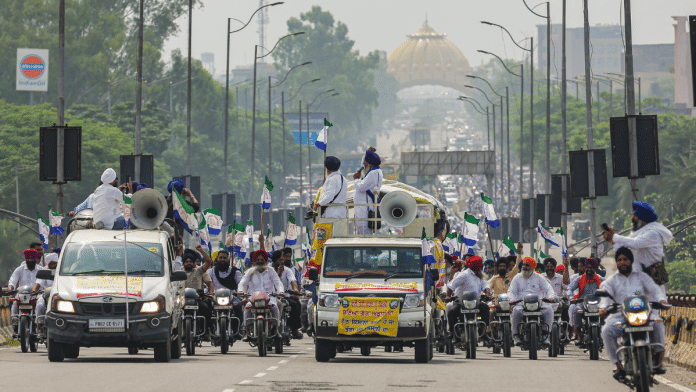
Earlier this August, the state government withdrew its Land Pooling Policy 2025, through which it had originally planned to get 65,000 acres for urbanisation projects.
The policy was mooted in May, but encountered large-scale protests from landowners. Under it, landowners could voluntarily part with their lands and, in return, get developed parcels of residential and commercial land. This, according to the state government, would also make them a beneficiary of urban development.
A senior GMADA official told ThePrint that the state’s now-revoked pooling policy was, in actuality, inspired by the 2013 Act’s provision on land-pooling.
Under the 2013 Act, there is an option of voluntary land-pooling, but governments can acquire land from owners in lieu of giving compensation.
“The conditions of land-pooling in the 2013 Act and the policy by the state government are the same. But the policy brought out by the state government was a standalone. It did not give the option to a land owner to get compensation for parting with land,” the official explained.
Interestingly, the official said, most owners whose lands are acquired under the 2013 Act opt for the land-pooling provision instead of compensation.
Typically, the compensation amount was lower than the value of the developed land an owner would get in return. The difference amounted to a few crores in the cases per acre of land given for acquisition, the official said.
“More than 95% of landowners prefer the land pooling option given under the 2013 Act, but they were not ready to accept the standalone policy of the state government. The reason for this was that wealth generated under the state policy was subject to taxes. But, under the 2013 Act, it was completely tax free,” the official said.
(Edited by Prerna Madan)
Also Read: Mann govt in Punjab locked in ‘cold wars’ with IAS officers. The ‘punishment’—no posting for months