








Bengaluru: The Karnataka government Tuesday formed a 16-member welfare board to provide social security to gig and platform workers in the state, facilitating app-based aggregators and e-commerce service providers to deposit their share with the newly constituted body.
All aggregators will have to pay a welfare fee in the range of 1-1.5 percent of the transaction, which was downward revised from the earlier proposal of 5 percent made in April last year.
The Gig Workers’ Welfare Board has been formed under the Karnataka Platform Based Gig Workers (Social Security and Welfare) Act, 2025.
“The Board has both ex-officio members (officers) and representatives from platforms/gig worker associations,” Salma K. Fahim, the secretary of Karnataka’s labour department, told ThePrint.
Apart from the labour minister, who will serve as the ex-officio chairperson, the board will include four senior officials from various government departments, the board’s director, four representatives from gig workers’ unions, and four members from major companies, including Porter, Zomato, Uber and Amazon.
The board will have representations also from two entities that have experience in these sectors and one (Azim Premji University) who will provide technical, data and other academic support.
Fahim added there would be further notifications in due course as the government will enable the activities in a stage-wise manner as the administration is careful trying not to be in contravention of the central code.
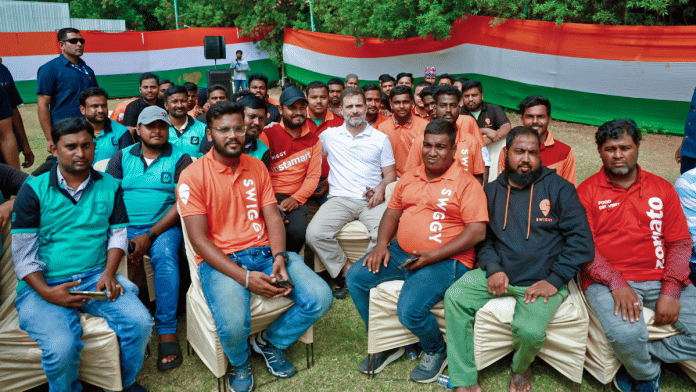
A representation of gig workers had met Congress leader Rahul Gandhi in November 2022 during the Hyderabad leg of the Bharat Jodo Yatra. Gandhi then followed this up with a promise to set up a gig workers welfare board during his campaign in Rajasthan, ahead of the 2024 Lok Sabha elections.
After Gandhi’s meeting with gig workers, the Siddaramaiah-led Karnataka government got down to drafting a bill with a provision for a welfare board that would provide a safety net for the lifeline of India’s e-commerce economy.
Karnataka has one of the highest numbers of people working in this rapidly growing sector, about 4 lakhs. The aggregators they work for often call them ‘driver partners’ ‘delivery partners’ or use other such terms, but they are not employed directly by the companies.
The Siddaramaiah-led Karnataka government had stated that the bill was “necessary to protect the rights of platform-based Gig workers” and to place obligations of “social security, occupational health and safety” on aggregators.
Also Read: Where are women in India’s gig economy? The question we forgot to ask in the outcry
‘Need to be recognised as workers first’
In April last year, several app-based aggregators spoke to ThePrint, raising concerns over the certain provisions in the bill. One was that there was no country-wide uniform law and catering to state-specific laws or boards would add to the burden of these companies.
“There is no uniformity and each state may charge a different percentage. It could be two percent in Bengaluru and 10 percent in Delhi. How do we as a company set aside money or a budget for this,” the official from a mobility service provider told ThePrint at the time.
However, these issues have been ironed out since, downward revising the earlier quantum of cess, people aware of the development said.
At the time of announcing the welfare measures in April last year, platforms had even said they had not been approached by state governments to consult on the issue, leaving them non-committal on the issue.
“Companies had earlier opposed the issue and then several changes were effected. Companies were hesitant to share real-time data with the government but those issues have been ironed out and there are representatives of the same firms who have been taken on board,” Tanveer Pasha, the president of the Ola-Uber Driver & Owners association, told ThePrint.
There were several other challenges, adding to the strain between the workers or ‘partners’ and aggregators.
Vinay Sarathi, the president of the United Food Delivery Partner’s Union (UFDPU), said Tuesday that the first issue is that gig workers unions are not even recognised by aggregators.
“There are pay out revisions where companies change payment policies without consultations. Unlike factories where there are unions who have provisions of protest, dialogues, escalation and other rights, gig workers are not extended such rights,” Sarathi said.
He added that apart from payout revisions, there are cases of instant ID terminations based on customer complaints without investigation, lack of social security and the fact that they are not even recognised as workers,” Sarathi said.
He added that the board and the cess would bring in much-needed funds to provide some safety net for lakhs of gig workers and safeguard their rights.
Sarathi and Pasha are both part of the newly-constituted board.
According to a June 2022 Niti Aayog report, there are approximately 7.7 million gig workers across India. The report, titled ‘India’s Booming Gig and Platform Economy’, further projected that the number of gig workers would rise to 23.5 million by 2030.
Shaik Salauddin, the founder-president of the Telangana Gig and Platform Workers’ Union (TGPWU), welcomed the Karnataka government’s move.
“Karnataka has shown the way by institutionalising a welfare board that recognises gig workers as workers deserving dignity, rights, and social protection,” Salauddin, who is also the Co-Founder and the National General Secretary of the Indian Federation of App-Based Transport Workers (IFAT, said in a statement Tuesday.
However, he added that the real success of this board will lie in its effective implementation and its ability to improve the lives of the workers on the ground that would help other states formulate similar measures.
(Edited by Ajeet Tiwari)
Also Read: Gurugram is waging a new class war. Now fight is over gig workers’ parking lots & toilets