





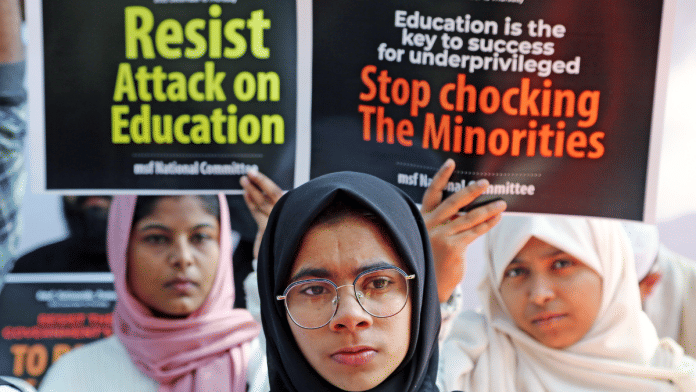



New Delhi: For the second time in less than a year, the disbursal of stipends under the Maulana Azad National Fellowship (MANF) has stalled, with scholars across universities reporting delays of three months.
Last year, after more than seven months of non-payment, the Ministry of Minority Affairs had said pending stipends were released following approval from the finance ministry in July.
The release came after several Opposition MPs wrote to Minority Affairs Minister Kiren Rijiju and Finance Minister Nirmala Sitharaman seeking clearance. Congress leader Rahul Gandhi also met MANF scholars and wrote to Rijiju flagging their grievances.
The present disruption comes amid an ongoing re-verification exercise by the ministry, which has linked tighter scrutiny of minority welfare schemes to concerns over duplication and alleged misuse flagged in recent years.
A ministry official told ThePrint that several states, including Assam, West Bengal, Punjab and Uttar Pradesh, as well as Jammu and Kashmir (a Union Territory) have either flagged duplication concerns or are conducting police inquiries.
The official added that the finance ministry’s approval for MANF was granted for a limited period and that further releases were contingent on reports from states, which the minority affairs ministry had not yet received.
In parliamentary submissions in 2025 and 2024 to the Standing Committee on Social Justice and Empowerment, the ministry has referred to media reports in 2020 alleging siphoning of scholarship funds that led to a Central Bureau of Investigation (CBI) probe and directions to states to investigate irregularities.
According to official replies, five states took “active action”, with Assam registering 15 FIRs and arresting 43 persons. In the North Eastern states, a special verification drive conducted in 2024–25 reportedly identified fake beneficiaries and verifying authorities for the academic years 2021–22 and 2022–23, leading to further FIRs.
As part of this process, states were asked to integrate their portals with the National Scholarship Portal, enforce a ‘one student, one benefit’ principle, and shift to Aadhaar-based biometric authentication and the Aadhaar Payment Bridge System.
Scholars argue that fellowship payments are being caught in a broader verification net meant for scholarship schemes, even though the MANF operates through a separate approval mechanism routed via universities and the ministry.
Introduced in 2009, MANF provides financial assistance comparable to UGC fellowships to scholars from six notified minority communities (Muslim, Sikh, Parsi, Christian, Buddhist, Jain) pursuing MPhil and PhD programmes. The monthly stipend is Rs 31,000 for the first two years (Junior Research Fellow) and Rs 35,000 for the remaining tenure (Senior Research Fellow).
Although the scheme was discontinued for fresh admissions from the 2022–23 academic year, the government assured scholars that existing beneficiaries would continue to receive stipends until completion of their tenure.
On Wednesday, Lok Sabha MP Asaduddin Owaisi urged the government to resume the Maulana Azad National Fellowship. “Can you make a Vikshit Bharat (Developed India) by keeping 14 percent of your (Muslim) population illiterate,” the All India Majlis-e-Ittehadul Muslimeen (AIMIM) chief said in the Lower House of Parliament.
Also Read: Telecom dept’s limited powers, SIM misuse aid digital arrests—Centre pushes for SIM binding in SC
16% dip in fellowship budget
The allocation for MANF in 2026–27 is Rs 36.14 crore, down from Rs 42.84 crore in 2025–26 — a reduction of about 16 percent. In 2024–25, the scheme was allotted Rs 45.08 crore, but actual expenditure was Rs 25 crore, meaning about 45 percent of funds remained unspent.
The broader trend shows persistent underspending by the minority affairs ministry. In 2022–23, it spent Rs 837.68 crore out of a revised estimate of Rs 2,612.66 crore—leaving about 68 percent unspent. In 2023–24, it utilised Rs 1,032.65 crore out of Rs 2,608.93 crore—around 60 percent remained unspent. In 2024–25, expenditure stood at Rs 919.10 crore against an allocation of Rs 3,183.24 crore as of December 31—roughly 71 percent of the allocation remained unspent at that stage.
The official quoted earlier said that the ministry has not issued a fresh timeline for resumption of regular MANF disbursements as yet.
Distressed scholars
On the ground, scholars say the renewed delays feel familiar. “It’s been three months. We’re told funds aren’t available and to wait,” said Fazle Wakil, 28, a MANF scholar from West Bengal. “Payments resume briefly and then stop again.”
Wakil rejects the suggestion that verification concerns justify the halt. “Our documents are verified by universities and the ministry before approval. Linking fellowship delays to scholarship misuse is misleading.”
Scholars were recently asked to re-upload income certificates submitted at the time of admission. “We resubmitted everything, including fresh certificates. Approvals are still pending,” he says, adding that many scholars have had to borrow money to manage expenses and spend days calling officials to follow up.
For Nida Kazmi, 28, a third-year PhD scholar at Delhi’s Jamia Millia Islamia who moved from Kashmir and was brought up by a single mother, the fellowship determined her decision to pursue research. “I missed the JRF cut-off by 0.05 percentile. MANF gave me the confidence to pursue a PhD.”
She says delays that were initially manageable have now become unsustainable, with some scholars leaving their programmes due to irregular payments. “Last year, payments stopped for seven months. After protests and outreach, they resumed briefly. Now again, three months have passed.”
Some scholars, she says, have not received stipends for December and January, and that a few are yet to receive November payments. “We’re told funds are over or to call after 10 days. How do we survive like this?”
For now, scholars like Wakil and Nida say that they are left waiting once again— between verification drives and promises of release.
(Edited by Tony Rai)
Also Read: 36-hr takedown window cut to 3 hrs: Centre notifies IT Rules amendment to tighten noose on deepfakes