








New Delhi: As foreign tourist arrivals fell 9.4 percent in 2025, the Ministry of Tourism had an explanation ready: Bangladesh. Leaving aside Bangladesh, the ministry told a parliamentary committee, arrivals from other markets actually grew 4 percent.
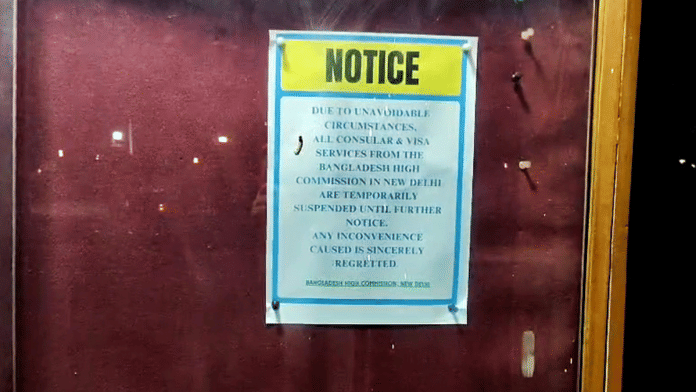
While Bangladesh accounts for 17-18 percent of India’s foreign tourist arrivals in normal years, it nosedived by 73.4 percent last year—from 17.5 lakh in 2024 to 4.66 lakh—following the political upheaval that swept through India’s eastern neighbour.
The backdrop to that collapse is significant. On 5 August, 2024, student-led protests culminated in the ouster of Bangladesh Prime Minister Sheikh Hasina. Subsequently, bilateral ties deteriorated sharply, with tensions over Hasina’s stay in India, Dhaka’s extradition requests, and the attacks on the Hindus in the neighbouring country.
In this context, the drop of Bangladeshi tourists in 2025 was not a statistical anomaly. But the committee, in its 391st Report presented to the Rajya Sabha on 25 March, flagged that India’s global tourism share remains below 2 percent nonetheless.
India, the committee said, ranks 39th globally despite ranking 6th in natural resources and 9th in cultural resources. And, yet India received 0.90 crore foreign tourists as compared to France’s approximately 10 crore.
Furthermore, the ministry’s suggestion that a strengthening domestic market was “to some extent displacing international tourism” was found “inadequate,” as committee members observed that both segments should be capable of growing simultaneously.
What the Bangladesh explanation could not account for, the committee found, was the ministry had done almost nothing to arrest the decline—and had the budget figures to prove it.
Overseas promotion overlooked
The Ministry of Tourism entered the 2026-27 budget cycle without a single rupee allocated for promoting Indian tourism overseas, the panel said. The entire Rs 3.50 crore under the Overseas Promotion and Publicity (OPP) head goes toward India’s mandatory membership fees to the United Nations World Tourism Organisation.
The ministry has separately written to the Ministry of Finance requesting Rs 265 crore for promotional activities. That request is pending.
In 2025-26, the ministry supplemented its thin OPP budget of Rs 3.07 crore with Rs 40 crore reappropriated from the Domestic Promotion scheme. Even then, it participated in only three international travel exhibitions. It was absent from IMEX Frankfurt, IBTM Barcelona, and AIME Australia. Indian private operators attended those fairs on their own.
The committee called this “a serious deficiency in the budget formulation process.”
Also Read: Scheduled Tribes finance body got just 2% of Rs 750 crore it sought from Centre, defunct in 6 states
What the money did & didn’t
The promotion gap sits alongside a broader pattern of unspent funds. In 2024-25, the ministry was allocated Rs 2,479.62 crore. It spent Rs 164.07 crore—a utilisation rate of 6.6 percent. The Swadesh Darshan scheme, the ministry’s flagship infrastructure programme, recorded utilisation of 3.4 percent: Rs 59.25 crore spent against a Budget Estimate of Rs 1,750 crore.
The ministry attributed the figures to states not submitting utilisation certificates, delays in appointing project management agencies, a transition between treasury models, and threshold constraints on releasing fresh funds.
“The same reasons have been cited in successive years to explain the same failures,” the report states. “The transition to the TSA-1 model, while a legitimate one-time disruption, does not account for a pattern of underutilisation that predates the transition.”
For 2026-27, the ministry was allocated Rs 2,438.40 crore—roughly 86 percent higher than the Revised Estimate for 2025-26 of Rs 1,310.30 crore.
Stalled projects
Of 91 active projects under the Swadesh Darshan 2.0 and the Challenge Based Destination Development sub-scheme, 77—or 84.6 percent — remain below 25 percent physical completion. One project, Mana Haat in Uttarakhand, stands at 1.24 percent. No final fund tranche has been released under Swadesh Darshan 2.0, according to the report.
At the Bom Jesus Basilica in Goa, a Rs 16.46 crore PRASHAD project was stalled after the Archaeological Survey of India (ASI) sealed the site following the discovery of ancient remains. The state took four months to submit a report despite repeated reminders.
A deviation proposal—including dropping the parking lot and heritage interpretation centre components—was submitted in September 2025, revised in January 2026, and remains under examination. No funds were released in 2025-26. About 24 percent of the project was done when it was stalled.
The cost problem
India’s wildlife tourism, the committee noted, is among the most expensive in the world. The members cited expenditure of Rs 8-10 lakh per visit at destinations such as Ranthambore, and suggested the ministry focus on specific reserves rather than dispersing resources.
Kaziranga was pointed as a potential model for concentrated, globally competitive development rather than a scatter-shot approach across destinations.
On hotels, the committee noted India has approximately 1,80,000 branded hotel rooms against an industry estimate of double being required. Room tariffs reach Rs 12-13 lakh during major events. Bangkok, members noted, offers rooms at Rs 25,000-45,000. The ministry said it was working to reduce hotel licensing requirements— currently between 50 and 90 permissions.
India’s Buddhist circuit, meanwhile, attracts less than 1 percent of the world pilgrims—4.4 lakh international arrivals—despite India being the birthplace of Buddhism.
Recommendations ignored
The ministry operates with 359 personnel against a sanctioned strength of 552. Twenty-one CAG audit paragraphs spanning 2021 to 2025 remain unsettled.
On the question of whether previous committee recommendations had been acted upon, the report is direct: “Members expressed concern during the evidence that Committee recommendations have not been acted upon and no Action Taken Reports (ATRs) have been provided despite proceedings over the past 12 years.”
Several senior members noted the ministry’s presentation photographs and content “have remained unchanged for 10-12 years.”
The committee has asked the ministry to submit ATRs on all recommendations from the preceding three reports within 90 days.
For the 16th Finance Commission cycle, the ministry has proposed a National Mission for 50 Globally Competitive Destinations with an outlay of Rs 25,000 crore over five years—roughly double the ministry’s current annual demand.
The committee’s recommendation: that all proposals be accompanied by “state-wise absorption plans based on past expenditure performance” and “a phased scaling mechanism linked to demonstrated expenditure performance.”
(Edited by Tony Rai)