





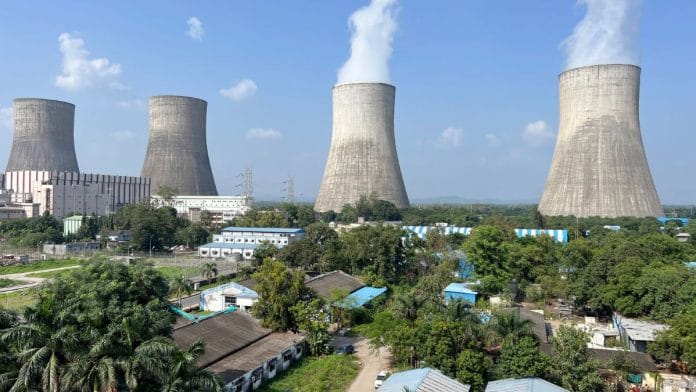



New Delhi: In a big push to the civil nuclear sector and paving the way for entry of private players, the Union cabinet, led by Prime Minister Narendra Modi, cleared the Atomic Energy bill 2025 Friday, two government sources told ThePrint.
Titled SHANTI (Sustainable Harnessing of Advancement of Nuclear Technology for India), the bill will be introduced in Parliament next week. One of the government sources said it will be a comprehensive umbrella bill that will allow private companies in areas like atomic mineral exploration and equipment manufacturing among others.
“Getting private players into the more closed-off sectors has been the aim of the government. We have done that with the space sector as well. This bill will move India’s nuclear sector from a purely government-controlled ecosystem to a more public-private model,” an official told ThePrint.
The official also said that while bringing private players on board, the bill is also expected to make provisions for a single-window system that will assist these companies in entering this state-guarded sector.
Besides allowing private sector participation, the bill will also address liability concerns of nuclear equipment suppliers. A new nuclear liability framework, which will define liability responsibilities, has been added in the bill to address the concerns of private players.
The government has also proposed to set up a nuclear safety authority and tribunals to handle disputes. The centralised nuclear safety authority is also expected to coordinate with the International Atomic Energy Agency (IAEA), the global nuclear watchdog.
The Atomic Energy Act 1962 prohibits participation of the private sector or even state governments. Under the Act, the central government and/or corporations established by it hold all the rights to India’s critical minerals along with the power to operate nuclear power plants.
The Nuclear Power Corporation of India Limited (NPCIL), a PSU under the Department of Atomic Energy, is the only entity operating nuclear power plants at present. Currently, NPCIL operates all 24 commercial nuclear power reactors in the country.
Friday’s cabinet decision comes 10 months after Union finance minister Nirmala Sitharaman announced in her budget speech 1 February that the government will take up amendments to the Atomic Energy Act 1964 and the Civil Liability for Nuclear Damage Act 2010.
The first government source told ThePrint said that instead of two bills, the cabinet has cleared one umbrella law, which, besides allowing private sector participation, will also address the liability issues of nuclear equipment suppliers.
Suppliers of equipment and potential operators including companies like US-based Westinghouse Electric have in the past expressed apprehension about some of the provisions of the Civil Liability for Nuclear Damage Act 2010 (CLNDA). This had led to foreign companies staying away, resulting in slower development in the nuclear power sector in the country.
The amendments, once they come through, will be a big reform at a time India has set a target of generating at least 100 GW nuclear energy by 2047. Energy sector experts have been lamenting for a while now that unless private players come in, it would be difficult for India to meet the ambitious target through just state-owned and state-controlled entities.
India’s nuclear power capacity at present is a minuscule 8,180 MW, which is just 2 percent of the country’s total power generation.
Government sources had earlier told ThePrint that among the amendments proposed to the Atomic Energy Act 1962, is changing the definition of “companies” in some of the sections of the current law.
Currently, the Atomic Energy Act 1962 limits ownership and operation of nuclear power plants to central government or government companies or their joint ventures.
There is a proposal to amend the definition to allow any “company” under the Companies Act 2013 to be eligible for licence for production and use of atomic energy.
For instance, Section 3 of the Atomic Energy Act allows only central government and its companies to manufacture, buy, store, dispose radioactive and prescribed substances, including that which can be used for production and use of atomic energy.
Government sources said several amendments have been proposed to the CLND Act 2010 that provide for a speedy compensation mechanism for victims of a nuclear accident.
(Edited by Viny Mishra)
Also read: The solution to deteriorating India-US relations—go nuclear
This is so important. Why is TV media so pathetic ? They don’t even talk about this. Everyone is more concerned about TRP. Same goes to these idiots in social media. Only few people talk about these policies and obviously print media does a good job