








New Delhi: The Modi government Tuesday passed a crucial legislation in Lok Sabha that will give a big fillip to India’s nuclear energy capacity by opening the sector to private companies and bringing in a pragmatic civil liability regime.
Currently, private companies or even state governments are not allowed in the nuclear power sector. This has led to India’s slow progress in harnessing nuclear energy even as our energy demand has surged.
India currently generates 8 GW nuclear power, which is just 1.6 percent of the total energy mix from more than 25 nuclear reactors in seven power plants across the country.
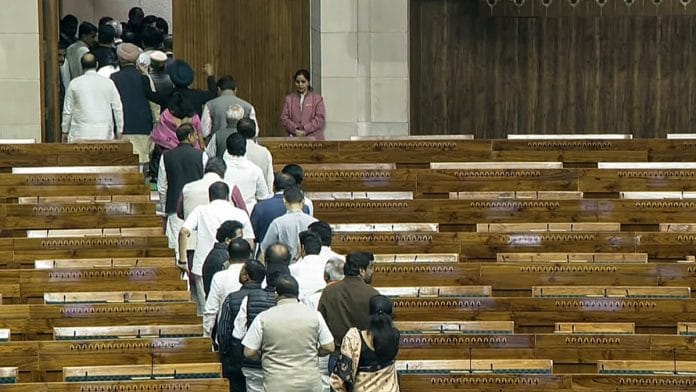
Despite a majority of opposition MPs demanding that The Sustainable Harnessing and Advancement of Nuclear Energy for Transforming India (SHANTI) bill, 2025 bill be referred to the select committee to scrutinise its complexities, the NDA government managed to pass it with a mere voice vote amid a walkout by the Opposition.
The bill seeks to repeal the Atomic Energy Act, 1962 that prohibited participation of private players in the nuclear sector and The Civil Liability for Nuclear Damage Act (CLND), 2010. Certain provisions of the CLND Act pertaining to the liability for suppliers and operators’ right to recourse had led to reservation among the private sector.
The bill drew sharp criticism from the opposition benches soon after Dr Jitendra Singh, Union Minister of State (Independent Charge), Department of Atomic Energy, introduced it in Lok Sabha saying it will give a new direction to the country’s developmental journey.
Making the opening argument on behalf of the Opposition, Congress’s Manish Tewari—who, incidentally, opened the debate back in 2010 too when the CLND legislation came up for passage—questioned the removal of the supplier’s liability clause.
“…if a nuclear accident takes place, since we are dependent on foreign suppliers, shouldn’t the supplier be liable,” Tewari asked.
In the SHANTI bill, the clause dealing with right to recourse has also been tweaked. Where earlier the CLND Act, 2010 provided for the operator’s right for recourse in three scenarios: where it is expressly provided for in a contract in writing; where the nuclear incident has resulted as a consequence of an act of supplier or his employee, which includes supply of equipment or material with patent or latent defects or sub-standard services; and where the nuclear incident resulted from act of commission or omission of an individual done with intent to cause nuclear damage.
The SHANTI bill seeks to remove the supplier’s liability clause, adding that the operator’s right to recourse against the supplier will now be based on what is specified in the contract signed between the two parties.
The earlier provision had created apprehension among suppliers and was seen as one of the main reasons that private players stayed away from investing in the nuclear energy sector in India. Several opposition MPs including Saugata Ray questioned the government for allowing private companies in the nuclear sector without enough safeguards.
Congress MP Shashi Tharoor termed the bill as a “dangerous leap into privatised nuclear expansion”.
“We cannot allow the pursuit of capital to override the non-negotiable requirements of public safety, environmental protection and victim justice,” Tharoor said. He said the bill will allow the central government to exempt any plant from license or liability if the risk is insignificant. “This is dangerous… it creates a backdoor to the entire framework through which any facility can escape oversight if the government deems it convenient,” he said. DMK’s MP Arun Nehru said the title of the bill is an oxymoron, highlighting how powerful nuclear energy is. Samajwadi Party MP Pushpendra Saroj too highlighted the misleading name of the bill.
“We clearly remember what happened with the Bhopal gas tragedy in 1984, and now the SHANTI Bill justifies what went wrong during the 1984 tragedy,” he said.
Responding to the charges, MoS Singh said the SHANTI bill is not new but a modified version of the Atomic Energy Act, 1962 and the CLND Act, 2010.
He said that opposition parties are opposing the bill for the sake of it. “Our government has defined the bill properly, and we have given more authorisation and independence to private parties involved.”
Singh said that India’s role in geopolitics is expanding. “If we have to be a global player, we have to follow global benchmarks and global strategies. The world is moving towards clean energy. We too have set a target of 100 GW of nuclear energy capacity by 2047,” he added. The SHANTI bill will now go to Rajya Sabha for passing before it becomes an Act.
(Edited by Amrtansh Arora)
Also Read: More power, less blame: SHANTI Bill’s ‘pragmatic’ take on prickly issue of nuclear liability