





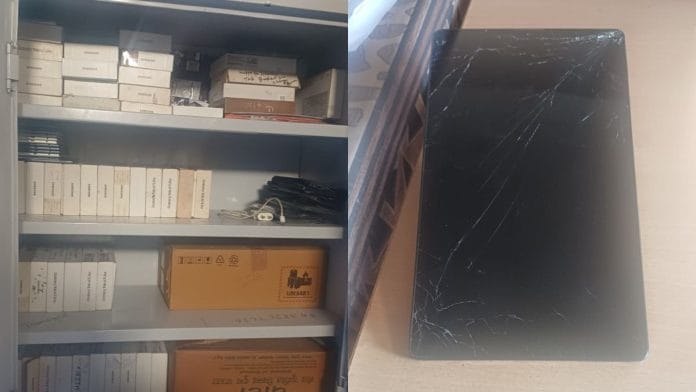



Gurugram: About five lakh tablets distributed to government school students under Haryana’s e-Adhigam scheme are now lying in school cupboards, nearly a year after the government stopped providing internet connectivity to the devices.
The Rs 700-crore scheme, launched by then chief minister Manohar Lal Khattar in 2022 for students in classes 10 to 12 with an aim to bridge the digital divide, has effectively collapsed, forcing teachers to return to the old blackboard and chalk system.
Many tablets have damaged screens, missing chargers, while some students who received them have already graduated, without returning the devices.
The government last year stopped recharging the SIM cards that provided internet access to these tablets, making it impossible for students to use the Personalised Adaptive Learning (PAL) app meant to deliver digital study material.
For thousands of students from economically weaker sections, scheduled castes and backward classes, the tablets have become useless.
Teachers say that now, many of the devices have been taken back from students and stored away. A significant number has damaged screens. Some students who’ve passed out haven’t returned their devices.
ThePrint reached Haryana Education Minister Mahipal Dhanda for comment through calls, but he was not reachable. His PA said the minister was in Assam on election assignment, and would convey the query.
Additional Chief Secretary Vineet Garg and Director General of Secondary Education Jitender Kumar didn’t respond to ThePrint’s calls and messages.
This report will be updated if and when their responses are received.
Also Read: Launched by Khattar, how Haryana’s Rs 700-cr tablet scheme for govt school students has fallen apart
The scheme’s origin
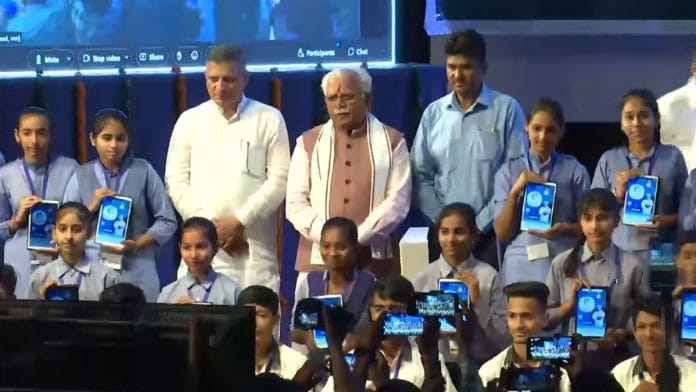
The BJP government approved the tablet procurement in April 2022, and earmarked Rs 620 crore for five lakh tablets, Rs 47 crore for SIM cards with 2 GB daily data, and Rs 5 crore for PAL software loaded with e-books, test videos and study material.
Then education minister Kanwar Pal had told the assembly in March 2022 that the initiative would “fill the chasm in digital learning” for students who couldn’t afford smartphones or tablets.
Tablets were distributed in May and June 2022. At the time, Khattar’s government called it a game-changer for SC and OBC students who form the bulk of government school enrollments.
“The devices will have preloaded content, along with personalised and adaptive learning software, and free internet data will also be provided,” Pal had said.
Reality hits
When the 2025-26 session began, the government failed to recharge the SIM cards installed in the tablets.
On 23 May last year, the Directorate of School Education sent a letter to district education officers, directing that students use the internet at home or rely on broadband at schools “wherever available”. Teachers and principals called the directive divorced from reality.
They said most of the students who attended government schools were from the Scheduled Castes or the Backward Classes, with no Wi-Fi connections at home. Most of the schools, too, didn’t have a 24X7 power supply, making it impossible to provide Wi-Fi facility there.
‘Problem is, with non-functional smart boards installed on the walls, we don’t find suitable places to install old traditional blackboards,’ says a teacher from Rohtak.
Even the PAL app was not updated.
A teacher said that even when the tablets were handed out, the content of all the subjects was not provided in the PAL, and of those for which the learning programme was installed, not all was as per the syllabus. Eventually, the teachers were asked to collect the tablets from the students till arrangements could be made for internet connectivity.
Blackboards gone, smart boards broken
A teacher from Rohtak district said the problem goes deeper. The government installed smart board LEDs in some classrooms. Teachers operated these boards using the tablets. But there was no provision for repairs when devices broke down.
“Now, the problem is that with the non-functional smart boards already installed on the walls, we don’t find suitable places to install the old traditional blackboard, even after altering the seating arrangements of students in some cases,” she said.
She added that even if the government decided to provide WiFi or SIM cards now, most tablets aren’t working. “In some cases, the screens are damaged, in others, the chargers are missing and in some cases the students have not returned the tablets after passing out.”
The ‘misuse’
A teacher in Kaithal said tablets are proving a complete waste for the department. Without repairs and internet connectivity, schools have returned to blackboards where possible.
The misuse problem was there from the start. With free internet, many students used tablets for Instagram and YouTube instead of the PAL app.
“Some students, particularly girls, made good use of the tablets when these were distributed,” the Rohtak teacher said. “A majority of male students installed social media apps and watched obscene content on these tablets.”
A Panipat teacher put it differently. “First, the government made these students dependent on the internet by giving them tablets with SIM cards. They spent more time on Instagram and YouTube than on the PAL app. But now, the government has stopped providing the internet, making the tablets useless.”
She said hundreds of tablets are lying in cupboards in schools across the state, making it a liability for teachers to safeguard these useless gadgets lest they are lost, putting them at risk of being blamed and having to pay the cost.
In August 2023, sarpanches had written to the additional chief secretary of school education asking the government to take back the tablets. Children were misusing the gadgets, they had said at the time.
(Edited by Ajeet Tiwari)
Also Read: Why UPSC has returned Haryana govt’s proposal for promotion of 27 of its officers to IAS