





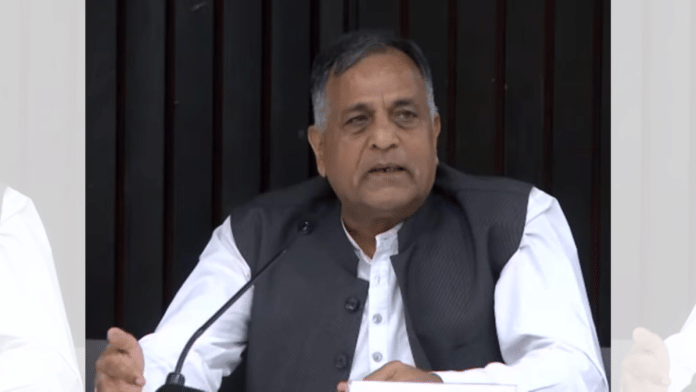



New Delhi: Former election commissioner Ashok Lavasa Tuesday said the immunity accorded to election commissioners from legal proceedings for decisions made in their official capacity was “baffling”.
“Where is the necessity of giving this kind of blanket immunity to people who occupy Constitutional provisions, who have been discharging their responsibilities for the last 75 years? I don’t think there has been any situation in which their status has been jeopardised in a manner that they deserve this immunity. So why was this immunity given? Totally baffling,” he said.
Ashok Lavasa’s remarks come at a time when the Opposition is working on a motion to impeach Chief Election Commissioner Gyanesh Kumar for alleged “biased conduct”.
The former election commissioner was speaking at a discussion on electoral and political reforms, organised by the Association for Democratic Reforms (ADR) and National Election Watch (NEW). He was a part of a panel on ‘The Impact of Election Commissioners’ Appointment Procedures on Electoral Credibility’. Also on the panel was former Supreme Court judge M. B. Lokur, Congress MP Sasikanth Senthil, and social activist Anjali Bhardwaj.
Ashok Lavasa also addressed the mystery around his resignation from the Election Commission of India in August 2020 with a quote from an old qawaali: “Aap woh baat kyun puchhte hain jo batane ke kaabil nahi hai? (why do you ask that which should not be shared?)”
Lavasa spoke about the Chief Election Commissioner and Other Election Commissioners’ (Appointment, Conditions of Service and Term of Office) Act, 2023.
In 2023, a five-judge Constitution bench had modified the process for appointing members of the Election Commission of India (ECI). The court had held that a committee comprising the Prime Minister, the leader of the Opposition and the Chief Justice of India (CJI) would advise the President on ECI appointments. However, after the Centre passed the 2023 law, the CJI was out of the committee.
Referring to the composition of the selection committee under the 2023 law removing the CJI, he said that “this is a clear case in which the government has scored a self goal”.
‘Remedy worse than illness’
Former chief election commissioner O. P. Rawat was also a part of the discussion in a panel on ‘Criminalisation of Politics: Implications for Electoral Integrity’.
Speaking on criminalisation of politics and the Constitution (130th Amendment) Bill 2025, Rawat cautioned against adopting a “remedy worse than the illness”.
The Bill proposes removal of a minister if he or she is accused of an offence punishable with five or more years of imprisonment, and he or she has been arrested and detained for 30 consecutive days. It has been referred to a Joint Parliamentary Committee.
Rawat asserted that globally, India is much better off than many other democracies, with elections still being “gold standard” and “systems are perfect”. However, he asserted that we must not lose focus of “emerging threats of our polity, our elections, our systems”.
Rawat warned against accepting “shortcuts” to fix the problem of criminalisation of politics. Without naming the 2022 Delhi excise policy case, he spoke of how public functionaries were in jail for months, before the trial court discharged them in the case. Last month, a special court in Delhi discharged former chief minister Arvind Kejriwal and his then deputy Manish Sisodia in the excise policy case.
He referred to statistics related to the rate of convictions in India and said, “How can you rely on such a system which doesn’t throw 90 or 85 per cent rate of conviction?”
“All these factors need to be kept in mind before jumping to something making the remedy worse than the illness,” Rawat said.
While he called for ensuring solutions are devised to ensure that the rising number of candidates with criminal antecedents are kept under check, he emphasised on improving current systems in India.
“We should try and improve our systems by inducting brilliant young minds, especially from NLUs which have now proliferated throughout the country and are churning out a huge mass of young legally brilliant and educated brains in investigation, prosecution and adjudication,” he said.
(Edited by Viny Mishra)