





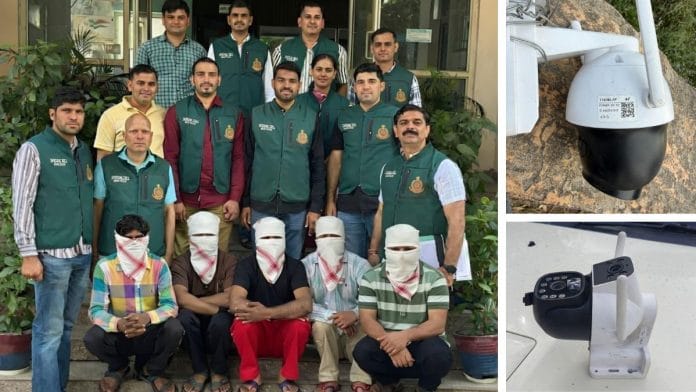



New Delhi: A farmer, an MBA graduate and a DJ are among 11 people arrested from Punjab and Delhi for allegedly installing cameras near Indian military bases and posts—an espionage ring that police say was orchestrated by Pakistan’s Inter-Services Intelligence (ISI) and Babbar Khalsa International (BKI).
Delhi Police’s Special Cell arrested the men, aged between 20 and 25, over the past few weeks. Several of the accused were allegedly recruited through Instagram.
They are accused of installing solar-powered CCTVs cameras near Army establishments, Air Force stations and BSF posts across states, and relaying the live feeds to Pakistan-based handlers through a mobile application.
They are also accused of receiving and distributing foreign-made firearms and planning grenade attacks on security installations—plots that police said have been foiled.
The arrests come weeks after Ghaziabad police’s Special Investigation Team (SIT) busted a similar module in which 21 people, including a juvenile, from Uttar Pradesh and Haryana were held for allegedly installing cameras near sensitive establishments and transmitting feeds via WhatsApp to Pakistan-based handlers.
Unlike the Ghaziabad case, Delhi Police said the present network had a direct BKI link too. BKI is a designated terrorist outfit by India.
“A credible and specific input was received from a reliable source indicating some foreign-based handlers of banned terrorist outfit Babbar Khalsa International (BKI), in coordination with Pakistan-based gangsters and ISI operatives, were conspiring to perpetrate subversive and terrorist activities in Delhi and Punjab,” Additional Commissioner of Police (Special Cell) Pramod Singh Kushwah told ThePrint.
He added, “The nexus is involved in radicalising, recruiting and indoctrinating youths for carrying out terror activities and arms smuggling.”
Two operations, 11 arrests
The arrests were made across two separate operations by the Special Cell.
In the first, conducted by the New Delhi range on 29 March, six people—three from Punjab and three from Delhi—were taken into custody. Nine CCTV cameras installed near sensitive security and defence establishments were recovered.
“The accused in the module were getting funds transferred through UPI accounts, a part of which was from the proceeds of the sale of these smuggled weapons,” Kushwah said.
The second operation was conducted by the South West range of the Special Cell on the basis of a tip from Military Intelligence (MI). Five accused, all from Punjab, were arrested for allegedly conducting reconnaissance, and sharing photographs and videos of sensitive security installations.
Kushwah said: “These individuals were tasked with capturing locations, videos, and photographs of sensitive Army and paramilitary installations. They were also instructed to install solar-powered CCTV cameras near such locations.”
Nine solar-powered CCTV cameras were recovered along with nine SIM cards, seized from locations spanning Punjab, Haryana and Rajasthan: Kapurthala, Jalandhar, Pathankot, Patiala, Moga, Ambala, Kathua, Bikaner, and Alwar. Photographs, videos, and location data were retrieved from the digital devices of all arrested persons, police said.
The 11 accused have been identified as Manpreet Singh, Anmol (resident of Punjab’s Firozpur), Sahil, Atul Rathee, Rohit, Ajay, Gurjeet Singh, Rimpledeep Singh, Salwinder Singh, Harpreet Singh, and Boota Singh.
A case has been registered at the Special Cell police station in under relevant sections of the Bharatiya Nyaya Sanhita.
The thread leads to Tarn Taran
Delhi Police’s operation began on 29 March with the arrest of Manpreet Singh from Tarn Taran in Punjab.
A Bachelor of Computer Applications (BCA) graduate, Singh was allegedly in contact with Pakistan-based handlers of the BKI-ISI network through an application with encrypted messages.
On their instructions, police said, he received seven foreign-made pistols and 56 live cartridges and delivered these to other associates. He also arranged SIM cards on fake identities and passed them on to Punjab-based contacts of the handlers—SIM cards that were subsequently used to transmit CCTV feeds from sensitive locations to Pakistan, they said.
His disclosures led to the arrest of the remaining five accused in the first operation, police said.
Anmol, who studied up to Class 10 and worked as a wallpaper installer, allegedly came in contact with his handlers through a mobile application app and was tasked with installing CCTV cameras at nine locations. Sahil, police said, assisted him.
Atul Rathee, an MBA graduate who returned to India from New Zealand in 2004, allegedly received foreign-made pistols from Manpreet through an absconding accused and country-made pistols from a separate arms trafficker. Rohit was also an MBA graduate; Ajay had a graduate degree.
A farmer, a driver, and a DJ
Gurjeet Singh, a farmer in Punjab, was routed to Pakistan-based handlers through his cousin, who was engaged in cross-border narcotics smuggling, investigators said. He allegedly conducted reconnaissance of an Army Cantonment and shared photographs and videos with his handler. He was also tasked with recruiting others for the network.
Rimpledeep Singh, a driver, served as a key conduit between local associates and a Pakistan-based handler, collecting and sharing images and videos of Army and BSF camps, according to police.
Harpreet Singh, who had studied through open schooling, allegedly carried out a wide range of tasks for his handler: facilitating drug trafficking across the international border, handling consignments, transferring proceeds to the handler’s agents, conducting reconnaissance, sharing photographs and videos, reporting on the movement of Army and paramilitary forces, arranging SIM cards, and planning installation of cameras.
Salwinder Singh, a DJ, is suspected to have accompanied Rimpledeep on reconnaissance missions and assisted in sharing photographs and videos of Army and paramilitary installations.
Boota Singh, involved in cross-border narcotics smuggling, helped photograph and film sensitive locations, including BSF posts and Army Cantonment areas, the additional CP said.
The men were paid Rs 15,000–20,000 per month and were lured, police said, by money generated through illegal smuggling of drugs and arms. Police said some of the accused were identified through Instagram.
Arms, surveillance and grenade plots
Police said the broader network had directed its Indian associates to receive and distribute foreign-made pistols, including Pakistan-manufactured weapons. The investigation exposed plans to carry out grenade attacks and other acts of terrorism against security and other establishments in India, they said.
Kushwah said the trend had become active three to four months ago and that the accused in this case had been operating for the past two to three months. Given the multiple arrests in similar cases, a CCTV camera audit is currently under way, he said.
(Edited by Prerna Madan)