





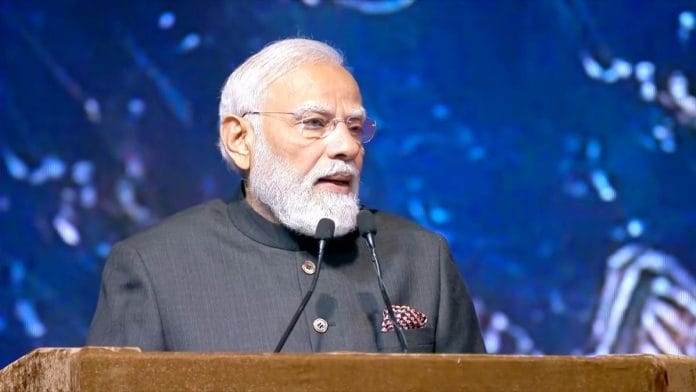



New Delhi: Prime Minister Narendra Modi on Saturday said that colonial rule didn’t just enslave India economically and politically, it also destroyed the nation’s heritage.
“The same thing happened with the Buddha’s relics. The heritage was taken away from India. For the descendants of those who took them from India, these were mere antiques, so they tried to auction the relics. For India, these are a proud part of our civilisation,” the Prime Minister said while inaugurating the grand exhibition of sacred Piprahwa relics at Delhi’s Rai Pithora Cultural Complex.
The exposition, titled ‘The Light and the Lotus: Relics of the Awakened One’, features the repatriated relics of the Buddha.
PM Modi said India decided to not allow the public auction of the Piprahwa relics, following which they were returned to India after a wait of 125 years.
“The knowledge of Buddha and the path he showed belong to the entire humanity and are eternal,” he said.
The Buddha relics were returned to India after two months of negotiations between the Indian government and the owner.
For the Buddhist community across the world, these relics hold immense spiritual value. They include the bone fragments of the Buddha, along with crystal caskets, gold ornaments, gemstones, and a sandstone coffer.
Modi said this is not an era of war, but of the Buddha. “Strength is important against those who are enemies of humanity, where there is conflict, compassion is essential,” he said.
The Prime Minister said India is connected with the world not just through politics and diplomacy, but also through faith and spirituality. “India is a living bearer of the Buddhist tradition. India has preserved these relics,” he said, urging the youth and students to visit the exhibition.
The Prime Minister said that India is striving to develop Buddhist heritage sites around the world. “In the last 10-12 years, efforts have been made to integrate Buddhist sites with modernity. A sound and light show has been started at the Dhamek Stupa in Sarnath. Facilities have been developed for pilgrims in Sanchi and Nagarjunasagar”.
The inaugural event was also attended by Union Culture Minister Gajendra Singh Shekhawat, Culture Secretary Vivek Aggarwal, ASI Director General YS Rawat, former DG of National Museum BR Mani, archaeologists, ambassadors, and several Buddhist monks.
A short documentary was screened at the event on the life of the Buddha, which also highlighted the government’s efforts in bringing back the Piprahwa relics.
“The darshan of Lord Buddha is the darshan of the incomparable soul of India. This Buddha Dharma of Lord Buddha has worked as a mantra of humanity, not only for Asia, but also for the world,” said Gajendra Singh Shekhawat.
Also read: The story of the Piprahwa relics, sacred Buddhist artefacts discovered by the British in 1898
What the exhibition shows
The exhibition has been divided thematically, and consists of eight galleries: Relic, Reliquaries and the Jewels, Introduction, Piprahwa Revisited, Repatriation of the cultural artefacts: The Continuing Endeavour, Vignettes of the Life of Buddha, Mahaparinirvana and the Distribution of Relics, Global Tapestry: The Expansion of Buddhist Art and Ideals Beyond Borders, and The Intangible in the Tangible: The Aesthetic Language of Buddhist Teachings.
It is supported by a comprehensive audio-visual component, including immersive films, digital reconstructions, interpretive projections, and multimedia presentations.
The introductory gallery highlights PM Modi’s vision of Vikas Bhi, Virasat Bhi as the guiding light behind the exposition.
At the Relic, Reliquaries and the Jewels gallery, a model of central stupa inspired by the Sanchi Stupa has been recreated, featuring three niches that highlight the findings from the Piprahwa excavations. The first niche showcases sacred bone fragments (Sarira Dhatu) along with a rock crystal casket with a handle containing a granulated gold string. The second niche presents recently repatriated gem relics from the Peppe family. The third niche emphasises ancient techniques used in crafting of reliquaries, featuring steatite vases known for their Mauryan polish and distinct chisel marks.
The Piprahwa Revisited gallery shows the Piprahwa excavation site identified as ancient Kapilavastu where the Buddha spent his early years. The site model highlights the three development phases of the Piprahwa stupa uncovered during the 1898 and 1971-73 excavations — from its Sakya origins to Ashokan reconstruction and Kushan expansion with monastic structures.
At the Repatriation of the Cultural artefacts: The Continuing Endeavour gallery, stolen artefacts returned from foreign are displayed. “With over 642 artefacts brought back in recent years, India’s proactive global engagement has set a remarkable precedence in the preservation and revitalisation of the Bharat’s cultural identity,” reads a display at the gallery.
The Vignettes of the Life of Buddha gallery chronicles the transformative journey of Sakyamuni Buddha, from Prince Siddhartha’s life of luxury in Kapilavastu to his meditation and enlightenment.
The Mahaparinirvana and the Distribution of Relics gallery, meanwhile, portrays the Buddha’s Mahaparinirvana and the events that followed.
The Global Tapestry: The Expansion of Buddhist Art and Ideals Beyond Borders gallery showcases the spread of Buddha’s teachings. For instance, in the 3rd century BCE, emperor Ashoka played a crucial role in disseminating Buddha’s teachings through his emissaries, Mahendra and Sanghamitra, who journeyed to spread these ideals beyond the subcontinent.
The Intangible in the Tangible: The Aesthetic Language of Buddhist Teachings gallery is dedicated to the Buddha’s teachings that shed light on the nature of human suffering with clarity and compassion.
(Edited by Aamaan Alam Khan)