





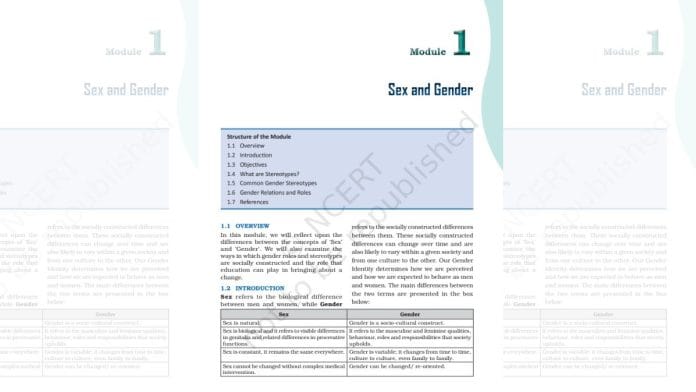



New Delhi: An NCERT training manual for teacher educators has sparked widespread debate, with critics accusing it of promoting “toxic western gender ideology”. The controversy centers on a chapter explaining the difference between sex and gender which states that “while sex is biological and constant, gender is a social construct”.
The manual, titled Training Material for Teacher Educators on Gender Equality–Volume 1, has been in circulation since 2013 and was reprinted in 2019. It is currently available on the NCERT website.
The manual came into the spotlight after Sankrant Sanu—author and founder of Garuda Prakashan, an international publishing venture focused on Indic narratives—shared a page from it on X, tagging Union Education Minister Dharmendra Pradhan and the Ministry of Education.
“Saw these current NCERT books at the World Book Fair. This is the teacher training manual where they have copy-pasted the entire toxic Western gender ideology into the training. Why @EduMinOfIndia @dpradhanbjp?” he wrote on X.
Saw these current NCERT books at the World Book Fair. This is the Teacher Training Manual where they have copy-pasted the entire toxic Western gender ideology into the training.
Why @EduMinOfIndia @dpradhanbjp? pic.twitter.com/rHQPQfax0x
— Sankrant Sanu सानु संक्रान्त ਸੰਕ੍ਰਾਂਤ ਸਾਨੁ (@sankrant) January 12, 2026
The page shared by him explains the difference between sex and gender. It states that while “sex is constant and remains the same everywhere,” gender is variable and “changes from time to time, family to family, and culture to culture”.
It further states that “sex cannot be changed without complex medical intervention, whereas gender can be changed or reoriented”.
“In the time of abysmal academic standards to have this gender ideology garbage guide a multi-volume teacher training volume is inexcusable. NONE of this needs to be part of curriculum, stop social engineering,” Sanu wrote. His post went viral and drew reactions from a large number of people both criticising the manual as well as supporting it.
Ratan Sharda, author of The Relationship between RSS and India’s Struggle for Independence and other books, also reacted on X saying, “ We can’t get over the #Woke domination even after 11 years. We can’t go back to our scientific tracts to define issues in our own way!”
We can’t get over the #Woke domination even after 11 years. We can’t go back to our scientific tracts to define issues in our own way! https://t.co/FBlWLcmNEE
— Ratan Sharda 🇮🇳 रतन शारदा (@RatanSharda55) January 13, 2026
Another X user, The Ruchi Connect, who calls herself proud sanatani Army brat, posted saying, “The current western gender ideology can create long term damage not only to the highly malleable minds but also have long term consequences for the society. And, I really don’t want to look at a guy and not be sure if I say – He, She or they. Stop #woke”
However, some doctors voiced support for the manual on X.
For instance, Dr Nisha Dubey, who identifies herself as an MBBS doctor, wrote: “Kudos to the mind that introduced Sex vs Gender so clearly in textbooks. Sex is biological. Gender is social, learned, and changeable. Teaching this early helps break stereotypes, build empathy, and create a more equal society. Education that makes students think is real progress.”
Kudos to the mind that introduced Sex vs Gender so clearly in textbooks.
Sex is biological.
Gender is social, learned, and changeable.
Teaching this early helps break stereotypes, build empathy, and create a more equal society.
Education that makes students think is real… https://t.co/xlliU6kvzl
— Dr Nisha Dubey (@Nishadoc9) January 13, 2026
Another X user, Dr Dutta, who identifies himself as a radiologist, wrote: “Doctor here. There is absolutely nothing wrong with the statements made in the Book! Not sure about the person tweeting about it.”
ThePrint reached NCERT director D.P. Saklani for a comment via calls and messages. This report will be updated if and when a response is received.
Also Read: ‘Honest history, not ideology’—NCERT social science panel chief on changes in Class 8 textbook
What is the manual about
NCERT’s Department of Gender Studies published three volumes in 2013 to support teacher educators in understanding and integrating gender-equality concepts into education. These were designed as training and reference material, not as standard school textbooks.
The training material is not meant for students. It is intended for teacher educators who train school teachers and for others involved in teacher training and curriculum development.
Volume 1 of the manual, which is currently under scrutiny, comprises six modules. These cover the themes of sex and gender; indicators of gender equality and empowerment; gender budgeting; gender, media and education; gender and violence; and gender, science and technology.
According to the introduction to the manual, the first chapter, titled “Sex and Gender”, which has been criticised on social media, “makes a subtle distinction between these two terms through the incorporation of activities. While sex is biological, gender is a social construct. The chapter also outlines the stereotypical attitudes and notions associated with specific gender roles. The activities included in this chapter are designed to help practitioners raise awareness about gender complementarity among participant groups.”
The remaining two volumes of the training material cover a wide range of topics, including gender-sensitive textbooks and pedagogy, language and gender, creating gender-friendly classrooms, adolescent girls’ mental health, teacher counselling, life skills, leadership, sports, and women’s empowerment through education, legal rights, self-help groups, and vocational training.
Earlier in 2021, NCERT had removed a teacher training manual on the integration of transgender and gender non-conforming students in schools from its website, after the National Commission for Protection of Child Rights (NCPCR) flagged “anomalies” in the document.
The manual had recommended measures such as providing gender-neutral toilets and uniforms, ending practices that segregate students by gender for school activities, and inviting members of the transgender community to speak on campus.
(Edited by Amrtansh Arora)