







New Delhi: A preliminary paper by Arvind Virmani, economist and member of federal think tank NITI Aayog, has concluded that India’s school system produces certificates that do not reliably signal learning, and that the Right to Education (RTE) Act, meant to improve access to quality education, has actually worsened learning outcomes.
Furthermore, several of India’s wealthiest states are moving backwards on foundational learning skills, the paper suggests. With respect to government vocational institutions, fewer than half of ITI graduates and less than a third of polytechnic graduates can be considered employable.
Published in March, the paper—titled ‘Education and Skilling for Employment: From Credentials to Learning Outcomes’—is a data-intensive assessment of India’s education system, whose findings conflict the narrative of progress that has accompanied both the RTE and the National Education Policy (NEP) 2020.
Its introduction says: “Education cannot be measured by the certificates issued for primary school, lower secondary school and upper secondary school, if they merely indicate the number of years spent in school, if the majority of students don’t have minimum proficiency in reading and arithmetic.” Such certificates, it adds, “do not necessarily create human capital”.
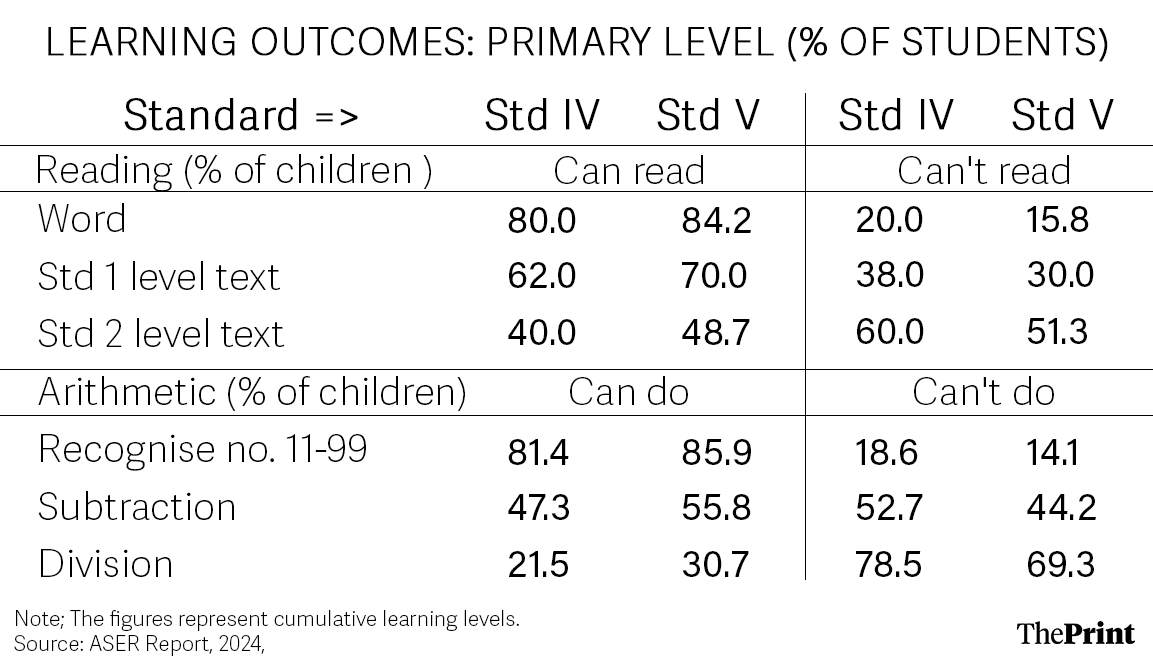
The paper paints a curious picture of Indian education. It says that given the country’s significant population, India’s tertiary educated adult population (those who have done their higher education like Bachelor’s and Master’s degrees) is “the second-highest in the world after China”. Meanwhile, in rural areas, 42 percent of Class 6, 36 percent of Class 7 and 29 percent of Class VIII students cannot read a Class 2-level text, and 64 percent in Class 6, 59 percent Class 7 and 54 percent in Class 8 cannot do mathematical division.
The author further cautions that it will be a big challenge for Indian states to meet the NEP 2020 goal of 100 percent Foundational Literacy and Numeracy (FLN), the 2025 deadline for which has already passed.
To create a picture of learning outcomes in India, the paper has used data from the latest versions of various surveys—including Annual Status of Education Report (ASER), National Achievement Survey (NAS), Foundational Learning Study (FLS) and PARAKH Rashtriya Sarvekshan (PRS) from 2006 to 2024. To draw international comparisons, data from World Bank, World Development Indicators (WDI) was used. Both private and government institutions have been included in the study.
The author, Arvind Virmani, is a macro economist who played a prominent role in the economic reforms of the 1990s and 2000s, and had earlier served as executive director of International Monetary Fund (IMF), chief economic adviser, Ministry of Finance, and principal adviser, Planning Commission.
Though published as a ‘NITI Working Paper’, the paper carries a disclaimer that the views expressed are personal.
RTE indictment
The most politically sensitive finding in the paper is its assessment of the RTE law. Passed in 2009 under the UPA government and never substantially amended by subsequent administrations, the RTE established free and compulsory education as a fundamental right while mandating minimum standards, higher pay scales, and administrative requirements for all schools—government, private-aided, and NGO-run alike.
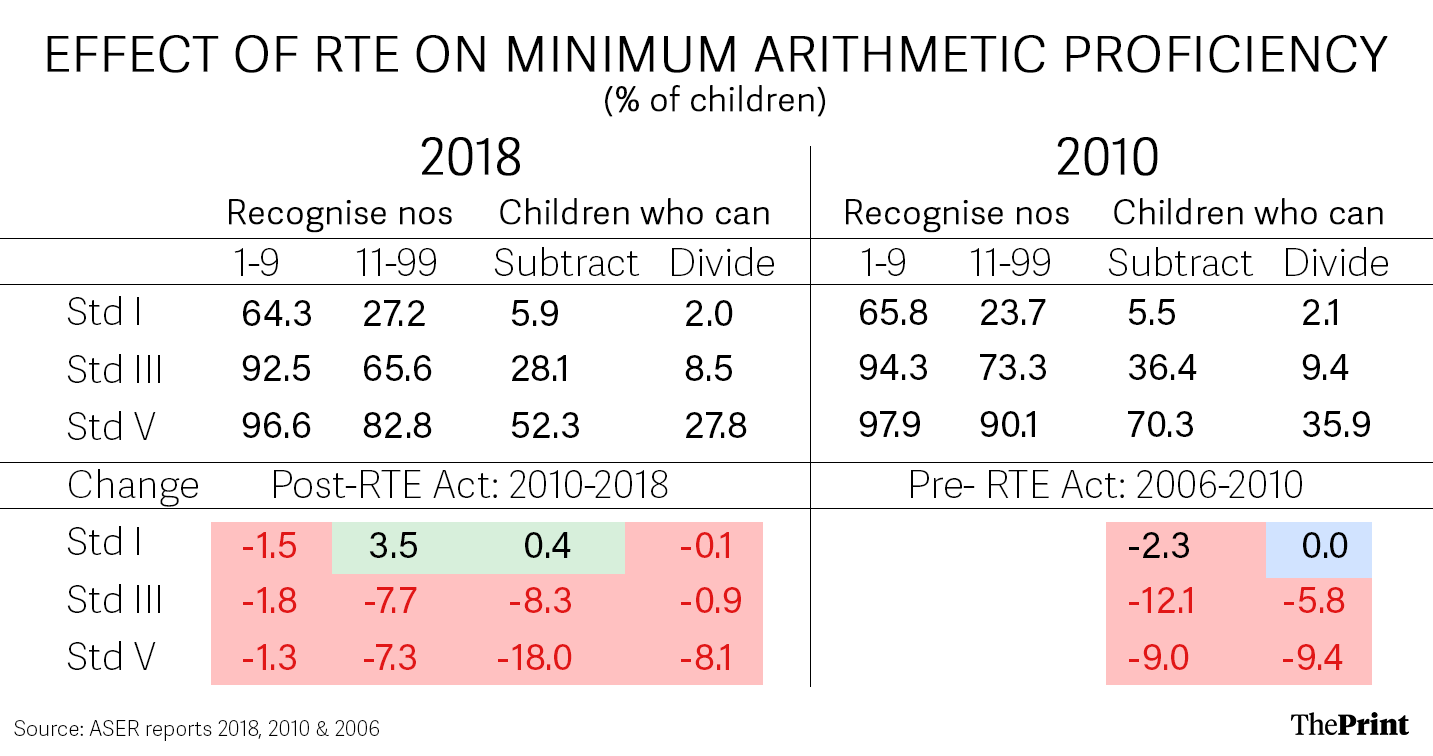
The paper through survey data (ASER reports 2006, 2010, 2018) shows that the post-RTE period (2010–2018) coincided with accelerating declines in learning. In Class 3, while arithmetic skills were already dipping, the share of children who could subtract dropped by another 8.3 percentage points after RTE. In Class 8, minimum reading proficiency fell by over 10 percentage points in the post-RTE years. Arithmetic in lower secondary school dropped even more sharply.
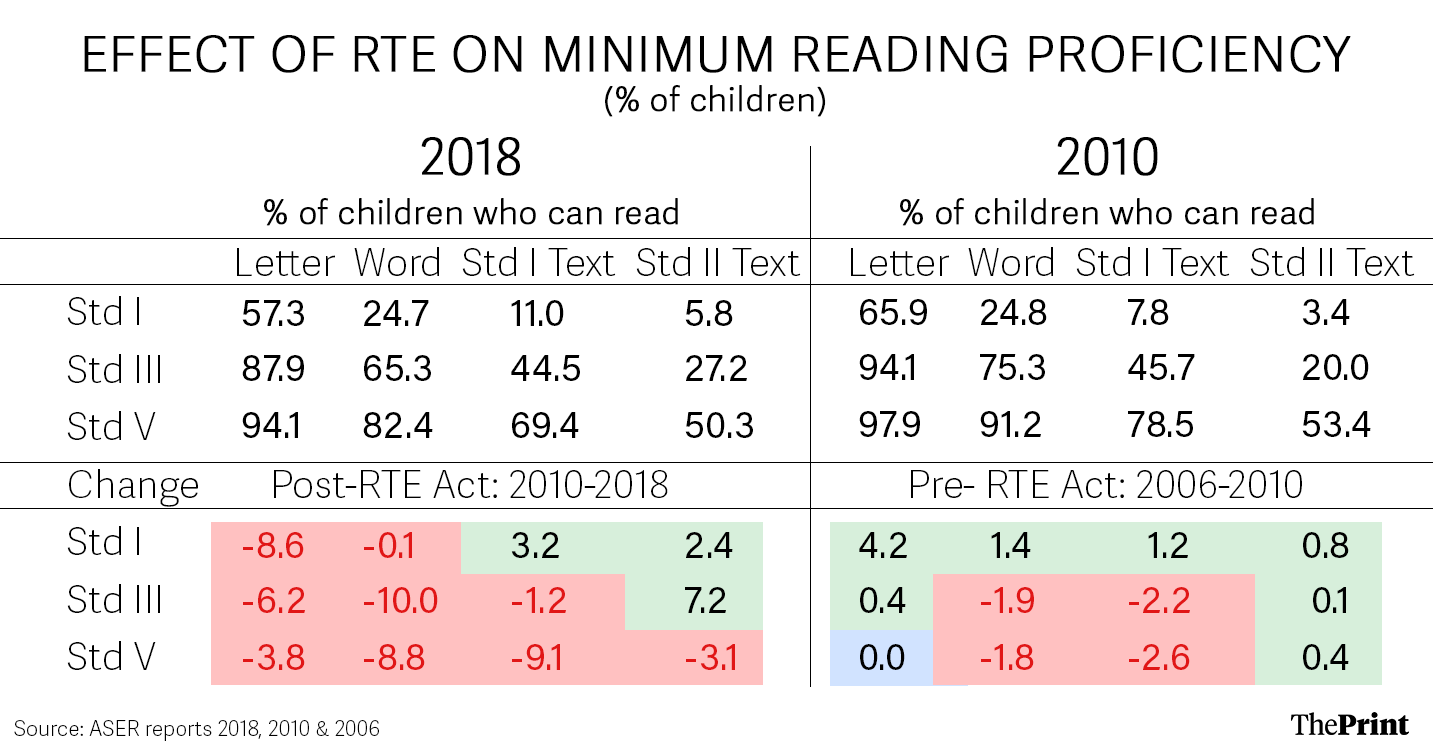
“RTE seems to have had a broadly negative impact on learning outcomes, affecting both minimum reading proficiency and minimum proficiency in arithmetic. While the pre-RTE period (2006–2010) showed declines with stability in a few grades, the post-RTE years (2010–2018) showed greater declines in most grades,” the paper says.
The author also mentions the factor of school closures due to the RTE Act. The RTE’s “strict” compliance requirements—on teacher qualifications, infrastructure, and fees—proved unworkable for low-cost private schools and NGO-run institutions that served poor families.
Data collected by the National Independent Schools Alliance, cited in the paper, shows that by October 2016, over 9,300 private schools had received closure warnings; 7,898 had received actual closure notices; and 3,332 had already shut down—and these are numbers drawn from just three states.
The paper states in a footnote: “This was partly due to a reduction of students, due to the closing of NGO/NPO schools.”
‘Money does not improve learning’
The paper’s inter-state analysis is direct in its implication for education spending. Across Indian states, there is no correlation between a state’s per capita income and its primary school learning outcomes. The correlation between state per capita net domestic product and minimum reading proficiency in Grade 5 is 0.16. For arithmetic, it is negative: -0.08.
“There is no evidence that variation in school infrastructure, teacher pay, or subsidies to child’s family, improve learning at primary and lower secondary levels,” the paper states.
Pupil-teacher ratios improved between 2018 and 2024—primary school ratios dropped from 27 to 20—and the share of trained teachers rose by over 20 percentage points at the primary level. Neither had a statistically significant effect on whether children could read or do arithmetic. The correlation between pupil-teacher ratios and minimum arithmetic proficiency across states was 0.03; for minimum reading proficiency it was -0.09. The paper uses 2024 state-level Pupil Teacher ratio data from UDISE+ (Unified District Information System for Education Plus), and correlates it against 2024 ASER learning outcome data across states.
The international evidence the paper cites reinforces this. In Indonesia, an increase in a teacher’s salary produced no improvement in student learning across mathematics, language, or science after three years, “despite increased teacher satisfaction, reduced financial stress, and fewer second jobs among teachers”. The paper cites the researchers’ explanation: “In public-sector systems with high job security and weak accountability, unconditional pay hikes are unlikely to raise productivity.”
What does work, the paper argues, is pedagogy. Specifically, teaching at the right level—grouping children by their actual learning level rather than age or grade—and structured, repeated testing to identify and support children falling behind.
Also Read: Graduate and unemployed: India’s middle-class rulebook for career & success no longer works
State-wise comparison
Several of India’s most economically developed states are moving backwards on learning, the paper finds.
Between 2014 and 2024, Andhra Pradesh’s minimum reading proficiency in Grade 5 fell by 19.7 percentage points. Telangana’s fell by 22.9 percentage points, Karnataka’s by 13.2, and Tamil Nadu by 11.3. These states rank among India’s top ten in terms of per capita income.
Meanwhile, Uttar Pradesh improved its minimum reading proficiency (MRP) in Grade 5 by 11.7 percentage points between 2014 and 2024, and minimum arithmetic proficiency (MAP) by 13.7 percentage points. Odisha’s improved by 7.6 and 10.4 percentage points, respectively. “This is far above the all-India increase of 0.6 percent points in MRP and 4.6 percent points in MAP during the same period,” the paper notes.
Himachal Pradesh, Kerala, Punjab, and Haryana—states with high per capita incomes and historically better education indicators—all show declining learning outcomes in the same period. Kerala’s minimum reading proficiency fell by 0.8 percentage points, Punjab’s by 5.5, Himachal Pradesh’s by 8.4.
The paper identifies UP’s gains as connected to its adoption of TaRL (Teaching at the Right Level) methodology at scale from 2019 onwards. Within three months of implementation, over 1.7 million children in grades 4 and 5 were able to read basic grade 1 level Hindi text, according to research by MIT-based Abdul Latif Jameel Poverty Action Lab cited in the paper. TaRL methodology groups children by their actual learning ability rather than age or grade, and gives them targeted instruction at that level until they catch up.
Govt exams & ‘fabricated’ scores
The paper also contains an extended section on the integrity of official learning assessments that has implications for how any government data on education outcomes should be read.
Based on data from Madhya Pradesh, Virmani has found that official test scores in mathematics were, on average, 38.9 percentage points higher than scores on the same questions administered in a retest with external monitoring. In Hindi, the gap was 33.8 percentage points.
Researchers cited by the report found that “mandated multiple booklets and external grading sharply cut the discrepancy, indicating that cheating by students and teacher-assisted manipulation of scores accounts for much of the gap”.
In Andhra Pradesh, a randomised experiment across 2,400 schools found that students tested on paper scored 28 percentage points higher in mathematics, 26 in English, and 21 in Telugu, in comparison to students who took identical tests on tamper-proof tablets. “In 40 percent of classrooms, the teacher left the classroom for at least part of the test, leaving students unsupervised, teachers commonly provided the correct answers, and helped erase and correct them,” the paper quotes from field observations.
Government school students in Andhra Pradesh scored 18-24 percentage points less on tablets than on paper. Private school students showed a gap of only 3-8 percentage points.
It implies that National Achievement Survey scores and state board results—the metrics on which education department performance is typically assessed and publicly reported—may substantially overstate actual learning levels, particularly in government schools.
NEP & vocational education
Virmani’s paper treats National Education Policy 2020 (NEP) as a framework with sound direction, but documents a gap between its commitments and current reality.
NEP set a target of providing vocational education to 50 percent of learners by 2025, with a “clear action plan with targets and timelines”.
The data shows that by 2017, only 1.8 percent secondary students were enrolled in vocational and technical programmes—12.8 percentage points below the international benchmark for India’s per capita income level.
The paper estimates the 2023 enrolment figure at approximately 3.3 percent, assuming the 12.8-percentage point gap remains the same.
“According to NEP 2020, less than 5 percent of the 19-24 age group had received formal vocational education,” the paper notes, citing the Twelfth Five-Year Plan baseline.
NEP 2020’s target was to have 50 percent of students through school and higher education systems be exposed to vocational education the following decade. On the current trajectory, the paper finds that reaching even the upper-middle-income country benchmark of 18.4 percent will require a five-fold increase in enrolment.
NEP’s original target date for universal foundational literacy and numeracy—that every child would be able to read, write, and do basic arithmetic by grade 3—was 2025. ASER 2024 data shows 47 percent of grade 3 children can read a grade 1 level text.
The paper does not comment on the 2025 deadline’s passage.
NEP proposed the constitution of a National Committee for Integration of Vocational Education (NCIVE) to oversee implementation. Virmani’s paper references this proposal without indicating the committee has been formed.
Also Read: The IIM (under)grad is born: India’s B-schools are reinventing themselves & it’s a ‘win-win’
The skilling failure
If school data puts the government in a spot, skilling data paints a more bleak picture.
Only 46.9 percent of sanctioned trainer positions in India’s 14,615 Industrial Training Institutes are filled. Of those filled positions, only 18.4 percent (around 18,779) hold the Craft Instructor Training Scheme certification—the standard qualification for ITI trainers.
The paper describes this as a system in which over 83,000 working trainers are unqualified by their own sector’s standards.
Virmani’s assessment of the “governing elite’s bias” on skilling is direct: “State level officials, in the middle of the pyramid, still give more weight to traditional social welfare issues, than to job skilling for employment generation and real wage growth… The fact that the governance system still pays more attention to higher education and futuristic skills than to the semi-skilled/medium skills, adds to the concern. Another indicator of the governing elite’s bias is the fact that CSR [corporate social responsibility] funds going to job skilling are a tiny fraction of the CSR funds going into health.”
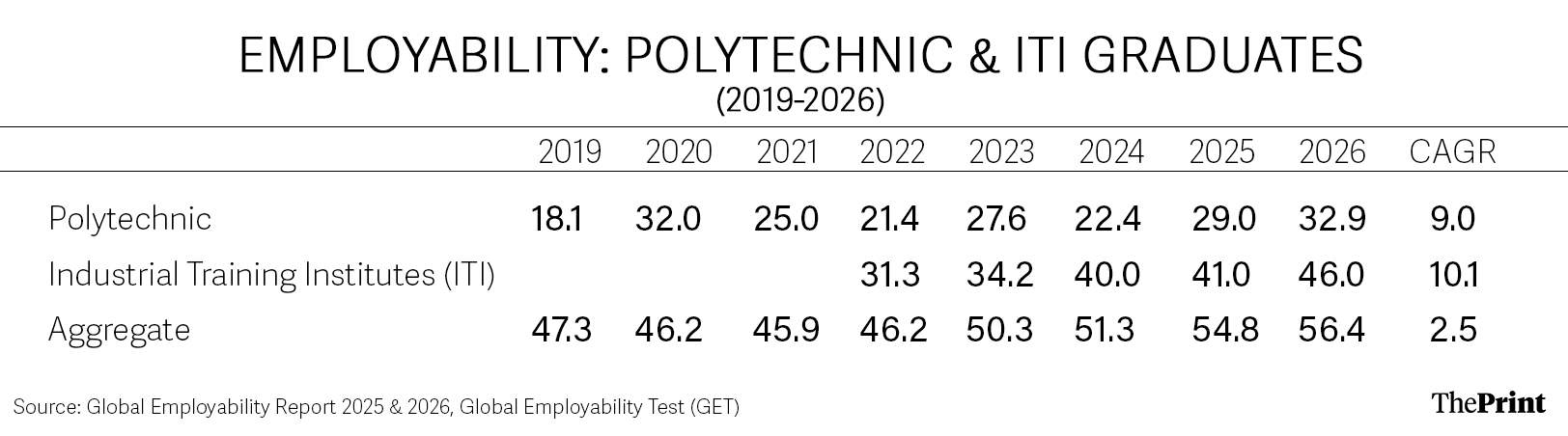
Employability of ITI graduates, as measured by the Global Employability Test, reached 46 percent in 2026. For polytechnic graduates, it reached 32.9 percent. This means that over half of those trained at these formal vocational training institutions are not, by this measure, employable.
Both numbers have improved—ITI from 31.3 percent in 2022, polytechnic from 18.1 percent in 2019—but the paper notes that the gap between ITI and polytechnic employability has widened.
Only 7.7 percent of Indian firms provide formal training to employees, against 8.7 percent in Vietnam, 18 percent in Thailand, 24 percent in Malaysia, and 38 percent in Mexico.
The paper recommends allowing companies to use “a much greater fraction of their funds” for employee training and for upgrading ITIs and polytechnics—a change that would require tax and regulatory reform.
Where India lags
India has witnessed improvements in terms of primary completion, secondary enrolment, and progression from primary to secondary school level—meeting or exceeding international benchmarks pertaining to its income level.
Virmani’s paper constructs a detailed account of where India stands relative to the benchmarks it would need to attain as an upper-middle-income country by around 2030, and a high-income country by 2047—the Viksit Bharat target.
In rural Standard VI, 42 percent of children cannot read a grade 2 text. In Standard VII, 36 percent cannot. In Standard VIII, 29 percent cannot.
Virmani estimates that urban outcomes may be 10–12 percentage points better, but notes that data for direct confirmation is not available.
More than 64 percent of rural Standard VI students cannot do division. For Standard VII, the number stands at 59 percent, and for Standard VIII at 54 percent. These are children who have been in school for six, seven, and eight years, respectively.
Adult literacy must rise by 22 percentage points to reach the high-income country benchmark. Upper secondary completion must go from 63 percent to 79 percent in 20 years. Vocational enrollment—across secondary, post-secondary, and short-cycle tertiary—must increase across all three levels to reach benchmarks.
The paper identifies this collectively as requiring “a herculean effort”.
It does not conclude that these targets are impossible. It instead says that the approaches taken till date—expanding inputs, raising enrollment, issuing certificates—will not get India there.
“Skills and jobs are two sides of the same coin,” the paper reads, quoting its own framing for the 58 percent of India’s workers who are self-employed. For that majority, the paper argues, the education and skilling system as currently structured offers almost nothing.
This is an updated version of the report.
(Edited by Viny Mishra)
Also Read: NITI Aayog says lack of English proficiency key barrier to state university graduates getting jobs