





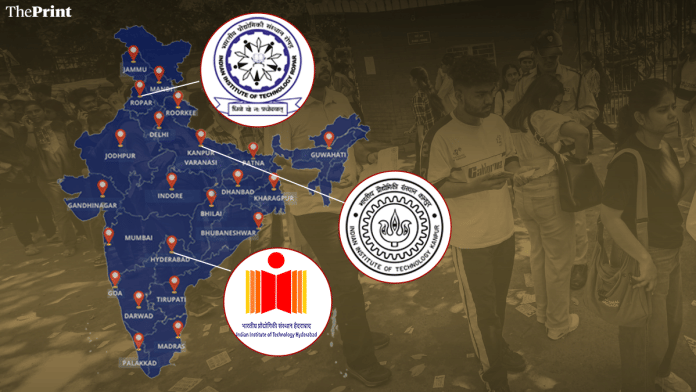



New Delhi: Concerned over low M.Tech enrolment due to limited specialisations and weak industry exposure, the IITs are planning to overhaul their masters programmes, with compulsory internships, dual industry-research tracks and multidisciplinary options.
The country’s premier engineering institutes are also likely to introduce major changes in their PhD programmes, with a focus on project-first models, clearly defined research goals, tighter timelines, and greater emphasis on product-focused research to ensure doctoral work leads to tangible technological and national outcomes.
The proposals were discussed during the 56th meeting of the IIT Council—the apex policy-making and coordinating body for all IITs—held on 25 August 2025, the minutes of which were shared Tuesday.
According to the minutes, a copy of which is with ThePrint, the director of IIT Hyderabad presented the recommendations of the Committee on M.Tech reforms, outlining the current status of M.Tech programmes in India, evolving industry requirements, proposed reforms, and strategies for the way forward.
Noting that limited specialisations and the absence of structured internship opportunities are key reasons B.Tech graduates often opt out of pursuing M.Tech in India, the council underscored the need to make industry internships a compulsory component of M.Tech programmes to balance practical exposure with theoretical learning.
Vacancies in advanced and research programmes have been a persistent issue in IITs.
According to data submitted by the Ministry of Education in Rajya Sabha in 2022, 3,229 M.Tech seats and 1,779 PhD seats remained vacant in 2020–21. In 2021–22, 3,083 MTech seats and 1,852 PhD seats went unfilled, underscoring the ongoing challenge of attracting candidates to these critical programmes.
“The Council also discussed the potential benefits of introducing a dual-track M.Tech programme, with one track focused on industry engagement and the other on research, to better align academic pathways with national research goals and private sector demands,” the minutes stated.
The Council further suggested exploring multidisciplinary and blended-mode M.Tech programmes, along with product-based courses that do not mandate research publications.
“All IITs should revamp and redesign their M.Tech curricula in line with their specific needs and institutional vision,” the committee recommended.
Also Read: IIT Madras is India’s best institution for third year in a row, IISc, JNU & BHU in top 10
Reforms and accountability in PhD
The IITs are also considering wide-ranging reforms to doctoral education to align PhD programmes with the national vision of Viksit Bharat @ 2047, with an emphasis on accountability, outcomes, and innovation.
According to the minutes, IIT Ropar proposed repositioning IIT PhD programmes as “engines of innovation, leadership and global competitiveness”, rather than being driven primarily by publications.
To address long-standing issues such as “prolonged PhD durations, administrative delays, limited mentorship and under-utilised infrastructure”, the reforms recommend a shift to a project-first PhD model, with “structured timelines, predefined research goals and enhanced industry collaboration” built into doctoral training.
The project-first PhD model is a doctoral programme where research starts with a clearly defined project, structured goals, and timelines, emphasising practical outcomes and industry collaboration from the outset.
The minutes also record proposals for “networked PhD programmes across IITs and with international universities” to promote interdisciplinary research and global exposure, along with the creation of “Doctoral Academies at each IIT to support mentorship, career development and international engagement”, backed by upgraded infrastructure and digital labs.
Acknowledging systemic constraints, the council noted that “institute rankings and faculty promotions continue to be largely tied to publications”, which has limited the scale of “product-based PhDs”.
However, it observed that “metrics linked to commercialised patents and ventures created have begun to influence evaluation frameworks”, citing global universities such as MIT, Stanford, ETH Zurich and the Technical University of Munich as examples where doctoral research routinely leads to start-ups and deployable technologies.
To strengthen oversight, all IITs have been advised to “constitute internal committees to assess the baseline quality of incoming PhD students, streamline administrative processes and map research outcomes”.
These committees are also expected to “develop a roadmap to improve student quality, mentoring processes and overall doctoral outcomes”.
Further, it has been recommended that IIT Kanpur may “define common parameters through a central MIS to benchmark PhD outcomes across IITs”, while reforms to “monitor faculty dedication and performance in guiding PhD students” could influence future allocation of doctoral scholars.
‘Student friendly’ JEE (Advanced)
According to the minutes of the meeting, professor Manindra Agrawal, Director of IIT Kanpur, highlighted concerns over the current structure of JEE Advanced, noting the heavy reliance on coaching and the emotional and financial stress it places on families.
“The exam must go beyond rote learning and better assess critical thinking and reasoning skills, while being robust against operational issues,” the minutes quoted him as saying.
To tackle these challenges, the institute proposed a shift to adaptive testing, which dynamically generates questions based on a student’s performance, reducing coaching dependency and enhancing fairness.
The minutes recommended constituting an Expert Committee led by the Joint Admission Board (JAB), responsible for admissions at IITs, and IIT Kanpur to evaluate the proposal, conducting a pilot mock test two months in advance for the candidates, developing a dynamic question generation tool, and preparing a white paper outlining a phased roadmap and timeline for implementation.
Based on pilot results and expert analysis, as per the minutes, IIT Kanpur will outline a phased roadmap in next six months to transition JEE Advanced to adaptive testing, which dynamically adjusts question difficulty to better assess student skills while reducing stress and enhancing fairness.
(Edited by Ajeet Tiwari)