








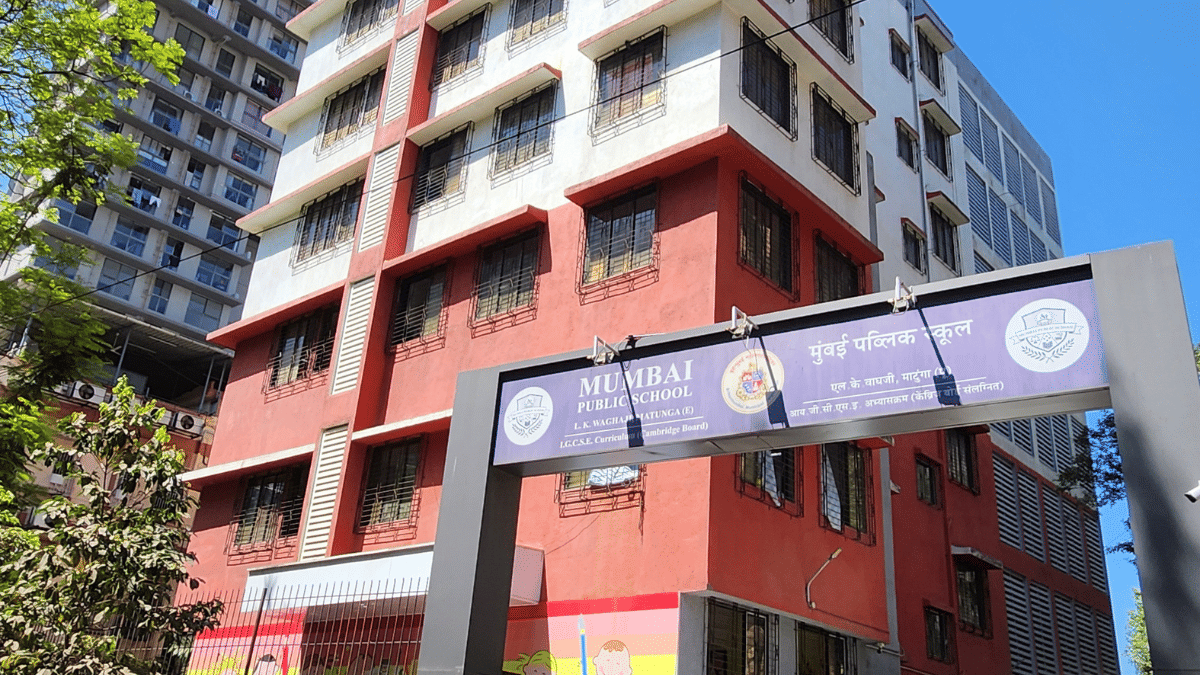
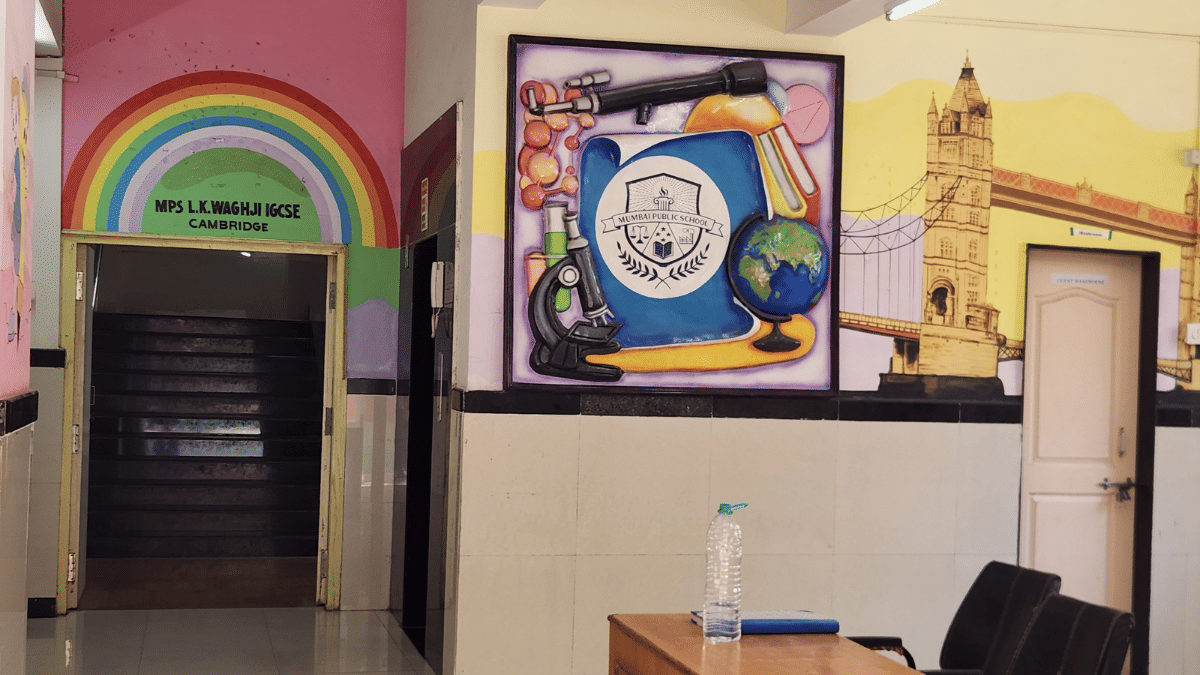
Mumbai: At the entrance of LK Waghji School in Mumbai’s Matunga is a painting of the London Bridge and the British Royal Guards. It isn’t a private school. It is run by the city’s civic body—and it offers Cambridge IGCSE-affiliated education entirely free of cost.
It is the only IGCSE school run by any civic body in Maharashtra. And its counterpart, the Vile Parle International School — affiliated to the International Baccalaureate (IB) programme — is the only IB school in Mumbai’s western suburbs to be run by a municipal body. Both offer education up to primary classes so far.
Together, they form the frontline of the Brihanmumbai Municipal Corporation’s experiment to bring world-class schooling within reach of the city’s children, regardless of their parents’ income and background.
The 2021 project
The push to introduce IGCSE and IB boards in Mumbai was initiated in 2021 by the then Maha Vikas Aghadi government, which modelled the project on Delhi’s publicly-run schools under the Aam Aadmi Party. The same year, then-AAP government in the capital had launched its own IB-affiliated public school.
Accordingly, the two schools were rebranded Mumbai Public Schools by BMC to signal the shift in ambition.
BMC had already been widening its board portfolio before that. Until 2017, its schools were affiliated exclusively to the Maharashtra state board. That year, it began introducing CBSE-affiliated schools and one CISCE school. There are now 18 CBSE schools, one ICSE, one IB, and one IGCSE school run by the civic body—providing free education to 13,316 students from nursery up to Class 10.
The current financial year’s budget commits to adding one more CBSE school to the city.
Who is actually enrolling?
The common assumption that municipal schools serve only low-income families does not hold at the IGCSE school.
Staff at LK Waghji told ThePrint that their students are from mixed backgrounds: children of central and state government officers sit alongside those of mantralaya employees, and middle-class and lower-income families.
Ashwin Sable, who works for a private company in Mumbai, drives close to half an hour each way to bring his son—currently in Class 3—to this school. The board, he says, was the only reason.
“This board imparts excellent education. Teachers are well trained and our kids have no issues here. The quality of education is also very high. In fact, we stay about half hour from here but I wanted to send my child to this school only because of the board,” Sable said.
For him, the school is a “gateway to foreign education”—a system that replaces rote learning with a curriculum that puts his child ahead.
Another parent, Prashant Salvi, whose child is in Class 4, made a similar point.
“The curriculum is very tough as well. What other kids learn in fourth or fifth, my child had that in first or second. Since there are limited students, teachers pay good attention, which helps our kids,” he said.
Also Read: ‘Urban Maxwell’, ministers’ blessings & a Chinese robot meme fest. The Galgotias University story
Demand that outstrips supply
The response, the two schools said, has been emphatic.
Every year, the IB school receives 400 to 500 applications for students who want to enrol in classes 1 to 4. The IGCSE school receives upwards of 200 applications for classes 1 to 5, and roughly 100 for just 30 pre-primary seats available here.
Under Cambridge norms, each class is to be capped at 20 students—though BMC has been granted leeway to admit up to 30, with a student-teacher ratio of 40:1.
With only one division per standard and seven specially trained teachers at LK Waghji, demand invariably outstrips capacity. The school is actively working to strengthen its teaching staff.
“We want to increase the number of teachers and in the process of hiring specialised subject teachers like PT,” an official from LK Waghji School said.
“Our challenge is to admit students because every year we get 200 plus applications but because of the mandate, we can’t admit more students in each class. But we still interview students and keep them on waitlist in case if any student changes school and there is vacancy,” the official added.
One source of vacancies, officials noted, is the transfer of government employees — when a parent is posted out of Mumbai, their child’s seat opens up.
What the schools provide
Beyond academics, the scale of support is striking. Each student at LK Waghji receives 27 items, including a school bag, water bottle, tiffin box, midday meal, stationery, books, shoes, and uniforms.
In the past month, the school has added two protein bars—each containing 25 grams of protein—given to students on alternate days.
The school has a functioning library and a computer lab, with 16 computers that, staff say, is a favourite among children.
Infrastructure for STEM studies, physics, chemistry, and biology labs is already in place — awaiting students in higher standards to use it.
The schools have certification for pre- and primary-level classes; and an application for high school certification, to eventually take students up to Class 10, has already been filed.
The constraint: it costs more, in dollars
For all its promise, the model strains BMC’s finances. Running IGCSE and IB schools costs approximately two times that of running a school affiliated to a state board, education department officials said. Certification fees and books have to be paid in foreign currency, the officials said, though they refused to disclose the amount.
A senior officer from BMC’s education department, speaking anonymously, raised another concern.
“These boards are primarily for students who later wish to study abroad. Right now, we are imparting free education to these students studying in IB and IGCSE boards, but for higher studies, if parents cannot afford to send their kids abroad and if they have to come back to lower boards, the whole exercise becomes pointless,” the officer said.
This worry has prompted the civic body to take a cautious stand in expansion. Rather than a rapid scale-up, BMC is watching demand signals, and noting that CBSE and ICSE still attract far more families.
Rajeshri Shirvadkar, chairperson of BMC’s education committee, captures the balance the corporation is trying to strike.
“There is a good response to these schools and in the future, we will be expanding. But most of the people prefer ICSE schools. We need more trained teachers for IB and IGCSE schools, but the world is competitive, so we want to ensure our BMC students don’t fall behind,” she said.
“And since this is also a bit more expensive, we will increase these schools depending on the response we get response in the future,” Shirvadkar added. The experiment is, by BMC’s own account, a well-begun one.
Rajesh Singh, a teacher at a private school and president of non-profit Adarsh Shikshak Samiti, told ThePrint that though it was a good initiative by BMC to give students from lower income families an opportunity to get exposure to international boards, the emphasis should be on quality.
“There won’t really be a level-playing field between students who study at international boards in private and BMC-run schools because the quality of teachers and how they dispense education matters. Plus, the environment at home will also be different for these students, especially those who come from low income groups,” he said.
(Edited by Prerna Madan)
BMC is shutting these schools my child studies in IB school vileparle, they have given us notice today that they are shutting it down. School principal and teachers were at tears, when they learnt about it. Government official from BMC education department are shutting these schools. Media and people need to know how few govt officials are intentionally closing these schools.
Strange that BJP is going back to the education system and food choices of the colonists! What about Indian knowledge systems?
But where is teachers?????
No teachers are available in many school
And teachers Grade is aslo important to tech