





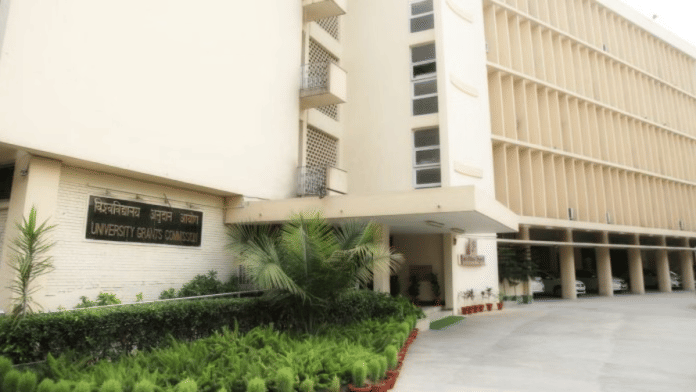



New Delhi: The University Grants Commission (UGC) has urged all universities and colleges to encourage students, teachers and staff to “learn one more Bharatiya Bhasha”, saying the country is shifting from an “English-dominant framework” to a “Bharatiya Bhasha-centred learning ecosystem”.
The Commission released guidelines Wednesday drafted by the Bharatiya Bhasha Samiti (BBS), a high-level committee set up by the Ministry of Education in 2021 to promote Indian languages, which offered incentives such as extra weightage in national assessments and career-linked advantages for institutions promoting multilingual learning.
The guidelines propose that institutions promoting multilingual learning may receive additional weightage in assessments such as the National Assessment and Accreditation Council (NAAC) and the National Institutional Ranking Framework (NIRF), and that multilingual proficiency could be tied to better placement and career opportunities.
The move is another push from the government to promote multilingualism under the National Education Policy (NEP) 2020, which emphasises learning multiple Indian languages.
The Commission requested all Higher Education Institutions (HEIs) to implement the guidelines on “Learning One More Bharatiya Bhasha”.
The guidelines are being shared with all UGC-recognised universities—including central, state, private, and deemed universities—as well as affiliated colleges, Institutes of National Importance, and technical education institutions regulated by the All India Council for Technical Education (AICTE).
“Knowledge of many Indian languages, languages spoken in other States in particular, would help the students in the future job landscape anywhere in India. Hence it is imperative that HEIs should offer courses on various Bharatiya Bhasha as credit courses and encourage students to learn more Indian languages,” the UGC said.
At least three multi-level language courses at all levels
According to the guidelines, all HEIs are expected to offer these courses as Ability Enhancement Courses (AEC), credit courses, audit courses, or other formats aligned with the NEP 2020, in at least three Indian languages. One must the local language, and the other two can be any of the 22 scheduled Indian languages.
The courses will be offered at three levels—Basic, Intermediate, and Advanced—with flexible entry and exit options, allowing students to progress at their own pace.
These levels can also be integrated as minors under the new credit framework. These courses will primarily focus on developing practical communicative skills in speaking, reading, and writing, with measurable proficiency targets and provisions for credit transfer across institutions.
The guidelines further state that the initiative is aimed at all students across undergraduate, postgraduate, and doctoral programmes, irrespective of discipline, along with teachers, staff, and interested members of the local community.
It also encourages HEIs to offer these courses to local community members interested in learning a language, while online courses enable participation from learners across the globe.
Building effective learning tools
The guidelines recommend that HEIs develop quality resource materials to enhance communication skills—speaking, reading, and writing—in Indian languages. Course content should meet quality standards, uphold ethical norms, and “promote national integration”.
The HEIs can use platforms like the Central Institute of Indian Languages (CIL) portal or SWAYAM (Study Webs of Active Learning for Young Aspiring Minds) channels, or create their own print, audio, or video modules.
Language bodies like CIL or Kendriya Hindi Sansthan (KHS) guide curriculum, while tools like the National Language-Tech Stack and “Bhasha Sikhen” app enhance engagement with certified trainers.
To monitor progress, HEIs should develop dedicated dashboards to track enrolments, course completions, and multilingual skill distribution, they stated.
Incentives to promote Bharatiya Bhasha learning
According to the guidelines, structured incentives are recommended to encourage students, teachers, and staff to learn additional Indian languages.
For instance, they suggest that institutions promoting multilingual learning may receive additional weightage in institutional assessments such as NAAC and the NIRF.
Furthermore, multilingual proficiency can be linked to tangible career benefits, including placement advantages, internships, and support for start-up incubation through AICTE Internship and Career Portal.
They further suggested that learners who achieve the defined proficiency targets may receive micro-credentials recorded in the Academic Bank of Credit (ABC) and reflected on their academic transcripts. Those who learn five or more languages can be felicitated during events like Bharatiya Bhasha Utsav or Convocation, making multilingual learning “a matter of passion, pride, prestige, and honour”.
The guidelines also emphasise recognition for mentors and volunteers. Mentors whose cohorts show consistent proficiency gains can receive credits toward a stackable ‘Language Mentor’ certificate.
Volunteers teaching Bharatiya Bhashas may be acknowledged through letters of appreciation or honorary titles such as “Bhasha Bandhu”, “Bhasha Mitra”, or “LipiGaurav”.
(Edited by Sugita Katyal)
Also Read: ICHR launches project to explore Aryan history. ‘Aim not merely to refute colonial frameworks’