








New Delhi: Three years after the central government froze its flagship minority scholarship schemes over alleged fraud involving fake schools, ghost beneficiaries and siphoned funds, investigations into such cases across states have barely made headway. And with no clear timeline for when the schemes will be revived, minority students continue to struggle without financial support.
This week, the parliamentary standing committee on social justice and empowerment led by BJP MP P.C. Mohan tabled a report in both Houses that has laid bare the extent of the failure, calling the situation an “injustice to minority students for no fault of theirs”.
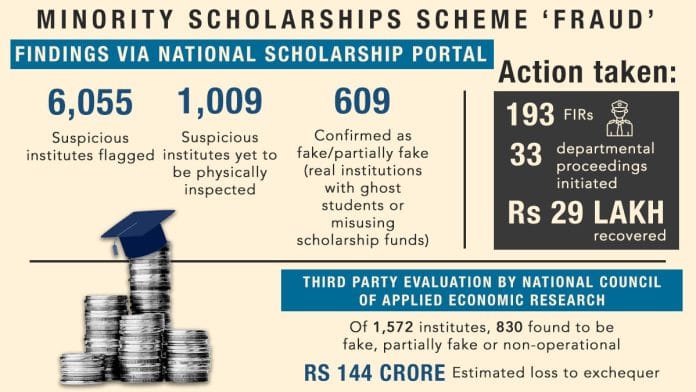
There have been two separate tracks of investigation into alleged minority scholarship fraud, involving different sets of institutes, different processes and different agencies. One was led by the National Council of Applied Economic Research (NCAER)—an independent, economic policy research think tank—that revealed an estimated loss of Rs 144.33 crore.
The second pertains to a larger pool of 6,000+ institutes flagged by the National Scholarship Portal—a government portal used for applying, processing, verifying and sanctioning of scholarships—which is still being worked through.
How the ‘fraud’ unfolded
The issue first surfaced in November 2020, when media reports said scholarship funds were being siphoned by a nexus of bank staff, middlemen, school employees and government officials. The Ministry of Minority Affairs asked five states—Assam, Bihar, Jharkhand, Chhattisgarh and Punjab—to investigate. It also referred the matter to the CBI. And then, for the better part of four years, very little happened.
The ministry commissioned the NCAER to conduct a third-party evaluation of 1,572 institutes that had received scholarship funds between 2017-18 and 2021-22. A total of 830 institutions—more than half of those evaluated—were found to be fake, partially fake (real institutions with ghost students or misusing scholarship funds), or non-operational, according to the standing committee report. The estimated loss to the exchequer from these 830 institutes alone was Rs 144.33 crore.
According to the report, following the NCAER findings, the CBI in 2023 was asked to examine 14 schools. Of these, only one—in Punjab—was taken up for fresh investigation, since the remaining 13 had already seen state police action. A separate case, registered on the basis of a written complaint from the ministry secretary in July 2023, resulted in a chargesheet against 10 accused following investigation in Bhopal, Madhya Pradesh. That investigation is still underway.
A ministry representative informed the standing committee that it is “working very closely with the states and holding continuous meetings with the CBI to expedite the closure of the issue”.
The representative further said that the ministry will engage a “reputed” study team to visit the states and “understand why visible action is not happening”.
“In meetings they say certain steps are being taken, but a structured assessment is needed. With that study report, we hope to get clarity on the future course of action,” this representative added.
Separately, the National Scholarship Portal threw up red flags, pointing to a deeper rot within the scholarship system. It led the minority affairs ministry to identify a much larger pool of 6,055 suspicious institutes across the country.
In February 2025—more than four years after the first signs of fraud came to light—these cases were finally sent to state governments for physical verification, action and recovery.
What have states done so far?
Of the 6,055 institutes reported to respective state governments for verification in February 2025, physical inspections have been completed in 5,046 cases, with 1,009 still pending. Of those inspected, 609 have been confirmed as fake or partially fake, according to the standing committee report.
Against this, states have collectively lodged 193 FIRs, initiated 33 departmental proceedings, and recovered a total of around Rs 29 lakh.
This recovery figure relates to action on the portal-flagged pool. What has been recovered against the 830 institutes in the original NCAER sample remains unaccounted for in the committee’s report.
The state-wise picture is deeply uneven. Madhya Pradesh leads in FIRs with 55, though it has made no formal recovery—the committee notes separately that the state deposited approximately Rs 14 lakh directly to SBI outside the official recovery mechanism. Bihar has lodged 85 FIRs but recovered nothing. Assam, which made early headlines by arresting 43 people, has registered only two FIRs in the latest round and recovered just Rs 59,317. Uttar Pradesh, which had the largest number of suspicious institutes to verify at 1,076, has lodged 16 FIRs and recovered Rs 3.2 lakh. Telangana, with three FIRs, has recovered the most, at Rs 16.37 lakh.
ThePrint has reached the chief secretaries of Assam, UP and West Bengal for comment via email. This report will be updated if and when they respond.
Several large states have done virtually nothing at all. Gujarat, with 88 institutes to inspect, has not inspected a single one. Delhi and Puducherry have also completed zero inspections. Karnataka, with 911 institutes to verify—the second largest caseload in the country—has inspected fewer than half and recovered nothing despite confirming 12 fake institutions.
At least five states and Union territories—Odisha, Chandigarh, Himachal Pradesh, Goa and the Andaman and Nicobar Islands—were cleared after inspections found no irregularities.
Also Read: SC scholarship scheme achieved just half its target this year; fellowship cap unchanged since 2005
Schemes frozen, budgets unspent
The Centre essentially offered three types of minority scholarships—pre-matric, post-matric, and a Merit-cum-Means scholarship.
The Pre-Matric Scholarship Scheme, covering students in Classes IX and X from families with annual income below Rs 1 lakh, and the Post-Matric Scholarship Scheme, covering Class XI through PhD for families earning below Rs 2 lakh, were not approved beyond 2021-22. The Merit-cum-Means Scholarship for professional and technical courses is similarly in limbo. No scholarships have been disbursed under any of the three schemes since 2022-23.
The Pre-Matric scheme was allocated Rs 433 crore in the Budget Estimates for 2023-24, but only Rs 95.84 crore was spent. In 2024-25, Rs 1.55 crore was spent under this scheme, and nothing in 2025-26. The Post-Matric scheme, allocated Rs 1,065 crore in 2023-24, saw Rs 85.02 crore spent that year, Rs 5.31 crore the next, and nothing in 2025-26.
For 2026-27, the government has allocated Rs 198 crore for Pre-Matric and Rs 581 crore for Post-Matric scholarships.
A tangled path to revival
The ministry’s own account of the revival process reveals how far off a resolution is. The proposal to revive the three schemes has been cleared by the Expenditure Finance Committee twice—in January 2023 and again in December 2024—but it has not yet been taken to the Cabinet.
“Unless and until the states show some visible progress on all the legacy issues, we cannot disburse scholarship,” a ministry official said during the parliamentary committee’s deliberations.
When the committee asked about action taken by states, the ministry representative said, “Only a few states have shown satisfactory action.”
The ministry also acknowledged that whatever limited progress has been made—around 33 FIRs and some recovery—has occurred only in the last 3-4 months, which it said followed sustained pressure from it that included personal visits by senior officials to states.
“In the last three to four years, the states have hardly done anything,” the official said.
‘Punishing those in genuine need’
Tanvir Aeijaz, associate professor of political science at Ramjas College, said the suspension of minority scholarship schemes has disproportionately affected students from marginalised communities, particularly Muslims, many of whom rely on such support to continue higher education.
Stopping the schemes altogether because of irregularities in some institutions has ended up punishing genuine applicants, he told ThePrint.
“If there were fake colleges or misuse, the government should have taken action against those institutions rather than discontinuing the entire scheme,” Aeijaz said. He added that the delay in investigation and lack of decisive action by authorities has meant that “for three to four years, students who genuinely needed financial support have been left in limbo”.
Aeijaz also stressed that if the government believed there were structural issues with the scheme, it should have focused on reforming and rehabilitating it instead of suspending it indefinitely.
“The scheme could have been strengthened with better verification and monitoring mechanisms. What was required was reform and rehabilitation of the system, not its abrupt stoppage,” he said, warning that prolonged disruption risks widening educational inequalities for minority students who already face socio-economic barriers.
(Edited by Gitanjali Das)
Also Read: 2 neighbouring states allow Muslims to leave work early for Ramzan. 1 faces ‘anti-secularist’ barb