





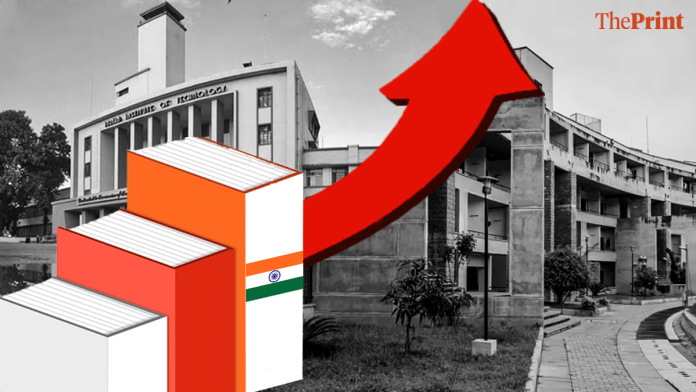



New Delhi: India’s leading engineering schools drove a significant jump in global academic rankings this year, with the Indian Institutes of Technology (IITs) helping deliver the fastest improvement by any major country in the QS World University Rankings by Subject 2026.
The new data released Wednesday by QS Quacquarelli Symonds, one of the world’s most widely followed university ranking organisations, covers more than 21,000 academic programmes across 1,900 universities in over 100 countries.
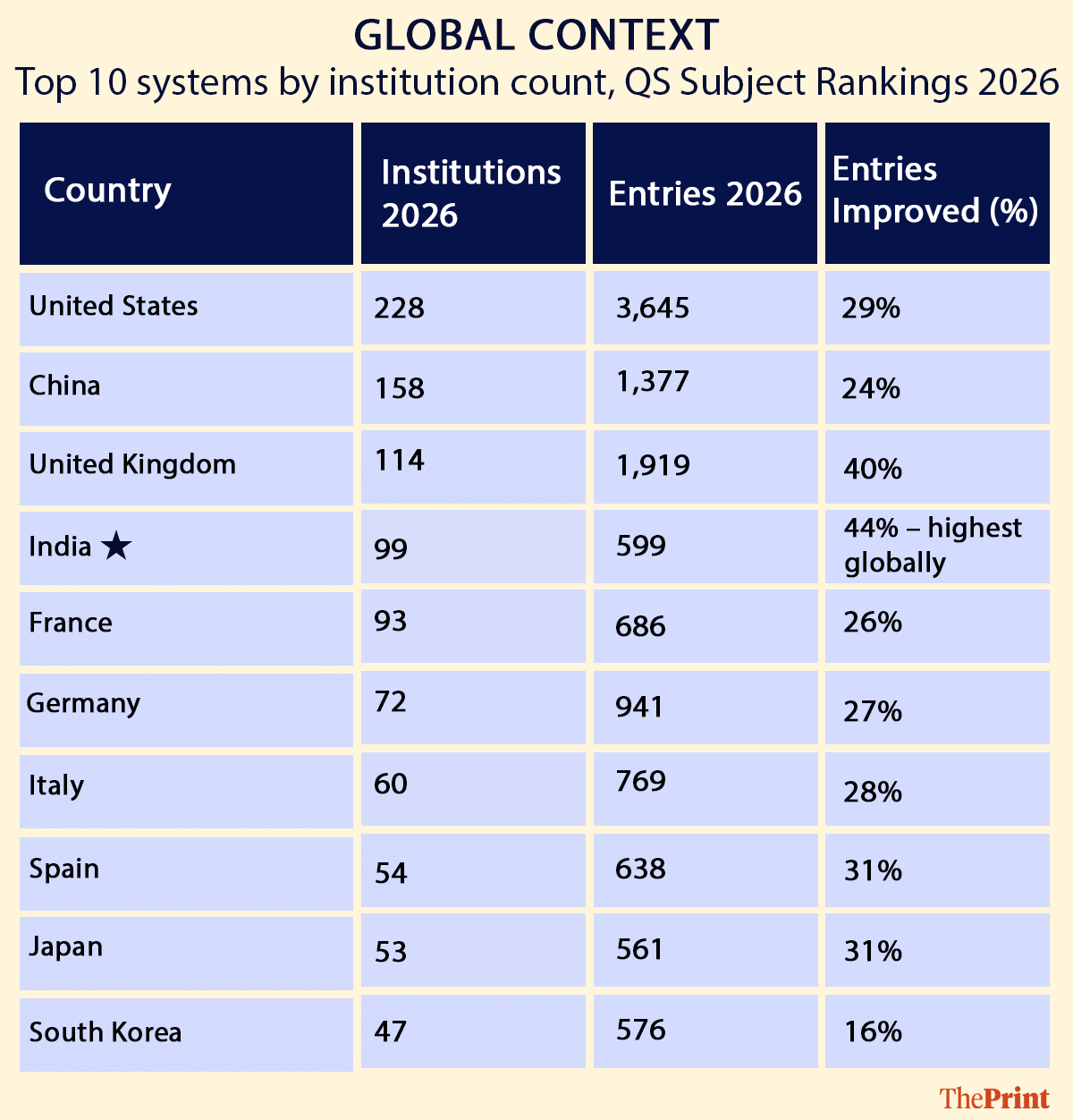
The headline number is straightforward: 44 percent of India’s entries in the rankings moved up this year, the highest proportion worldwide among countries with at least 10 universities on the list. The UAE came second at 41 percent, followed by the UK, Indonesia and Colombia, all at 40 percent.
India now has 99 universities featured across 55 subject areas, up from 79 last year. Twenty institutions are appearing for the first time. In total, Indian universities feature 599 times across the rankings, a 12 percent increase from 2025, and more than double the number of appearances from five years ago.
“India’s rise this year is not just about scale—it’s about momentum in quality and global competitiveness. The breadth of improvement across engineering, technology and business signals a system that is accelerating with intent,” said Jessica Turner, CEO of QS.
What the numbers mean
QS, a British higher education analytics firm, has been ranking universities globally since 2004. Unlike overall university rankings, the subject rankings assess institutions by academic discipline, from engineering and computer science to law and medicine. So a university might rank poorly overall but perform strongly in engineering or law.
Each subject is ranked separately, which means a single university can appear multiple times across the full list—once for each subject it qualifies in. A university in the “top 50” of a subject is among the 50 highest-ranked institutions in the world for that field, out of over 1,900 universities assessed.
When India’s total “entries” go up, more Indian universities are qualifying in more subjects—and when those entries “improve”, they are moving higher within that subject’s global list.
Engineering
The report identifies engineering and computer science as the country’s most strategically significant cluster of results.
In Computer Science, six Indian universities now rank in the global top 100, up from just two last year. IIT Bombay and IIT Delhi have both entered the top 50 for the first time — ranking 44th and 45th, respectively. The total number of Indian universities ranked in Computer Science has nearly doubled over five years, from 23 to 44.
A total of 10 Indian institutions now feature in the top 200 in Computer Science, up from seven last year, and nine institutions achieve their highest ranking to date in the subject in 2026. While the US, the UK, Germany, and France saw fewer entries in Computer Science in 2026, India strengthened its representation, ranking 44 times in the subject.
In Chemical Engineering, five Indian universities are now in the global top 100, up from two. IIT Delhi entered the top 50 for the first time, ranking 48th. In Electrical and Electronic Engineering, six universities are in the top 100, and 12 achieved their highest-ever individual position.
In Mechanical, Aeronautical and Manufacturing Engineering, the number of top-100 entries rose from four to six. The report notes that in that subject, 19 of last year’s 22 Indian entries improved their positions in 2026, and that India recorded the second most improved entries globally in materials science, behind only the US.
According to QS, the findings are relevant to India’s stated ambition of becoming a $1 trillion manufacturing and export hub by 2030, with the rankings data pointing to what the report calls “institutional readiness” in subjects central to that goal.
“India is excelling in subject areas key for the future,” said Ashwin Fernandes, Chair of QS India and Vice President of Strategic and International Engagement.
IITs are leading, but others are catching up
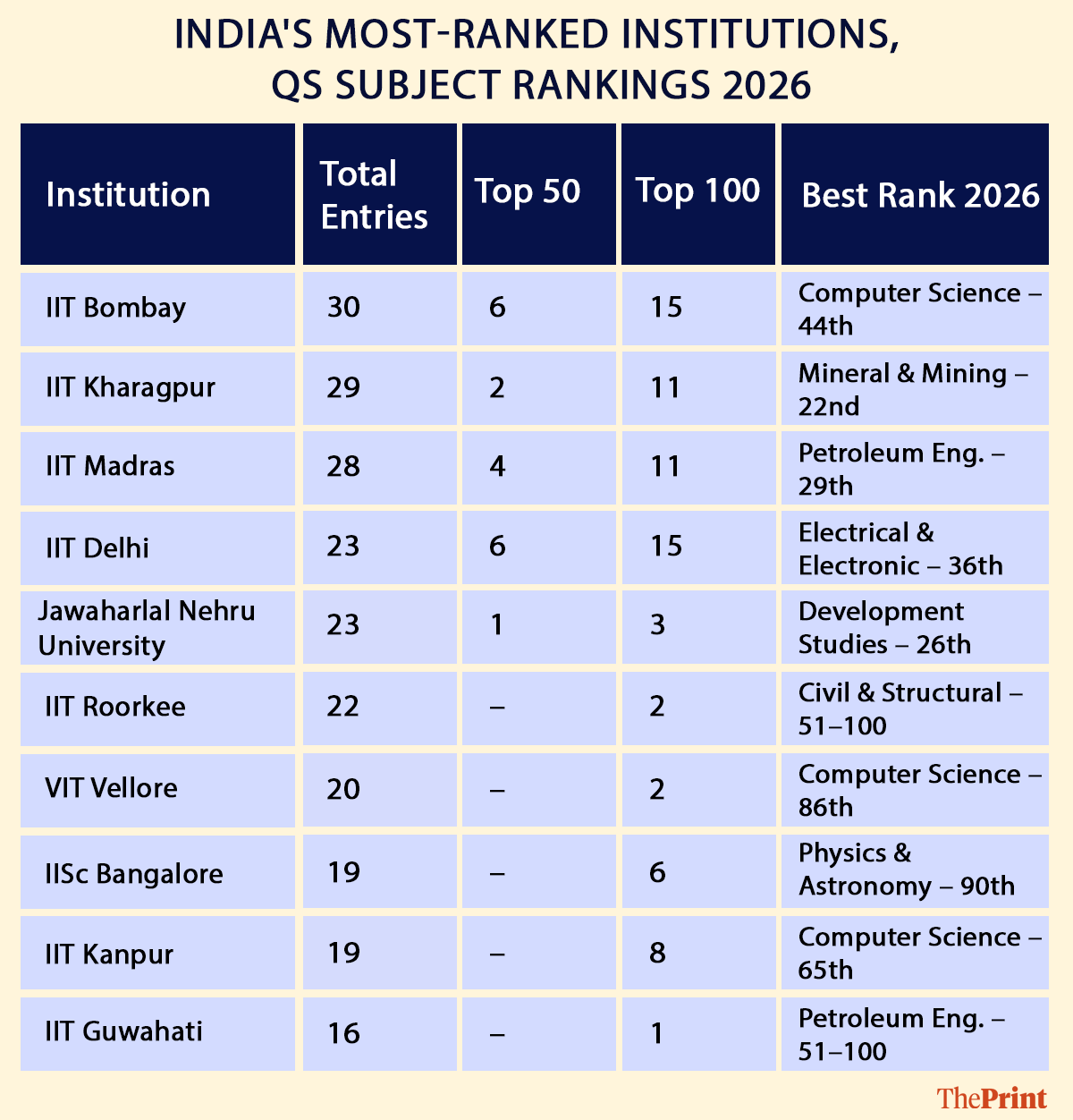
The Indian Institutes of Technology—a network of government-funded technical universities established from the 1950s onwards—account for the bulk of the results. IIT Bombay appears 30 times across the rankings, IIT Kharagpur 29 times, and IIT Madras and the University of Delhi 28 times each.
IIT Delhi recorded six top-50 positions across different subjects this year. It led India in Chemical Engineering, Electrical and Electronic Engineering, Mechanical Engineering, and the broad Engineering and Technology category.
Its number 45 ranking in Computer Science is its best-ever performance in that subject. The report described it as “the edition’s most complete single-institution performance”.
IIT Kharagpur made its debut in Petroleum Engineering—the extraction of oil and gas—and immediately ranked 28 globally. IIT Bombay entered the top 50 in four subjects: Chemical Engineering, Civil and Structural Engineering, Computer Science, and Electrical and Electronic Engineering.
The report notes that the IIT network “appears to be translating decades of infrastructure investment into measurable global standing, while newer institutions such as VIT Vellore, BITS Pilani, and several private universities are broadening the competitive base beyond the traditional elite”.
Vellore Institute of Technology entered the top 100 in Computer Science for the first time, ranking 86th. Birla Institute of Technology and Science, Pilani jumped from 84th to 45th position in Pharmacy and Pharmacology, entering the top 50 in that subject for the first time.
Business schools and other subjects
Seven Indian institutions now rank in the top 100 for Business and Management Studies, up from four last year. IIM Ahmedabad rose to 21, IIM Bangalore ranked 29, and IIM Calcutta entered the top 50 for the first time at number 47.
IIM Ahmedabad also became the first Indian institution ever to appear in the Marketing subject ranking, debuting at 21. The report said this was a subject debut, with India having never previously appeared in Marketing’s global rankings.
In Law, O.P. Jindal Global University rose from 78 to 35 in a single year, entering the global top 50. In Medicine, the All India Institute of Medical Sciences ranked 105th, up from 145 last year. The report describes this as India’s highest ever position in the subject.
India also made its first-ever appearance in Veterinary Science, with the Indian Veterinary Research Institute entering the 51-100 band.
Where India still has ground to cover
The report notes that the picture is not uniformly positive. Arts and Humanities remains a weak spot, with more entries declining than rising.
India’s top institutions still sit well outside the global elite in disciplines such as Medicine and the social sciences, where, the report says, research output volumes and international faculty ratios have historically lagged.
On the question of scale, the report says that India’s National Education Policy of 2020 targets a gross enrolment ratio of 50 percent by 2035, roughly doubling current participation.
The report says the QS data suggest that “the quality of India’s higher education output is advancing in tandem with the sector’s scale — a combination that few rapidly expanding systems have managed”.
Of India’s 599 entries this year, 80 declined in rank.
The report says that the direction of travel — 44 percent of entries improving, 120 debuts, and 27 top-50 positions — is “unmistakably upward”.
“The next phase will be defined by how effectively institutions deepen research strength, build global partnerships, and sharpen their distinctiveness on the world stage,” said Turner.
(Edited by Sugita Katyal)
Also Read: Graduate and unemployed: India’s middle-class rulebook for career & success no longer works