





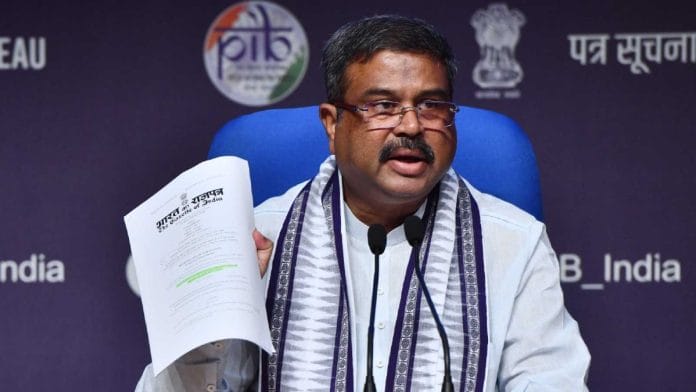



New Delhi: Union Education Minister Dharmendra Pradhan Tuesday defended the Viksit Bharat Shiksha Adhishthan Bill, 2025, asserting that it will not undermine the autonomy of higher education institutions or states, and instead, will strengthen India’s education ecosystem.
The Bill, introduced in Lok Sabha Monday, proposes to establish an overarching Higher Education Commission and three regulatory councils. But the planned overhaul triggered strong opposition over concerns of institutional autonomy and “excessive centralisation” of higher education.
Following the pushback, the government Tuesday referred the Bill to a joint parliamentary committee (JPC) comprising members from both Houses of Parliament. The proposal was approved by voice vote in Lok Sabha.
Speaking to the media later on Tuesday, Pradhan said: “We can’t see any threat to the autonomy of states and higher education institutions. Whatever powers states have right now in their universities, they will continue to remain the same. The states will be able to start their universities under their Acts, as they are doing presently.”
The minister said the JPC, which will include Opposition members, would provide an opportunity to address concerns. “It will give the Opposition an opportunity to clarify all the doubts and we will also take valuable inputs from the members of the committee,” he said.
Pradhan clarified that permissions state universities previously needed from the University Grants Commission (UGC) will now be obtained from the respective regulatory council under the new commission.
Under the UGC Act, 1956, state universities do not need UGC permission to be established but must be recognised under Section 2(f), which deals with definition of ‘university’, of the legislation. Similarly, the state universities need to be considered eligible under Section 12B of the Act to get grants, and require UGC approval for distance/online programmes.
Addressing concerns over centralisation, Pradhan said: “The sovereign authority was with the Centre even under the UGC. Nothing will change under the new Bill.”
Section 20 of the UGC Act empowers the central government to issue binding policy directions to the commission on matters of national importance. Centre’s decision is considered final in any dispute over policy.
On Tuesday, the minister emphasised that while bodies like UGC, AICTE, and NCTE never had state representation, the new framework would ensure cooperative federalism.
The All India Council for Technical Education (AICTE) is the statutory body for technical education institutes in India, and the National Council for Teacher Education (NCTE) regulates standards and norms for teacher-training programmes.
“Under the Viksit Bharat Shiksha Adhishthan Bill, 2025, all three councils—Standards Council, Regulatory Council, and Accreditation Council—will include state representatives. This will ensure cooperative federalism and allow states to continue having a voice in regulating and coordinating higher education,” Pradhan said.
On institutions of national importance, including IITs and IIMs, coming under the proposed legislation, Pradhan said they would retain their autonomy.
“They will continue to enjoy their autonomy; however, they will need to submit their data to the regulatory council, which will help raise the benchmark of standards for Indian institutions,” he said.
Explaining the rationale behind the Bill, the minister said higher education institutions were burdened with multiple regulators, standard-setting bodies, and accreditation agencies.
“Each of these imposed its own regulations, its own standards, and its own compliance costs,” he said, adding this made higher education not only expensive but also inefficient, subjective and fragmented.
“To take India’s education system to a truly global level, reforming this outdated structure became unavoidable,” he said.
Pradhan said UGC had simultaneously acted as regulator, standard-setting authority, funding body, and through NAAC (National Assessment and Accreditation Council), even the accreditation authority. “Many objections were raised that this concentration of power created a serious conflict of interest, where objectivity and transparency were compromised. A modern education system cannot function effectively under such an arrangement,” he added.
(Edited by Prerna Madan)
Also Read: 1 regulator, 3 councils: Inside Viksit Bharat Shiksha Adhishthan Bill for higher education overhaul