





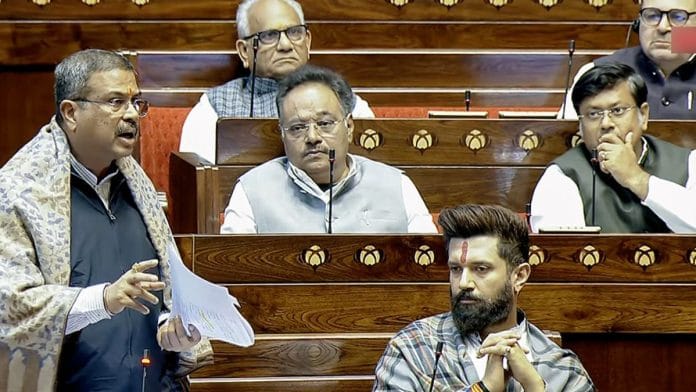



New Delhi: Union Education Minister Dharmendra Pradhan Monday introduced the Viksit Bharat Shiksha Adhishthan Bill 2025 in Lok Sabha to overhaul India’s higher education system by proposing an overarching Higher Education Commission and three regulatory councils.
The move triggered strong opposition, with members raising concerns that it could undermine institutional autonomy and lead to “excessive centralisation” of higher education in India.
The Viksit Bharat Shiksha Adhishthan Bill 2025, earlier named the Higher Education Council of India (HECI) 2025, has been introduced in line with the National Education Policy (NEP) 2020 which seeks to merge three existing regulators—the University Grants Commission (UGC), the All India Council for Technical Education (AICTE), and the National Council for Teacher Education (NCTE)—into a unified commission called the Viksit Bharat Shiksha Adhishthan.
Currently, the UGC regulates non-technical higher education institutions in India, the AICTE oversees technical education, and the NCTE regulates teacher education. Under the proposed commission, there will be three councils for regulation, accreditation and ensuring academic standards for universities and higher education institutions (HEI) in India.
Introducing the Bill, Pradhan said its objective is to enable higher education to achieve “excellence in teaching, learning, research, and innovation” through effective coordination and the determination of standards across higher education, research, and scientific and technical institutions.
“…for this purpose, the Bharat Shiksha Adhishthan would be constituted to facilitate universities and other higher educational institutions in becoming independent, self-governing bodies, while promoting excellence through a robust and transparent system of accreditation and autonomy.” he said.
However, several members raised concerns over the Bill and noted that they were not given an opportunity to study it. In response, Parliamentary Affairs Minister Kiren Rijiju said the government proposes to refer the Bill to a Joint Parliamentary Committee (JPC).
Raising concerns over the Bill, Congress Lok Sabha MP Manish Tewari said the Bill may lead to “excessive centralisation” of education.
“The bill results in excessive centralisation of higher education and violates the constitutional distribution of legislative competence… The Bill goes far beyond standards and intrudes into administration, affiliation, establishment and closure of university campuses, their institutional autonomy matters falling with an entry 25 of list three and entry 32 of list two, which cover incorporation and regulation of state universities,” he said.
Tewari said the Bill suffers from “excessive delegation of legislative power” (to the commission) ranging from accreditation frameworks, degree of granting powers, penalties, institutional autonomy and even supersession are left to be determined by rules, regulations and executive direction. “This application of essential legislative functions violates settled constitutional principles governing delegated legislation,” he said.
The Bill proposes that the regulatory council will have the authority to impose substantial penalties on higher education institutions (HEIs) for violating provisions of the Act or the rules and regulations under it. Penalties will range from Rs 10 lakh to Rs 75 lakh for repeated violations. Establishing an HEI without approval from the commission or the state government will attract a penalty of Rs 2 crore.
Some members from southern states raised concerns over the nomenclature of the Bill in Hindi.
N.K. Premachandran, MP from the Revolutionary Socialist Party, Kollam (Kerala), said even the name of the Bill was difficult to pronounce. He raised concerns about its nomenclature, noting that under Article 348, Clause B, the text of any Bill introduced in Parliament, along with amendments, must be in English unless Parliament provides otherwise.
T. M. Selvaganapathy, a member of the Dravida Munnetra Kazhagam (DMK) party, also raised objections over the name of the legislation.
“…All these years this government, any law they bring up, any scheme that they bring up, they title it only in Hindi and not as required by the Constitution of India. The Constitution is clear. The Bill has to be, the name has to be, the nomenclature has to be in the language, in English, so that every citizen, every part of the country knows what is the veracity of the Bill. Second, this is against the federal principle of the Constitution,” he said.
He also said the Bill was nothing but “an abuse of process of law”, as per various provisions of the Bill, the Union government will practically be the sole decision-making authority, which is against the spirit of the Constitution. “The Union government will have the final say,” Selvaganapathy added.
S. Jothimani, a Congress MP representing the Karur constituency in Tamil Nadu, termed it another way of imposing Hindi and “an attack on federalism”.
“The bill moves forward despite the parliamentary standing committees on education explicitly finding that the Bill maintains a union government-heavy composition and insufficient state representation,” she said.
(Edited by Viny Mishra)
Also read: 1 regulator, 3 councils: Inside Viksit Bharat Shiksha Adhishthan Bill for higher education overhaul