





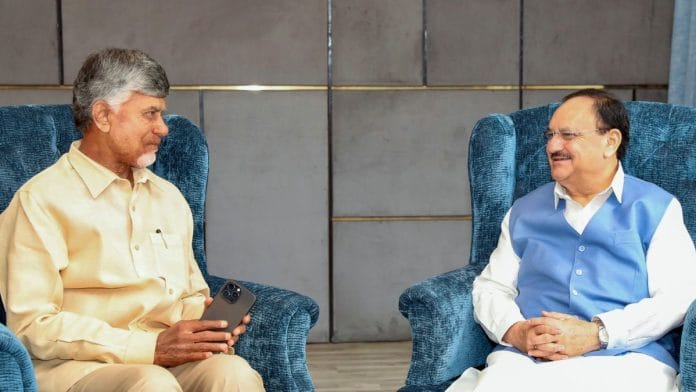



New Delhi: Amid political controversy over the Chandrababu Naidu government’s plan to introduce a Public-Private Partnership (PPP) model to set up 10 new medical colleges in Andhra Pradesh, the Centre has backed the move.
Union Health Minister J.P. Nadda gave his stamp of approval in a letter last month, citing PPP’s “proven role” in strengthening healthcare infrastructure and improving service delivery.
The Telugu Desam Party (TDP) government’s proposal, announced in September, triggered strong opposition from the Jagan Mohan Reddy-led Yuvajana Sramika Rythu Congress Party (YSRCP). The former chief minister has expressed concerns that the move would pave the way for the privatisation of government-run medical colleges.
After the TDP government announced the PPP plan, the YSRCP launched a statewide signature campaign against the move. Reddy later submitted more than one crore signatures to Governor S. Abdul Nazeer on 18 December, opposing the state’s proposal.
However, in a letter to Andhra Pradesh Medical and Health Minister Satya Kumar Yadav last month, Nadda wrote that “by strategically adopting PPP models, states and Union Territories can accelerate healthcare reforms, optimise resource utilisation, and ensure more equitable access to quality healthcare services”.
Nadda noted financial support available under Centre-run schemes. PPP health projects, he wrote, are eligible for substantial assistance under the Viability Gap Funding scheme. Under this scheme, funding support can rise up to 80 per cent of the total project cost for the first five years, while operations expenditure support can reach up to 50 per cent, with the Centre and the state paying equal shares.
The Union minister highlighted the India Infrastructure Project Development Fund (IIPDF)—a Centre-run scheme supporting states and public agencies in preparing and structuring infrastructure projects, particularly PPP initiatives—in his letter.
Stressing the need for proactive engagement, Nadda told the Andhra Pradesh government that its “personal intervention in this matter will enable better utilisation of the above schemes of the Government of India and result in a significant improvement in health infrastructure and services”.
A senior state government official told ThePrint that Nadda’s letter offered “much-needed clarity” on the PPP model. “The state faces a shortage of medical colleges and doctors, so we must accelerate this project to benefit the public, without any political considerations.”
Also Read: Email ID ‘abc@gmail’, ‘111111’ as bank A/C—CAG flags gaps in Modi govt’s flagship upskilling scheme
What the Naidu govt is saying
According to the state government, the previous YSR Congress government had sanctioned 17 new medical colleges in 2020–21 at an estimated investment of Rs 8,480 crore.
Six colleges began operations between 2023–24 and 2024–25, but the remaining 11—proposed at Adoni, Madanapalli, Markapuram, Pulivendula, Penugonda, Palakollu, Amalapuram, Narsipatnam, Bapatla, and Parvathipuram—remained incomplete even four years later. By then, only Rs 1,550 crore or 18.27 per cent of the total sanctioned amount had been spent on the colleges.
This was one of the crises that faced the TDP government after it assumed office in June 2024. The new government released Rs 902.89 crore to executing agencies to revive the stalled projects. But it soon became clear that traditional government measures could not ensure their timely completion, according to officials.
“To accelerate progress, the TDP government decided to adopt the PPP model, to leverage private sector efficiencies, reduce the financial burden on the state exchequer—estimated savings of Rs 3,700 crore initially and Rs 500 crore annually for operations—and improve the quality of tertiary healthcare and medical education,” a senior Andhra Pradesh government official, who did not want to be named, told ThePrint.
What the Opposition is saying
The YSR Congress has strongly opposed the plan to implement the PPP model in the ten new medical colleges in Andhra Pradesh, arguing that it could lead to the privatisation of public healthcare and medical education. The party contends that handing over operations to private entities may raise costs, limit access for students and patients by increasing fees and service charges, and undermine equitable healthcare delivery.
However, the Andhra Pradesh health department official, who spoke to ThePrint, dismissed all concerns, saying, “Outpatient services remain completely free, including doctor consultations, medical tests, and diagnostics. It doesn’t matter whether the hospital is run entirely by the government or through a public-private partnership—the patient does not pay a single rupee for OPD services.”
On in-patient care, the official explained, “For people below the poverty line, all inpatient services remain fully free. Even for others, the government has established reimbursement mechanisms through health insurance schemes, such as the NTR Vaidya Seva, which is similar to the Ayushman Bharat scheme. This ensures that private partners recover their costs without charging patients directly.”
Clarifying the fee structure for medical education, the official said, “Fifty per cent of undergraduate seats are reserved for government quota students, who come after clearing the NEET-UG entrance exam and who pay regulated fees. The remaining seats are divided into management and NRI quotas, with fees regulated by the state’s regulatory committee. Similarly, for postgraduate courses, 12 out of 24 seats are reserved for government students. There is no increase in fees due to private participation.”
The PPP model is vastly different from privatisation, the official said, explaining that the government retains ownership of the medical colleges and hospitals, and the private entities only invest in building and operating them for a fixed period under the model.
“The state continues to control academics, admission policies, and healthcare standards, ensuring public interest and quality are maintained. The main goal of PPP is to reduce financial burden and improve efficiency, not to transfer full control to private hands,” the official added.
Several other states have implemented PPP models in medical education and healthcare.
“Uttar Pradesh is developing 13 medical colleges, Jharkhand has implemented [the PPP model] at four, and Uttarakhand has developed one college with a hospital [under the PPP model]. Andhra Pradesh is following established frameworks with guidance from NITI Aayog, the health ministry, and the department of economic affairs, ensuring public service is maintained while leveraging the private sector’s efficiency,” the official added.
Also Read: From new year, NTA to verify candidates in NEET, JEE & other entrance exams with facial recognition
How the model works
In Phase 1 of the PPP model, the Andhra Pradesh government has selected four districts—Pulivendula, Madanapalle, Markapur, and Adoni—where new medical colleges will be developed under the Design-Build-Finance-Operate-Transfer (DBFOT) framework.
Under this framework, a private company—the concessionaire—will design the medical colleges, build the infrastructure, finance both construction and operations, operate and manage the facilities for a fixed period, and finally, transfer the fully functional medical college & hospital back to the government. Essentially, the government is supposed to own the project in the long term, while the private sector handles the construction, operation, and the initial investment, with efficiency.
Each hospital associated with these medical colleges will be upgraded from 420 to 625 beds, and a new medical college will be established in each location, having 150 undergraduate seats and 24 postgraduate seats. Project costs are estimated between Rs 410 crore and Rs 446 crore per college, with plots ranging from 50 to 95 acres.
Selected private partners through a competitive bidding process will finance, operate, and manage these medical colleges & hospitals. The colleges are expected to become fully operational within a year, and the concessionaires will assume operation and maintenance responsibilities for up to two years, or until the new 625-bed hospitals are fully functional, whichever is earlier.
The government will provide land on nominal lease charges of Rs 100 per acre per year, along with development rights to the concessionaires. It will also facilitate capital grants, approvals, and support in obtaining accreditation from the National Medical Commission. Moreover, the government will set tariffs for free and paid services, monitor quality, and provide overall oversight to ensure public healthcare objectives are met.
At the end of the concession term, all facilities will be returned to the government, ensuring the public retains long-term ownership, while benefiting from the private sector’s efficiency during the operational phase.
While the remaining six colleges will be developed in the second phase, bidding for the first phase has started. The response, however, has been lukewarm so far.
“Although we received good engagement during the pre-bid queries over three and a half months, only one participant submitted a bid by the 22 December deadline. We are now reviewing responses, speaking to interested parties, and will take a formal call on the next steps,” another senior government official said.
(Edited by Madhurita Goswami)