





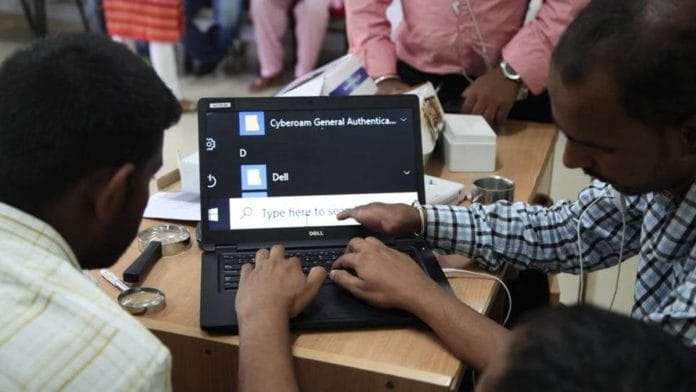



New Delhi: The CBSE has informed the Court of Chief Commissioner for Persons with Disabilities (CCPD) that it cannot provide computer access to a Class 10 student who has over 40% learning disability for his upcoming board examination, and can only provide a calculator, citing Board guidelines of 2020 and claiming adherence to internal rules.
The student in the present case suffers from dyscalculia, a learning disorder that affects a person’s ability to understand number-based information and maths, and dysgraphia, a neurological disorder that impairs written expression.
Hearing the case, the court last week directed the Central Board of Secondary Education to provide the student with a computer and calculator to enable him to appear in the examination, and to ensure full compliance with accommodations certified in the medical certificate, statutory provisions, and relevant government instructions, including a one-day prior electronic device/system check.
It also asked the Board to “sensitise the officials deployed at the examination centres about the needs of PwDs (persons with disability)”.
The Office of CCPD is a quasi-judicial body entrusted with the task of safeguarding the rights of persons with disabilities. It exercises its powers under the Rights of Persons with Disabilities Act, 2016, and comes under the Ministry of Social Justice and Empowerment.
In the 29 January, the court noted that despite the Supreme Court’s 2021 ruling in Vikash Kumar vs UPSC, which upheld the right of PwDs to reasonable accommodation and Sections 16-17 of the 2016 Act which mandate inclusive education and specific measures for PwDs, the CBSE had not complied with the same.
It was on 22 January this year that the Class 10 student from Shiv Nadar School, Gurugram, filed a complaint before the CCPD after being denied an assistive device by the CBSE, in violation of the Centre’s guidelines for conducting written exams for persons with benchmark disabilities.
By way of his plea, the boy told the court that despite providing a medical certificate from the All India Institute of Medical Sciences (AIIMS), New Delhi, which recommended him to use a computer as well as calculator on account of his physical limitations when it came to writing, he was denied the computer facility.
He submitted that his school had for the past four years allowed both facilities for such students, but the CBSE was allowing only one. The boy also said his exams were starting in 10 days, and the admit card was expected in three-four days.
According to his plea, the board’s refusal violated the ‘Guidelines for Conducting Written Examination for Persons with Benchmark Disabilities’ issued in August 2018 by the Ministry of Social Justice and Empowerment, which allow options for modes like computer, braille or assistive devices such as talking calculators.
Also Read: Why SIR is an exclusionary exercise for Persons with Disabilities
What govt guidelines say
The 2018 guidelines were introduced with the objective of having a “uniform and comprehensive policy” nationwide for PwDs writing exams.
A “person with benchmark disability” means someone with at least 40% specified disability where the specified disability has not been defined in measurable terms. Those with less than 40% disability are also included in the Rights of Persons with Disabilities Act, 2016, as long as their specified disability is defined in measurable terms, and is certified by a certifying authority. The Act recognises 21 types of disabilities.
The guidelines were to take into account improvements in technology and new avenues for persons with benchmark disabilities, so that a level-playing field could be ensured.
Significantly, the guidelines provide for extra time, scribes, readers, and lab assistants to persons having more than 40% disability, especially those who suffer from blindness, locomotor disability and cerebral palsy.
More importantly, one of these rules specifies that persons with benchmark disabilities are allowed to take exams on a computer, while adding that they can also be allowed to check the computer system a day in advance so that if there are any problems, they can be rectified.
In the present case, the boy, through his lawyers, argued that by not conceding to his request for a computer and a calculator, the CBSE was violating Clauses VIII and XIII of the 2018 guidelines.
Clause VIII states that those with benchmark disabilities should be given the option of choosing the mode of examination. Such options could range from giving it in Braille to giving it on a computer, or even by recording the answers.
Clause XIII states that candidates should be allowed to use assistive devices like a talking calculator (in cases where calculators are allowed for giving exams), tailor frame, Braille slate, abacus, geometry kit, Braille measuring tape and augmentative communication devices like communication chart and electronic devices.
Court directions
In the first hearing in the matter on 27 January, the court was informed by the CBSE that according to the CBSE Guidelines, 2020, it could only allow calculators for candidates with specific learning disabilities, but not computers.
The court, however, noted that the CBSE had not cited “any potential threat of misuse or undue burden” in providing computers, and that Section 2(y) of the 2016 Act provides that facilities like computers, calculators, and assistive devices are covered under “reasonable accommodation”.
Reasonable accommodation refers to necessary and appropriate modifications and adjustments, without imposing disproportionate or undue burden in a particular case, to ensure that PwDs enjoy or exercise of rights equally with others, the Act states.
In the present case, when the court asked the CBSE if there was any potential for misuse of such facilities, it noted that “the (CBSE) representative could not respond to these queries except stating that the CBSE guidelines do not allow extending the facility of computers”.
The court has now directed the CBSE to ensure that the legal rights and reasonable accommodation of the complainant are not denied. An action report should also be submitted by the CBSE within 90 days, and if it does not comply with the directions, it has to convey reasons for not doing so within three months.
(Edited by Nida Fatima Siddiqui)
Also Read: DPDP Act offers no special protection for disability data. It leaves PwDs vulnerable