







New Delhi: Showing off his wealth with all the swagger of a don, he influences youngsters on social media, promising them a slice of life abroad before recruiting them for petty sums.
His recruitment is religion-agnostic, with easily replaceable trainees, many with no criminal background, making them harder for law enforcement to trace.
ISI-backed Shahzad Bhatti’s expanding footprint has become a headache for agencies because the network has no experts, hardened criminals or history-sheeters. Instead, it relies on random individuals—from MBA degree-holders from foreign universities to labourers, carpenters, delivery boys and the completely uneducated—willing to carry out tasks for as little as Rs 10,000–15,000.
Their tasks? Installing CCTV cameras for espionage, attacking police stations with grenades and carrying out targeted killings of policemen in Punjab.
“Bhatti radicalised and recruited youths through social media platforms and encrypted communication channels. Investigation by agencies has revealed that he would assign tasks through handlers, including asking youngsters to install CCTVs at critical security installations, whose live feeds were then transmitted to Pakistan,” the source said.
Such CCTV systems were found in places like Kaurthala, Bikaner, Alwar, Ambala, Patiala, Jalandhar, Pathankot and Kathua.
“He also engaged youths to throw grenades at police stations. In one such case, the accused was found to have remained in touch with the handler during the planned attack,” the source said.
A multi-state operation was carried out on 12 August to thwart disruptions planned around Independence Day by the Bhatti network, using a real-time intelligence-sharing system in coordination with state police forces.
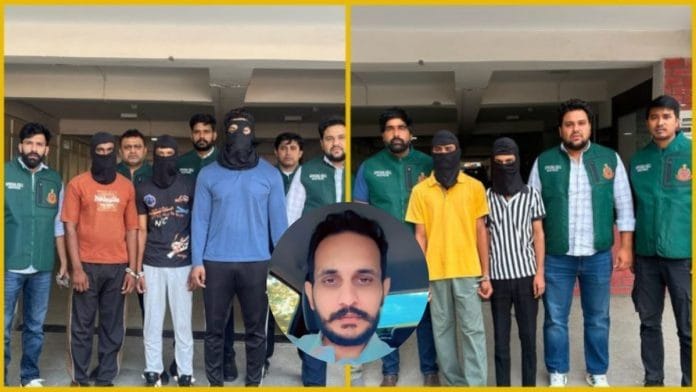
More than 200 people were arrested across 14 states in connection with 80 FIRs, thwarting the ISI-backed Shahzad Bhatti network’s plans for “subversive attacks” ahead of Independence Day, the government said Monday.
According to a statement by the Ministry of Home Affairs (MHA), substantial recoveries were made including IEDs, grenades bearing Pakistan Ordnance Factory markings, pistols, live cartridges and CCTV cameras allegedly used for espionage.
Cumulatively, more than 80 FIRs have been registered under the UAPA, BNS, Arms Act, NDPS Act and Explosive Substances Act, according to the statement.
‘Need to know rule’
According to the source, Bhatti uses social media to project himself as a wealthy businessman and philanthropist while promoting a ‘don’ culture.
“Religion is no basis for recruitment to the Bhatti network. There are several Hindus in his network. He deliberately uses expendable recruits. If one module fails, he can instantly replace the youth, as there are so many people hired through his handlers for petty sums and different tasks,” the source said.
The biggest challenge for agencies, sources said, is that these recruits are not connected to one another and that is precisely what makes the network difficult to crack. They operate as isolated, disposable modules, recruited for small, specific tasks.
According to the source, the network strictly follows a “need-to-know” principle.
“Recruits are kept within isolated modules, while third-party operatives are used for surveillance and reconnaissance. So even if someone gets caught, they are not aware of the entire plan,” the source said.
A second source also said that the once inducted, the recruits often find it difficult to walk away and are coerced into continuing with the network.
‘Money from drugs dropped by drones, firearms’
Speaking about the funds generated for these activities, the source said that it is done through sale of firearms and heroin that is dropped from across the border using drones.
“These proceeds are then disbursed, through local networks in very petty quantities, usually for Rs 10,000 to 20,000 using QR codes and mule shopkeepers to lure people on social media,” the source said.
(Edited by Viny Mishra)
Also read: 200+ arrests across 14 states: Centre says attacks by ISI-backed Shehzad Bhatti network thwarted