





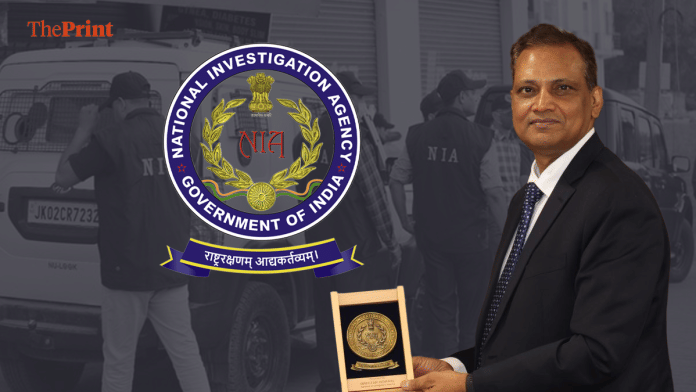



New Delhi: Among his contemporaries, IPS officer Rakesh Aggarwal was known as “Chacha Chaudhary”. The common thread was how the mind of the main character in the comic series worked faster than computers.
Officers who have worked with Aggarwal over the years, including those about two batches senior to him as well as his immediate juniors, say he has a photographic memory.
He was known among colleagues as a “no-nonsense” person and during his tenure at the CBI led a committee to identify non-performing officials. Multiple officials were handed compulsory retirements at the recommendation of this committee under Section 56(J) of the Fundamental Rules of the Government of India, which empowers the Centre to compulsorily retire any public servant in the interest of efficiency, economy, and public interest.
Aggarwal was appointed Director-General of the National Investigation Agency (NIA) Wednesday evening. He was already in charge of the agency for nearly two weeks after predecessor Sadanand Date was repatriated to his home cadre, Maharashtra.
Aggarwal will head the agency until his retirement in August 2028. An IPS officer from the 1994 batch of the Himachal Pradesh cadre, he has served for more than a decade with central agencies, including the CBI and the National Security Guard (NSG).
“The Appointments Committee of the Cabinet has approved the proposal of the Ministry of Home Affairs for appointment of Shri Rakesh Aggarwal, IPS (HP:1994), SDG, NIA, as Director General, National Investigation Agency (level-16 of Pay Matrix) from the date of assumption of charge of the post and upto 31.08.2028 i.e. date of his superannuation or until further orders, whichever is earlier,” the Appointments Committee of the Union Cabinet said in his appointment order Wednesday.
‘A workaholic’
Belonging to Haryana, Rakesh Aggarwal pursued a Bachelor’s in Mechanical Engineering and a Master’s in Management before qualifying for the Union Public Service Commission (UPSC) examination in 1993.
More than a decade after serving in the state police, he first joined the CBI on central deputation as a Superintendent of Police on a lateral transfer from the National Police Academy.
He was among the first officers to work in CBI’s cybercrime wing, which was established in the early 2000s.
Aggarwal was promoted to Deputy Inspector General in the agency and was also awarded the President’s Police Medal for Meritorious Service on Republic Day 2010.
He later led the anti-corruption branch at the agency’s headquarters during his first tenure. He went back to the cadre and was appointed Inspector General of the state police for a brief period before returning to Delhi as I-G in the NSG.
He won another President’s Medal in 2016.
Officials who worked alongside him in these agencies recall that Aggarwal was never vindictive toward his subordinates, nor did he allow proceedings against junior officers to drag on. Explaining his approach of “getting the job done” with “basic necessities”, officials recall that he was strictly against overspending government funds.
Sources said that during his second tenure with the CBI, Aggarwal was appointed Joint Director and head of the agency’s Delhi zone. Under the terms and facilities available to him as a CBI Joint Director, Aggarwal was permitted to travel on first-class tickets.
As head of the Delhi zone, he was a frequent traveller to the agency’s Jaipur and Jodhpur offices. Aggarwal insisted on not booking first-class tickets when the difference between economy and first class was manifold. “He rather snapped at officials managing his travel bookings if the difference in fare was five or six times. He also disapproved of the arguments of his subordinates, who countered him by saying that he was entitled to it,” said an official who worked with him, requesting anonymity.
“He is a fine human being, with compassion for his colleagues and subordinates. He trusts his team completely and also comes up with his own ideas and solutions when complications arise. He has been a workaholic officer in all the years I have known him, in charge of key roles,” another official said.
Aggarwal rose through the ranks to become the Additional Director General of the counterterrorism agency, a role he assumed in September 2024.
He was later appointed Special Director General last year, making him the de facto chief after Date’s premature repatriation to Maharashtra.
High-profile probes and a series of extensions
While serving as an Inspector General in the Border Security Force (BSF), Aggarwal was reassigned to the CBI as a Joint Director in March 2019. By then, the agency was investigating a corruption and abuse-of-power case involving a Delhi government minister.
The agency had in May 2018 booked Satyendar Jain and PWD officials such as Sarvagya Kumar Srivastava, the then Engineer-in-Chief, Manu Amitabh, the then Principal Director, A.K. Pait, the then Deputy Director, P.C. Chanana, the then Project Manager under 120-B (criminal conspiracy) and provisions of the Prevention of Corruption Act, 1988.
There were allegations against Jain and other officials that a 17-member team of consultants was hired through a third-party company, Soni Detective & Allied Services Pvt Ltd, by manipulating the tender process and bypassing established procedures.
It was also alleged that the eligibility criteria for hiring these consultants was diluted and that their payments were charged to unrelated projects without prior approval from the finance department.
However, after examining up to nine aspects of the allegations made by the Delhi Department of Vigilance, the agency filed a closure report in April 2022, giving Jain and others a clean chit. A Delhi court in August last year accepted the CBI’s closure report, highlighting no criminality in the recruitment process despite the Delhi Department of Vigilance opposing the move. Aggarwal was serving as a Joint Director during the investigation and subsequent submission of the closure report on extension.
His posting was extended for two years, from September 2020 to September 2022.
He received three additional extensions as CBI Joint Director: six months in September 2022, three months in March 2023, and an equivalent period in June 2023.
However, just a month before his extension in September 2022, the CBI booked the then Delhi deputy CM Manish Sisodia, the party’s campaign in-charge Vijay Nair and others on charges of irregularities in the process of drafting the excise policy for the NCT of Delhi. Sisodia was also arrested by the CBI in February 2023, when Aggarwal was Joint Director.
Over the next two years, Sisodia, then Delhi chief minister Arvind Kejriwal, among others, were arrested in what came to be known as the Delhi excise policy case.
“He always [Aggarwal] stays true to the facts of the case, and it was exemplified in the clean chit to Jain and probe by the CBI in the excise policy case,” an official privy to his track record told ThePrint. Aggarwal also oversaw pending corruption cases related to the 2010 Commonwealth Games held in Delhi, sources added.
Sources also said that during the DG/IG Conference held in Raipur in November last year, Aggarwal presented a paper on steps to be taken to extradite fugitives accused of involvement in terrorist attacks.
(Edited by Amrtansh Arora)
Also Read: In Anmol Bishnoi remand plea, NIA cites 2015 murder of a gangster in broad daylight