





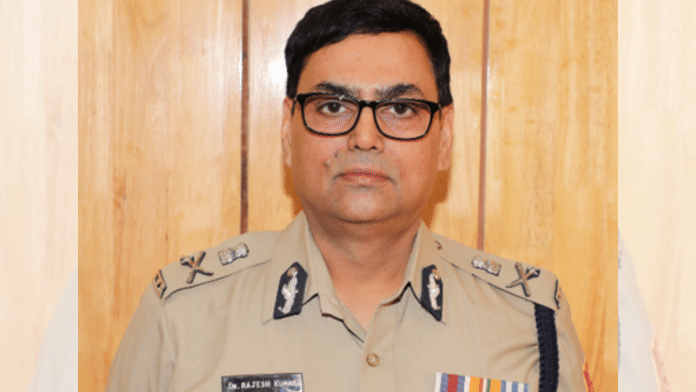



New Delhi: The Central Administrative Tribunal (CAT) has given a sliver of hope to 1990-batch West Bengal-cadre IPS officer Rajesh Kumar, who could lose the chance to head the state’s police force due to “administrative delay” that comes amid fraught ties between the Bengal government and the Centre.
West Bengal does not have a full-time Director General of Police (DGP) since December 27, 2023, after Manoj Malviya retired. Rajeev Kumar, acting DGP who is considered close to Chief Minister Mamata Banerjee, is due to retire on 31 January.
Kumar, currently serving as Principal Secretary, Department of Mass Education Extension and Library Sciences, is due to retire on 31 January, 2026. He was one of three senior Indian Police Service (IPS) officers eligible to be West Bengal DGP when the post fell vacant on 27 December, 2023. The officer had more than six months of service left at that time, a mandatory requirement to be eligible for the post.
But delay, first on the part of the Bengal government to send its proposal containing names of officers empanelled for the post of DGP to the Union Public Service Commission (UPSC), and then on the part of the UPSC in calling a meeting of the empanelment committee, jeopardised Kumar’s chances to be considered for appointment to the top post.
Kumar was forced to knock on the doors of the CAT’s principal bench in New Delhi last December seeking relief.
In its interim order issued Wednesday, the CAT has come to Kumar’s rescue and given deadlines to the state and UPSC to fast-track the process to appoint a full-time DGP.
First, it has directed the West Bengal government to resubmit the proposal for empanelment to the post of DGP to the UPSC on or before 23 January.
Secondly, it has directed the UPSC to convene a meeting of the empanelment committee on or before 28 January and prepare the panel of shortlisted candidates for the DGP’s post and forward it to the state government on or before 29 January.
The tribunal has further directed the West Bengal government to take an appropriate decision regarding appointment from the panel (of shortlisted candidates) received from the UPSC “as expeditiously as possible”.
The UPSC, in its response, said that there has been no delay on their part from the time the proposal was submitted to them by the West Bengal government on 16 July, 2025. “On examination of the proposal, certain deficiencies were observed which were communicated to the state government vide letters dated 12.08.2025. In response, the state government furnished the reply finally vide letter dated 25.09.2025 only, hence, proposal was complete 25.09.2025, there was no delay on the part of the Commission.”
The Commission said that the DGP’s post fell vacant on December 2023 and as per the SC guidelines, the state government had to sent the proposal for empanelment at least three months in advance.
“As the proposal was received with a delay of about 1½ years, the UPSC vide letter dated 31.12.2025, returned the proposal to the State Government with an advice to seek leave or clarification from the Supreme Court. Such inordinate delay has a substantial impact on the eligibility list. Moreover, the Commission has decided to follow this uniformly for all states.”
ThePrint has mailed West Bengal Chief Secretary Nandini Chakraborty with queries on the matter. This report will be updated as and when a response is received.
Also Read: HC asks Telangana to explain why IPS officers hold IAS posts. Case could stir up the services’ net
How matter unfolded
Kumar had filed an application before the CAT last December through senior counsel Sanjoy Ghose, in which he said that the state sent its proposal, comprising names of 10 IPS officers including his own, for empanelment to the UPSC only on 16 July last year—19 months after the DGP post fell vacant.
This was a violation of the 2023 UPSC guidelines formulated following the Supreme Court’s 2006 order in Prakash Singh and others vs Union of India and others, mandating states to send a proposal to the UPSC for convening the empanelment committee meeting at least three months prior to the vacancy.
It was not just the West Bengal government that delayed the appointment process.
The UPSC also did not act promptly. Ghose informed the CAT bench that though the UPSC received the proposal from West Bengal on 16 July, 2025, it convened the empanelment committee meeting only on 29 October, 2025—more than three months later.
“The applicant submits that he is due to superannuate on 31.01.2026 and that any further delay in preparation of the panel would cause serious and irreversible prejudice to his right to be considered for appointment to the said post,” the interim order reads.
Ghose told the tribunal that on 31 December, 2025, the UPSC communicated to the West Bengal Chief Secretary that it is returning the state’s proposal on account of delay and violation of the Supreme Court’s order in Prakash Singh. This further jeopardised Kumar’s case, who then had a month left for his retirement.
The UPSC’s 31 December communication to the Chief Secretary was challenged by Ghose.
In its interim order, the CAT has held that the right to be considered for promotion is a fundamental right, and in the present case, prolonged inaction by the UPSC cannot be ignored.
The case has been listed for next hearing on 11 March.
The West Bengal government and the Centre share a fractious relationship, which has worsened in the run up to the state elections scheduled for April-May this year. Many state cadre bureaucrats have got caught in this crossfire in the recent past, losing their right to be considered for appointment to top posts like the DGP.
Ghose told ThePrint that since 2023, as many as 43 officers have retired without being considered for top posts.
This is an updated article with UPSC’s response
(Edited by Nida Fatima Siddiqui)
Also Read: All IAS, IPS officers can’t reach top positions. Many perks, few drawbacks is nature of the job