





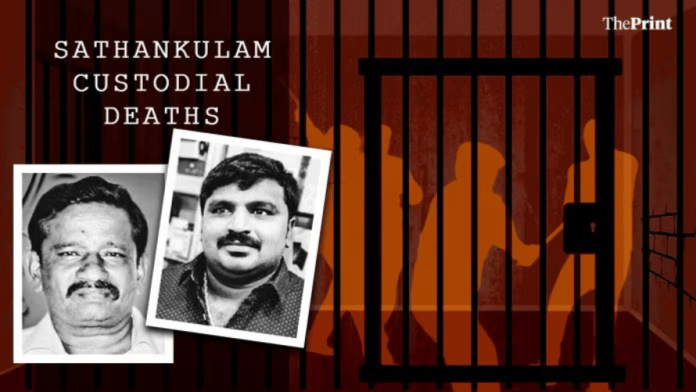



Chennai/Thoothukudi: In a rare order, a Madurai court has sentenced nine Tamil Nadu police personnel to death in the 2020 custodial killing of a father–son duo in Sathankulam, a case that had sparked nationwide outrage and condemnation.
Judge G. Muthukumaran of the First Additional District and Sessions Court in Madurai put the case in the ‘rarest of rare’ category, citing extreme abuse of power, sustained torture, and the betrayal of public trust by those meant to uphold the law.
The nine police personnel were convicted on 23 March and the quantum of punishment was pronounced Monday, six years after P. Jeyaraj and his son J. Bennix died in Sathankulam, Thoothukudi, in June 2020, following their arrest for allegedly violating COVID-19 lockdown norms.
The Sathankulam Police had arrested the mobile phone shop owners for allegedly keeping their shop open beyond the permitted hours.
The court found the duo was subjected to brutal assault at the police station. They were later remanded to Kovilpatti sub-jail, where both succumbed to their injuries.
On 22 June, the family was informed that Bennix died at the government hospital, with Jayaraj dying the next day. The deaths sparked widespread outrage over allegations of torture in police custody.
Following public pressure and intervention by the Madras High Court, the case was handed over to the Central Bureau of Investigation (CBI).
After a trial spanning over six years, the court had on 23 March 2026 convicted the nine policemen, including Inspector S. Sridhar who was the prime accused, sub-inspectors, and other personnel.
On 6 April, the court awarded death sentences to the convicts and ordered Rs 1.40 crore in compensation to the victims’ families. The court noted that the victims had no prior criminal record and highlighted evidence of fabricated cases and destruction of proof.
Also Read: 24 deaths since 2021, no convictions: Custodial violence has left a blood trail in Tamil Nadu
‘Will fight till the end’
The family welcomed the verdict with a mix of relief and hope for deterring such incidents in the future. Bennix’s elder sister J. Persis told the media the court order ends their six-year wait for true justice.
“We express our gratitude to all the members of the public, political organisations, local residents, and the media who stood by us and supported us throughout this process,” Persis said.
“Those who carry out such barbaric acts should be scared. We believe that this verdict will serve as a safeguard, ensuring that such an atrocity never occurs again. If they go to appeal, we will go too. We will fight till the very end.”
With the verdict coming about a month before Tamil Nadu goes to polls, it has also drawn sharp political reactions with the ruling Dravida Munnetra Kazhagam hitting out at the All India Anna Dravida Munnetra Kazhagam (AIADMK), which was in power in 2020.
Tamil Nadu Congress president K. Selvaperunthagai welcomed the verdict, crediting the CBI probe and the cooperation extended by the current DMK government under Chief Minister M.K. Stalin.
He asked AIADMK general secretary and former chief minister Edappadi K. Palaniswami, who was in power when the incident occurred, to publicly apologise for the “police high-handedness” and “incompetent” handling under his regime.
Selvaperunthagai clarified that he does not support the death penalty, but believed strong punishment was essential to uphold justice in this grave case. He strongly condemned the “brutal murder” of two innocent people and drew parallels with another custodial death—Ajith Kumar case in 2025—stating the DMK government has shown consistent commitment to accountability.
The ruling DMK had earlier highlighted the verdict as evidence of its proactive approach compared to the previous AIADMK dispensation.
Speaking after the Madurai court had pronounced the conviction last month, Tamil Nadu Law Minister S. Ragupathi had said the conviction exposed the “falsehoods” spread by the previous AIADMK regime under Palaniswami.
He specifically pointed to Palaniswami’s statement in which the two deaths were attributed to “breathing difficulty” and “ill health”.
Ragupathi had said the conviction verdict “brought to light the falsity of those claims”. He accused the AIADMK government of attempting to “shield the accused police personnel by presenting misleading explanations and downplaying the incident”.
The AIADMK, however, had said the DMK had no moral authority to speak on the issue.
“It was Edappadi Palaniswami who ordered a CBI inquiry into this case. The DMK has no moral authority to speak on this issue, especially when multiple custodial deaths have occurred under its regime,” AIADMK spokesperson Kovai Sathya had told ThePrint then.
He further alleged that incidents such as the deaths of Vignesh and Ajith Kumar reflected a pattern of custodial violence being downplayed.
Vignesh (25) died in police custody in April 2022 in Chennai after being arrested in a narcotics case. A post-mortem report found 13 injuries on his body, contradicting police claims that he died from a seizure. The case raised serious concerns about custodial violence and led to further investigation.
Ajith Kumar, a temple security guard from Sivaganga district, died in police custody in June 2025 after being detained in a jewellery theft case. He was allegedly assaulted during interrogation, and a post-mortem revealed multiple injuries and internal bleeding. His death intensified scrutiny over custodial practices in Tamil Nadu.
“The DMK cannot claim credit for the Sathankulam case. It was Edappadi Palaniswami who provided government jobs to the bereaved family,” Sathya said, adding he hoped the verdict would ensure justice for the victims’ family.
The incident
Jayaraj, a resident of the Sathankulam town, was picked up by the Sathankulam Police on 19 June 2020 around 8 pm, when curfew began in view of the Coronavirus lockdown.
Soon after, his son Bennix visited the police station. Bennix was later called inside the police station and no one was allowed to meet them after this. The police said Jayaraj and Bennix had died at the Kovilpatti Government Hospital, about 100 kilometres from Sathankulam.
The CBI’s forensic report showed that both were tortured for about seven hours on the night of 20 June, according to the inquiry report, a copy of which is with ThePrint.
Autopsy reports revealed that Jayaraj had sustained at least 17 injuries and Bennix 13 injuries. They both suffered severe blood losses.
DNA samples collected from the lock-up walls, toilet, and lathis at the Sathankulam police station matched those of the victims. The inquiry report further said the two men were forced to clean up their own blood with their clothes and made to change multiple times as the garments became soaked in blood.
The blanket, given to them to sit on while being transferred to the Kovilpatti sub-jail, got stained with blood despite changing their clothes. The CBI found that 11 sticks in total had been used to assault the victims, including two lathis and a plastic pipe, as per the chargesheet.
The blanket, given to them to sit on while being transferred to the Kovilpatti sub-jail, got stained with blood despite changing their clothes.
As per the inquiry report, friends who saw Bennix and Jayaraj shortly after described them as being covered in blood, in extreme pain, and unable to even sit properly. Despite their critical condition, they were allegedly pushed through legal procedures without being able to speak freely before a magistrate, reportedly due to police intimidation.
The CBI in its inquiry report said that medical attention was delayed and inadequate, and within days, both men died—Bennix on 22 June 2020, and Jayaraj the following day—due to severe internal injuries.
The case exposed police brutality through post-mortem reports, witness statements, and trial evidence indicating the victims were subjected to prolonged physical abuse, with torture corroborated by medical findings and DNA matches on lathis.
The incident drew widespread attention across Tamil Nadu. Public pressure led to the transfer of the investigation to the CBI.
Deaths initially blamed on Covid
Jaba Singh, the counsel representing the father-son duo, had said they faced resistance from the police since the very beginning, noting that even registering a murder case under Section 302 took significant time and sustained protests.
“The court has highlighted crucial evidence, including DNA matches between the bloodstains on the lathis and the victims. The judge has also directed the Central and state governments, along with a probation officer and a psychiatrist, to submit reports regarding the convicts,” he said.
The post-mortem report revealed that the deaths were not due to COVID-19 infection but the result of severe physical abuse. The medical findings also indicated that the victims were subjected to extreme violence, including being attacked while restrained on a table. They were assaulted with rod-like objects, with their hands tied.
According to evidence produced during the trial, police personnel allegedly made remarks as they assaulted them, including statements suggesting they were using the victims to “practice” their methods of beating.
The convicts
The accused in the Sathankulam custodial deaths case were all serving police personnel from the Sathankulam police station.
Ten police personnel were initially arrested, including inspector S. Sridhar, sub-inspectors K. Balakrishnan and P. Raghu Ganesh; head constables S. Murugan and A. Samadurai; and constables M. Muthuraj, S. Chelladurai, X. Thomas Francis, S. Veilumuthu and special sub inspector P Paldurai.
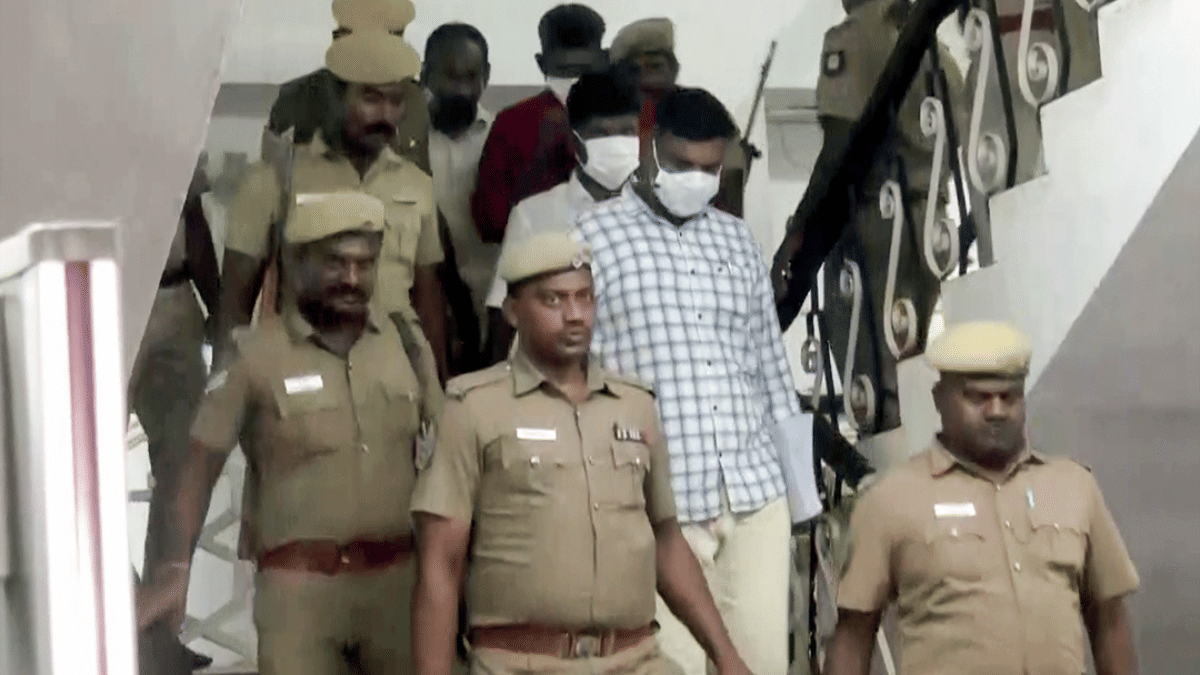
Inspector Sridhar was said to be the prime accused.
One of them, Special Sub-Inspector Paldurai, died during the course of the investigation, after which the CBI proceeded against the remaining nine accused. The charges included murder, criminal conspiracy, wrongful confinement, and destruction of evidence.
The case involved an extensive investigation by the Central Bureau of Investigation (CBI), which examined 105 witnesses and filed a 2,427-page chargesheet. The court confirmed that the injuries sustained by the victims were the result of police assault, and questioned why the victims had been transported in a private vehicle instead of an official police vehicle.
Low conviction rate
Tamil Nadu police records show 24 custodial deaths in the state since 2021. It also shows zero convictions in custodial death cases between 2017 and 2022.
Speaking to ThePrint after the pronouncement of conviction on 23 March, human rights activist Evidence K. Kathir had described the verdict as significant, though delayed, noting that such convictions in custodial death cases remain rare.
“While this is a belated judgment, it is a welcome one,” he had said, adding that stronger legal action—such as consistently invoking murder charges under Section 302 of the IPC in such cases—is necessary to ensure accountability.
Kathir also said the conviction in this case was possible largely due to the presence of multiple witnesses, and added that any appeal against the judgment must be met with firm opposition.
Several cases of custodial violence in Tamil Nadu after the Sathankulam incident drew political and social attention.
In 2021, A. Murugesan, a fruit stall owner from Salem’s Edayapatti, died following alleged torture. In 2022, Vignesh, a 25-year-old Dalit balloon seller from Chennai, died after alleged torture, with the autopsy showing 13 injuries including a leg fracture.
Four custodial deaths occurred in Madurai, Viluppuram, Chennai and Virudhunagar districts within 12 days in April 2024.
In June 2025, B. Ajith Kumar, the 27-year-old temple guard, died after interrogation in a theft case at Sivaganga police station, with the autopsy revealing 44 injury marks, five policemen were arrested and the case was transferred to the CBI by Chief Minister Stalin.
The most recent case is of the death of 26-year-old Akash Delison from Sivagangai in March 2026, who died after allegedly being subjected to custodial violence.
This is an updated version of the story.
(Edited by Ajeet Tiwari)