





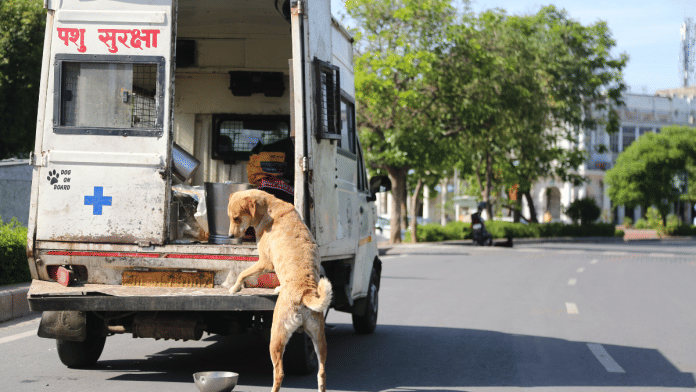



New Delhi: Even as the Supreme Court continues hearing a batch of petitions on the issue of stray dog management, at least four state governments have written to the Centre expressing strong objections and concerns with regard to the Standard Operating Procedure (SOP) meant for implementation of the court order to move stray dogs to shelters.
On 7 November, 2025, the Supreme Court asked the Centre and states/UTs to immediately remove all stray dogs from railway stations, schools, hospitals, bus stops and other public areas, and relocate them “to a designated shelter”.
Subsequently, the Animal Welfare Board of India (AWBI) issued SOPs to all state governments in compliance with the order on 27 November, 2025.
In separate letters accessed by ThePrint, the governments of Uttar Pradesh, Rajasthan, Uttarakhand and Jammu and Kashmir have, however, written back to the AWBI flagging administrative and budgetary infeasibility of the SOP, unreliability of data on dog bites, confusion stemming from serious discrepancies between existing rules and the new directions, fear of outbreaks of zoonotic diseases, and concerns over animal cruelty.
The governments of Rajasthan, Uttarakhand and Jammu and Kashmir have argued that there is no reliable data to establish whether there is indeed an increase in cases of dog bites, and conjectures to this effect have been based on unreliable media reports.
“Number of dog bite cases are not reliable as data is formed on the basis of anti-rabies shot and not for every single dog bite case,” the governments of Rajasthan, Uttarakhand and J&K have written in their letters.
“Secondly, it (data) does not differentiate the cases of dog bite between stray and pet dogs,” they added.
Governments of Rajasthan and J&K have further said that as a result, “conjectures have been drawn on the basis of social and electronic media reports which cannot be relied on.”
For every case of dog bite, five anti-rabies shots are given.
Moreover, the state governments have questioned the methodology deployed to calculate the space requirement needed to provide shelter to the dogs as per the SOP, with the UP government stating that even breeders are legally bound to provide more space to dogs than prescribed by the AWBI in its SOP for permanent housing of dogs.
“The space prescribed in SOP for the permanent housing of dogs at designated locations is even smaller than the standards prescribed under the ‘Dog Breeding and Marketing Rules, 2017’,” the letter by the UP government dated 24 December, 2025 states.
It adds, “Housing dogs in such limited spaces will not only increase their aggressiveness but also heighten the risk of infectious diseases.”
“This may amount to animal cruelty and could give rise to legal and administrative challenges for the State government,” the letter states.
The governments of Rajasthan, Uttarakhand and J&K, have similarly stated, “It is not clear, how the space requirement has been calculated and has been challenged by many organizations on scientific grounds as will result in overcrowding and will lead to many infections and avoidable deaths.”
Further, they have said that the AWBI has not provided space for circulation of the animals, space for feeding, separate spaces for dogs with rabies and distemper, among other specifications needed for any shelter to operate.
Also Read: 110 dog carcasses found buried in Telangana, sarpanch among 9 booked
Questions of staff, training, budget
In its SOP, the AWBI simply stated that the number of caretakers should be assigned to each shelter as per the requirement for waste management, and that the shelter must be cleaned twice every day to avoid spread of infection and better waste management.
However, the state governments have questioned where the trained staff for this purpose will come from. The AWBI, the state governments have said, will need to create training institutions in every state for it.
“Waste management at animal shelter require specially trained staff. AWBI needs to create training institutions in every state for capacity building of staff at animal facilities a now facilities are to be created in every ULB (Urban Local Body) and RLB (Rural Local Body) also,” they have said.
Echoing concerns of zoonotic outbreaks expressed by medical experts, the state governments have also said, “SOP needs to be detailed on cleanliness of these shelters where cases of distemper require a specific cleaning protocol to prevent outbreak of communicable fatal diseases.”
“Waste management at animal shelter require specially trained staff. AWBI needs to create training institutions in every state for capacity building of staff at animal facilities a now facilities are to be created in every ULB (Urban Local Body) and RLB (Rural Local Body) also,” the governments of Rajasthan and J&K said in their letters.
Echoing concerns of zoonotic outbreaks expressed by medical experts, the governments of Rajasthan and J&K also said, “SOP needs to be detailed on cleanliness of these shelters where cases of distemper require a specific cleaning protocol to prevent outbreak of communicable fatal diseases.”
The SOP by the AWBI states that the jurisdictional municipal corporation or local bodies as the case may be, after removing dogs, shall ensure all the dogs have been sterilised before putting them in the shelter.
In this regard, if the sterilisation center is not available, they may take the help of the local veterinary hospitals under the administrative control of the animal husbandry department or take any help of civil societies or organisations or trust volunteering for the sterilisation programme.
However, the state governments have pointed out that the above mentioned SOP contradicts existing rules.
The governments of Rajasthan and J&K stated, “AWBI has to clarify if this SOP overrides the ABC rules in force as on today, as SOP contradicts the ABC Rules completely.”
Uttarakhand government, on the other hand, pointed to difficulties with state-run veterinary hospitals performing this work. “It is very difficult to perform this activity at local veterinary hospitals as the function requires a standard structure/facility to perform the work,” it said.
Adding, “Government veterinary hospitals are over burdened in their work so birth control should be kept separated. And for this local bodies should d manage a full time veterinarian at their own level.”
Further, the AWBI SOP states that sterilized dogs, after recovery, shall be vaccinated against rabies, and that the vaccination shall continue every year at least for five years.
However, state governments have said that “Creation of this kind of capacity will have huge budgetary and space constraints.”
Moreover, raising questions of legal inconsistencies, the state governments have asked if “this SOP overrides the ABC (Animal Birth Control) rules in force as on today, as SOP contradicts the ABC Rules completely”.
In its letter, the government of UP has expressed the same issue of legal inconsistency. “Several provisions of the said SOP are inconsistent with the ‘ABC Rules, 2023,’ and the ‘Revised ABC Module 2025,’ particularly regarding sterilization-vaccination procedures and kennel standards.”
“Different rules prescribing different protocols at the same time may create confusion at the implementation level,” it has further stated.
It has also categorically said that local bodies in a large state like UP “do not have the necessary resources and basic infrastructure” for ensuring total exclusion of animals and installing fencing in religious and public places.
(Edited by Amrtansh Arora)
Also Read: British Raj determined what kind of dog was acceptable in India—pets vs strays
A sensible article finally !!! The state govts do not have the money, the manpower or the ability to erect and manage such a large money of shelters. What’s truly amazing is, no SC judge, including the one on line to be CJI can understand this, get this or fathom this !!! Truly scary and completely inhumane