








New Delhi: A parliamentary standing committee report tabled Wednesday raised concerns over staffing at Archaeological Survey of India monuments, the condition of Hyderabad’s Charminar, stalled restoration at Bodh Gaya, the demolition of colonial-era heritage structures, and the absence of a plan for the Yuga Yugeen Bharat Museum, proposed at the Central Secretariat’s North and South Blocks in New Delhi.
The Standing Committee on Transport, Tourism and Culture, in its report on the Ministry of Culture’s budget for 2026-27, noted that ASI-designated protected monuments have no staff physically present at sites. Presenting oral evidence, panel members raised concerns that a lack of personnel meant monuments were being used as “relieving spots (urination)”.
According to the report, the ASI maintains 3,685 centrally protected monuments across 38 regional circles.
The staffing shortage is not limited to ASI; the committee’s report noted that all departments within the Ministry of Culture are experiencing severe shortages. The Indira Gandhi Rashtriya Manav Sangrahalaya in Bhopal—an institution under the ministry—has 30.51 percent of its posts vacant and displays only 26 percent of its collection.
These figures come from a 2024 Comptroller and Auditor General report. The ministry has not submitted a final response to the CAG report, so far.
The parliamentary committee called the non-submission of action taken notes “a serious matter” and set a 90-day deadline for compliance.
Also Read: Sheila Dikshit to Kejriwal, every CM pledged to fix Old Delhi. Now BJP wants NDMC-like teeth
Flagged gaps
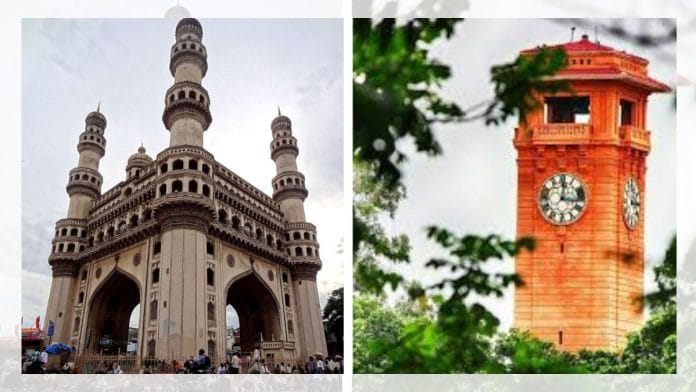
Regarding Hyderabad’s Charminar—an ASI-listed heritage structure built in 1591 by Muhammad Quli Qutb Shah—the panel noted that the area behind the monument was being used as a urinal and requested details from the ministry on immediate measures taken.
At Bodh Gaya—one of Buddhism’s holiest sites and a UNESCO World Heritage Site since 2002—Rs 1.68 crore was deposited in 2014 for a restoration project at the temple complex. However, no work has been initiated and materials have been lying unused at the site for over a decade. Noting this, the parliamentary committee directed the ASI to resolve the matter and submit a status report.
The panel’s report also flagged the demolition of 74 district collectorate buildings. Many of these structures date to the British colonial period and are not under ASI protection, leaving them outside the purview of heritage law.
The panel also cited a 150-year-old building in Darbhanga, the Patna clock tower, and churches and chapels in Goa as examples of heritage at risk. Sasaram Fort in Bihar—built by Sher Shah Suri in the 16th century and the site of his tomb—was cited as an example of current neglect, receiving neither maintenance nor protection.
The panel recommended that the culture ministry prepare an inventory of non-ASI heritage structures at risk in coordination with state governments. Further, the ministry was asked to examine whether provisions were needed to penalise the defacement or destruction of cultural property.
Moreover, the panel called for coordination with the ministries of defence, railways, civil aviation, and ports, shipping, and waterways to preserve heritage assets in their custody, including rail engines, ships, and aircraft.
Regarding the proposed Yuga Yugeen Bharat Museum, the parliamentary committee noted that the culture ministry did not furnish a detailed project plan, timeline, or budgetary breakdown when its representatives appeared before the committee for oral evidence on the Demands for Grants 2026-27 in February this year.
The proposed Yuga Yugeen Bharat Museum, which translates loosely to “India through the ages”, is the government’s proposed national museum intended to showcase Indian civilizational history from prehistoric times to the present. It is to come up in the North and South Blocks of the Central Secretariat, which housed the Finance and Home Ministries respectively. The offices are being shifted to buildings newly constructed under the Central Vista redevelopment project, which has also involved the reconstruction of the Parliament building and a redesign of the area around Kartavya Path.
The government has positioned Yuga Yugeen Bharat as India’s answer to institutions such as the Smithsonian in Washington or the Louvre in Paris. The North and South Blocks, designed by Herbert Baker and completed in 1927, are themselves heritage structures. Converting them into a museum would require substantial interior reconfiguration while preserving their facades.
The parliamentary committee formally called for a project plan covering timelines, institutional arrangements for curatorial and administrative management, and a strategy for sourcing collections.
The parliamentary committee report noted that the ministry’s earlier submissions highlighted the Light and Lotus exhibition at Qila Rai Pithora as the museum’s intended quality standard. The exhibition showcases the Piprahwa Buddhist relics, which India repatriated from Hong Kong after 127 years. The relics, originally excavated in 1898 and believed to be among the earliest known relics of the Buddha, arrived in India on 30 July 2025. However, the ministry offered no reason for the stalled work.
Under the ministry’s proposed restructuring for the 16th Finance Commission cycle covering 2026 to 2031, the museum has been listed as a standalone scheme. The broader infrastructure scheme that covers the project involves a proposed investment of over Rs 12,000 crore over five years. The ministry earlier said that if Expenditure Finance Committee approvals are obtained, scheme funding could rise from the current Rs 569 crore to approximately Rs 2,000 crore annually.
Policies & plans
Since monuments managed by the ASI earn approximately Rs 365 crore annually in ticketing revenue, which goes to the general exchequer, the parliamentary committee has asked the ministry to propose a ring-fencing mechanism within six months. This would establish a secure, separate structure that reserves portions of the funds for designated purposes, thereby protecting or managing them for tax efficiency.
Not all 3,685 centrally protected monuments are ticketed; the ministry’s earlier submissions noted that 143 monuments currently have ticketing, with plans to expand that number to 200.
The parliamentary committee also asked for the expeditious passage of the Ancient Monuments and Archaeological Sites and Remains Act, which would make the 100- and 200-meter buffer zones around protected monuments more flexible.
The government has prepared the amendment but has not introduced it in Parliament.
Constructing or repairing any structure within 100 metres of a protected monument requires ASI permission. Regulated permission is required under the law within 200 metres.
The panel asked the ministry to ensure that ASI conservation expenditure reaches previous years’ levels by the close of the financial year. ASI conservation expenditure remained above 99 percent utilisation from 2021 to 2024, across an annual allocation ranging from Rs 270 crore to Rs 443 crore. By November 2025, the utilisation rate for the current financial year stood at 67.17 percent against an allocation of Rs 346.15 crore.
According to the ministry’s submissions, 55 centrally protected monuments now have public-private partnership souvenir shops, with plans to expand to 200 ticketed monuments from the current 143. The National Culture Fund, which channels private and corporate donations for conservation, has been restructured to a direct donor-architect model under which the ministry has empanelled 15 to 16 conservation architects. Donors can select an empanelled architect, choose a monument, and fund conservation work under ASI supervision.
The ministry also plans eight to 10 underwater archaeology expeditions in the coming financial year, collaborating with the National Institute of Oceanography, the Indian Navy, the Indian Coast Guard, and international partners. Among these expeditions is a Danish collaboration on a 17th-century shipwreck off the Tamil Nadu coast.
The panel recommended an action plan within 90 days, including a strategy for displaying the findings.
Additionally, the parliamentary committee asked the ministry to prepare a repatriation roadmap including a prioritised international inventory of Indian antiquities in foreign collections, and to develop a self-surrender portal for voluntary returns.
On repatriation, the ministry earlier highlighted that the United States has returned several objects in recent years and the Netherlands, the United Kingdom, and Germany are expected to repatriate 8 to 10 more objects in the coming months.
Regarding UNESCO World Heritage Sites, the ministry earlier noted that India currently has 44 inscribed sites, ranking sixth globally. The latest addition, in 2025, was the Maratha Military Landscapes of India.
(Edited by Madhurita Goswami)
Also Read: Qutub Minar to Sunder Nursery, Delhi is redefining nightlife. It’s not enough though