





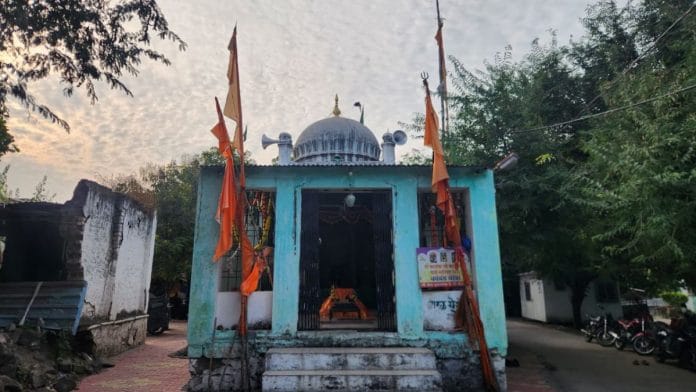



Ahilyanagar: As one enters the village of Guha, located in Maharashtra’s Ahilyanagar district about 270 km from Mumbai, an eerie sense of calm and restlessness is palpable—and so are the clouds of hostility among the residents from the Hindu and Muslim communities.
The village with a population of around 6,000 people, comprising around 1,000 Muslims, has become a flashpoint due to a dispute over a religious structure—the Hazrat Ramzan Shah Baba Dargah, or Kanifnath/Kanobha Dargah. Once frequented by both Muslim and Hindu villagers for prayers, the site is now at the centre of a communal conflict, which began over two years ago.
“We used to make around 20-30 litres of Sheer Korma for Eid in our village. Our Hindu brothers and sisters used to come and eat, and stay with us all day during the festival. On Diwali, we used to get ‘Faral (mix of sweet and savoury snacks)’ from their side. But all that has now stopped. Now, we don’t even look at each other,” says 70-year-old Shaikh Tuolek, who has lived his entire life in Guha.
Over the past two years, multiple villages in Ahilyanagar, and the city itself, have witnessed an alarming rise in incidences of polarisation. Hate speeches, calls for social and economic boycott of Muslims, and disputes over religious structures are now common in Ahilynagar, where both communities once lived in harmony.
Just last month, ahead of Diwali, the constituency’s MLA from the Nationalist Congress Party (Ajit Pawar), Sangram Jagtap called for a boycott of Muslims, urging people to buy from only Hindu shopkeepers. Local party workers even distributed saffron flags with the Hindu symbol ‘Om’ printed on them to shopkeepers to hang outside their shops to display their religious identity.
Jagtap was later reprimanded by party chief and Deputy Chief Minister Ajit Pawar. Since then, things have been relatively calmer, at least in the city.
Ahilyanagar, which was known as Ahmednagar until 2024, is said to have historical significance due to its connection with Chhatrapati Shivaji’s father Shahaji Raje Bhosale. Some historical accounts say that having remained childless for years, Shahaji’s mother had prayed to Shah Sharif pir (saint) of Ahmednagar, after which he was born, and as a gesture of respect and acknowledgment, had named Shahaji after the Muslim saint.
“Regarding Guha [dargah], the matter is pending with the Waqf board. The news I have received from some people who work for communal harmony is that there is some social boycott of Muslims but when I asked the tehsildar and the SP on ground, that situation may be tense,” Ahilyanagar Collector Pankaj Ashiya tells ThePrint.
Some political watchers say that the Bharatiya Janata Party (BJP) and the Rashtriya Swayamsevak Sangh (RSS) are to blame for the communal tensions.
“I feel this is a deliberate attempt by the BJP and RSS to polarise the district, which is otherwise known for its Leftist, progressive thought process,” analyst Jaidev Dole tells ThePrint. “All because BJP and RSS don’t have a base in the region, known as the sugar cooperative belt. This seems to be a laboratory [of Hindutva].”
Also Read: The hardliner BJP underestimated: Medha Kulkarni’s journey from sidelined MLA to Hindutva MP
The ‘boycott’
The calls for economic and social boycott of the Muslim villagers have purportedly not gone unanswered—impacting not just the adults, but also young children.
Maimuna Shaikh, aged over 60, says her grandchildren have stopped going to the village school. Her grandson, a Class 3 student, now has to go to a school located far away.
“After the issue began, we continued to send our kids to the school for a year, but they were harassed,” she claims. “They were asked to chant religious slogans, and when my grandson refused, he would be beaten up. So I decided to enrol him in a school about 45 km from here, where I have rented a room.”
Maimuna used to work as a farm labourer, but was asked to not come to work amid the tension.
Sultana Ayaz’s situation is no different. Her teenage daughter was bullied at the school in Guha, after which she was enrolled in another about 40 km away. After returning home for Diwali vacation last month, the girl refuses to go back.
“My kid was staying alone at her aunt’s place. She was forced to go there six months ago, and she is still not happy about staying away from family. Because of this atmosphere, our kids are suffering. Their careers are at stake. She is here, while her classes are ongoing, and refuses to go back. What do I do?” Sultana says.
The women say that the school principal and teacher give verbal assurances, but take no strict action against harassment.
Of the 153 Muslim families in Guha, about 11 have left the village so far, according to local residents.
Sattar Basheer, 47, used to run a grocery store there. Since the supposed boycott, Hindus have stopped coming to his shop, he claims. “This has affected my business about 80-90 percent. They want to trouble us for forcing us out of the village.”
Thirty-year-old Imran Yunus Shaikh, who ran an IT business in a rented space in Guha since 2020, says he was suddenly asked to vacate it two years ago. He had rented the place from his father’s friend, but was forced to leave. He has moved to Ahilyanagar city.
“I have left my village because they asked me to leave in 2023, when this all started. The atmosphere was so tense that I did not resist. Earlier, a person running a medical shop was also asked to vacate, and many others were asked to leave gradually,” Imran tells ThePrint.
According to the Muslim villagers, the boycott has been harsh to an extent that any Hindu individual speaking to a Muslim or employing them would face a fine of Rs 2,000.
But the Hindu villagers deny the claims. “Only young people got into these fights. Nothing else. There is no worry. I personally buy items from Muslim shopkeepers to set an example. Now other people don’t go to their shops, what do I do? Today everything is fine, but I can’t say anything about the future,” says Guha sarpanch Arunabai Ohol.
Avinash Ohol, the sarpanch’s son, tells ThePrint that the disputed dargah in question never existed in the first place. “It was always a temple. The Muslim side was only managing the place as per the Inam system that existed during the British period.”
“The villagers had peaceful relations earlier. They were spoiled about three-four years ago because they [Muslims] registered this property under Waqf board, and sought to remove the name ‘Kanifnath’.”
Avinash alleges that because of this, some Hindu villagers felt agitated and put up saffron flags, adding that someone may have said something about the Rs 2,000 fine in a fit of rage, but there was no formal resolution.
“These tensions, boycotts persisted only for the first few months after the issue arose in 2023. But I never agreed to this treatment. It has de-escalated now. And now only those who are too adamant or mischievous want to continue with this.”
But, the Muslims only partly agree. “Because of all this, there is a lot of negativity amongst us. And unfortunately, because of only 5 percent of the people, the remaining 95 percent have to stop talking to us,” says Ismail.
The hotbed
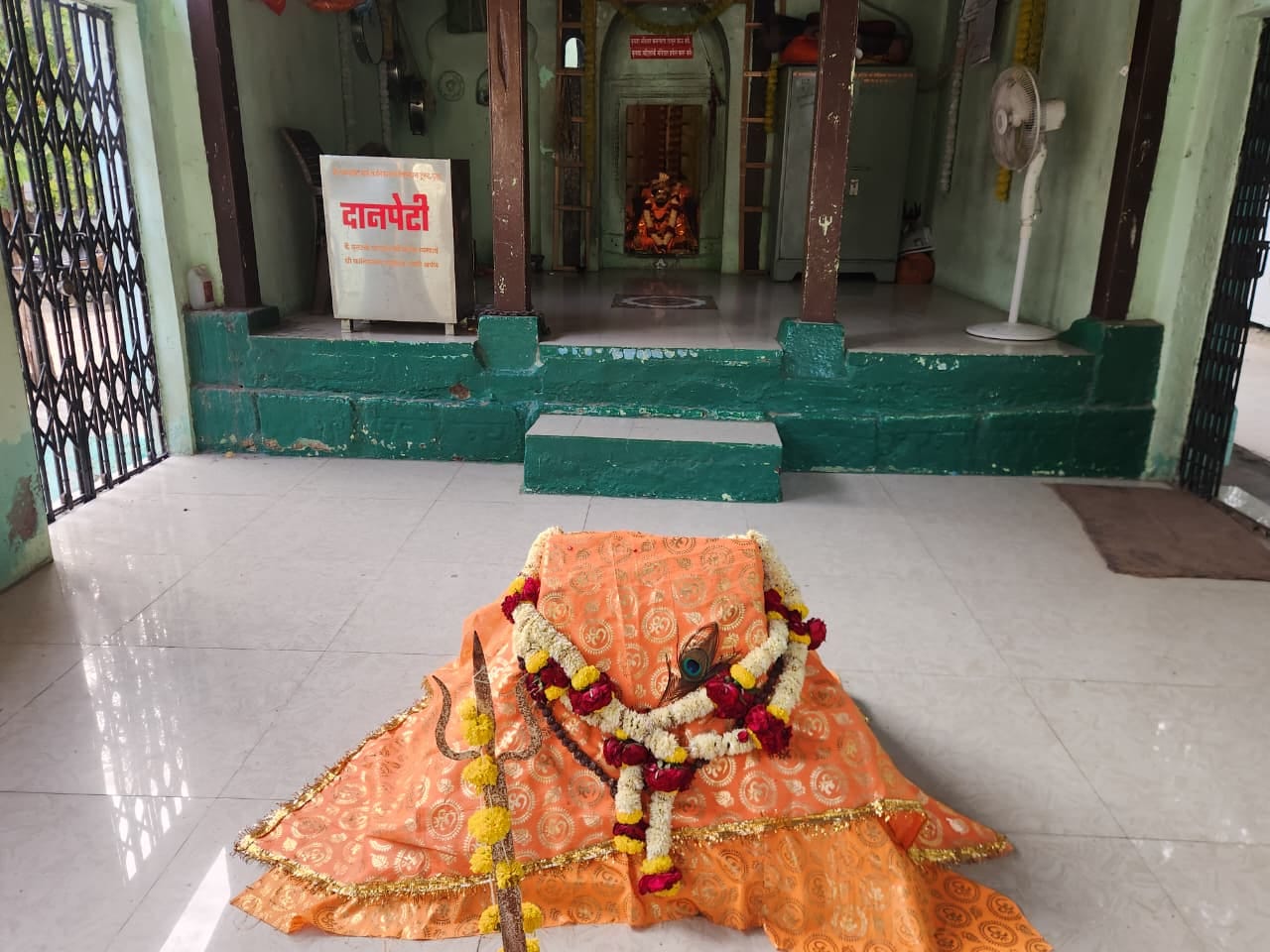
At the heart of the conflict is a centuries-old dargah, representing both the Sufi and Nath tradition (linked to Lord Shiva). The Hazrat Ramzan Shah Baba dargah, locally known as Kanifnath/Kanohba, in Guha, has held importance for both Hindu and Muslim communities, even as Muslim families took care of it for generations.
In 2022, members of the Hindu community established Kanifnath temple trust, after which puja and bhajans (devotional songs) began being regularly performed at the site. “We have documents to support that this is a temple, but the Muslim side claims it is a dargah. We have taken objection to it,” says Shreehari Ambekar, one of the trustees of the temple trust.
He claims their religious text says that with the onset of “Muslim reign”, they would need to protect the temples. “Because of this secularism, everyone would pray at the site, but they [Muslims] say everything is theirs. This won’t be tolerated,” Ambekar says.
In November 2023, a communal clash broke out when bhajans were played on loudspeakers installed at the dargah. Over 120 people were booked for rioting and promoting enmity from both sides.
According to the FIR, accessed by ThePrint, Hindu villagers alleged that the Muslim side attacked the pujari (priest) and others with rods and sticks, injuring them. The Muslims, in turn, alleged that the Hindus vandalised the dargah, and replaced green flags with saffron.
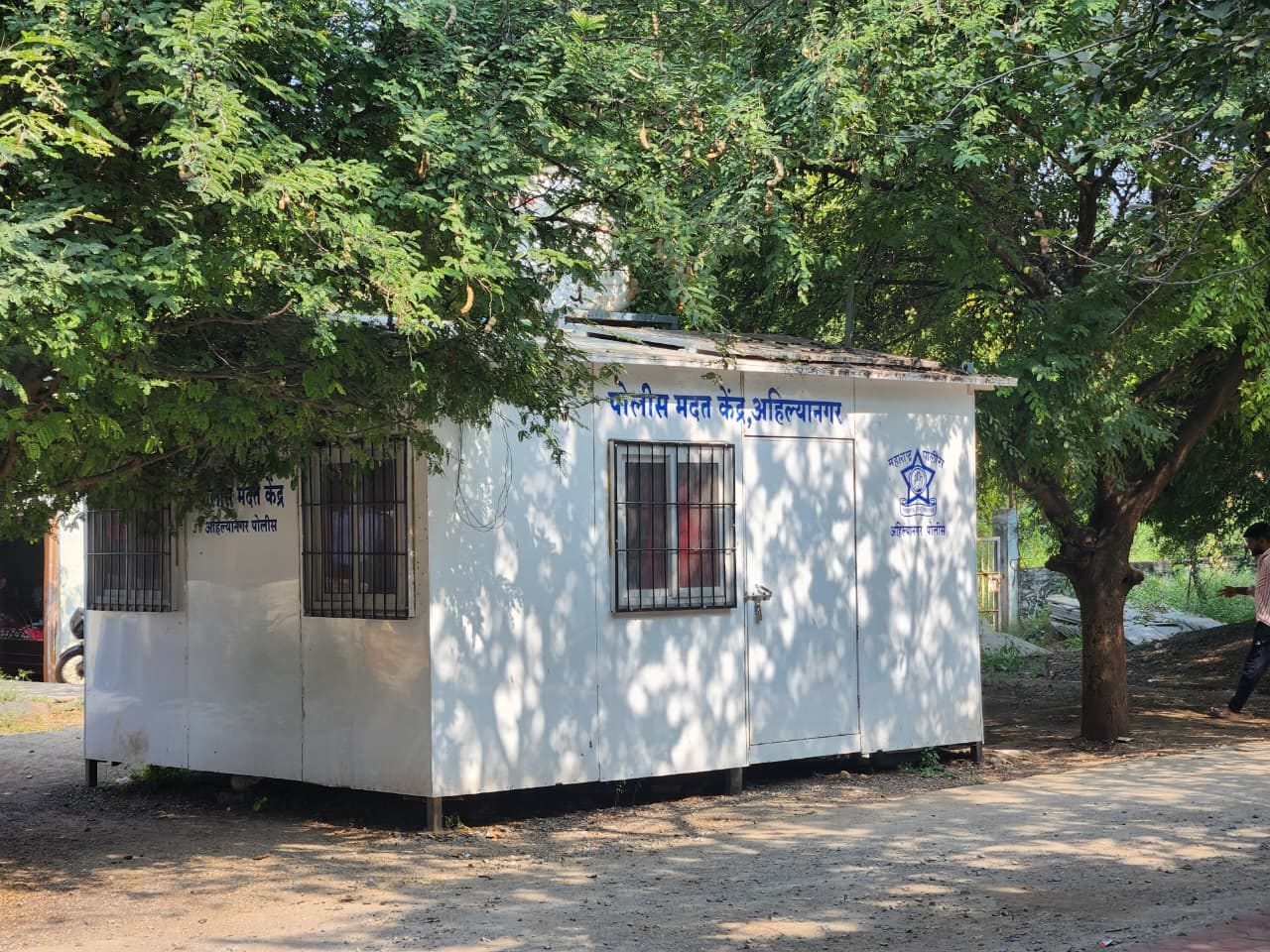
Post the clashes, a police chowki was set up to maintain law and order. But the matter further escalated the following month, when on 28 December, 2023, a Kanifnath idol was installed at the site. The Hindu community carried out a ‘Jan Akrosh Morcha’, which was also attended by former MLA Shivaji Kardile of the BJP, who passed away last month.
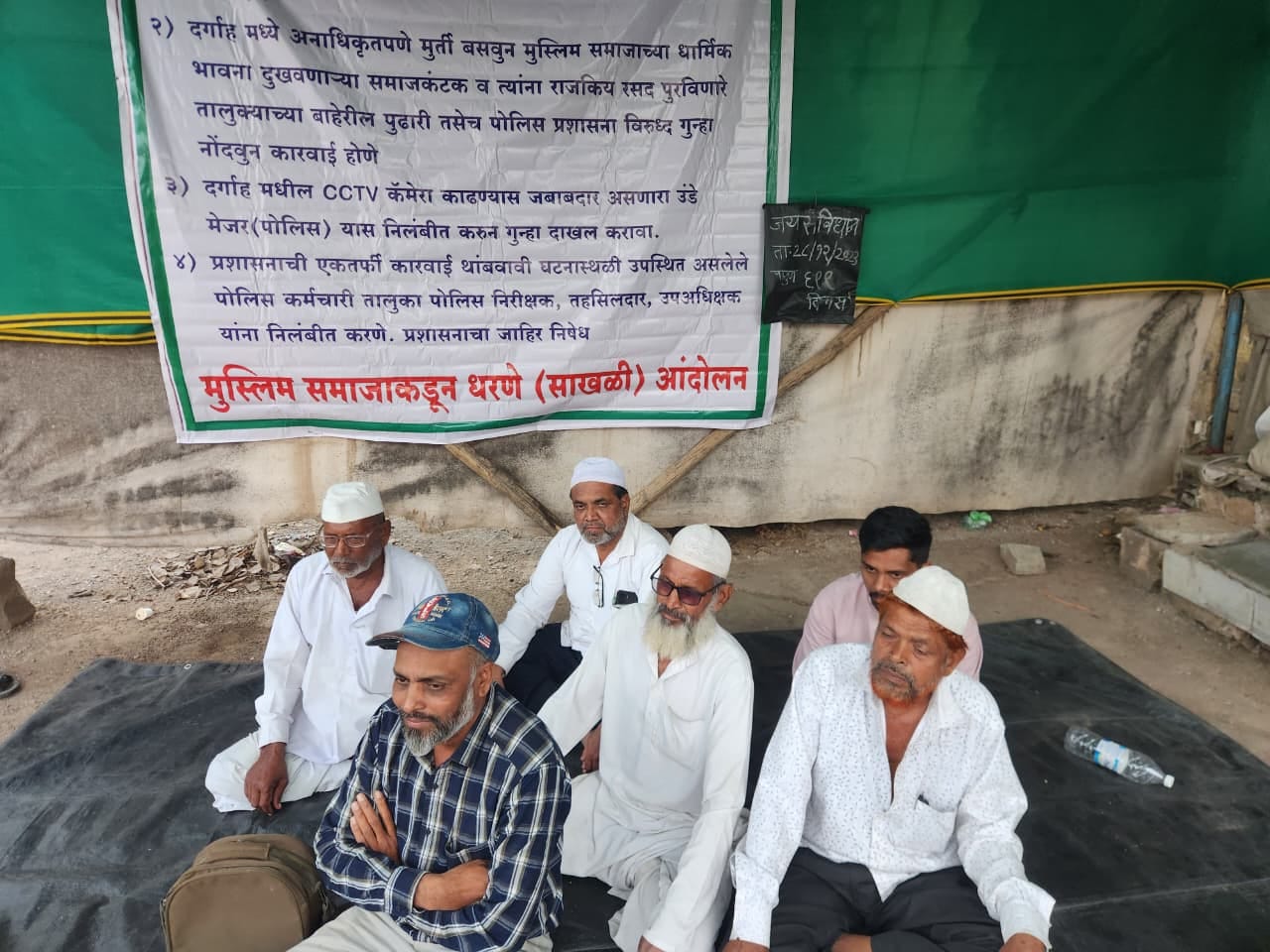
Since then, the Muslim community in Guha has been protesting relentlessly outside the Rahuri taluka office. Every day, five people from the village sit at the protest site on rotation basis from 10 am to 5 pm.
“It will now be two years since our protest began. Nobody is taking note. We even blame the collector, Superintendent of Police and all other authorities for not addressing our problems,” says Yunus Alam, who is helming the protest and posts a live video every Saturday on Facebook. “There is dirty politics involved in this. They want to polarise our village. We will not budge until the idol is removed, along with all unconstitutional things. We want unity in this village like before.”
The protesters claim they have all the documentation and letters to support their argument. ThePrint has seen the papers. “I have all the documents including the charter, property registration, 7/12 documents from 19th-20th century. Our forefathers have been taking care of this dargah for generations,” says Ismail Papamiya.
The disputed site has another masjid in the compound and a burial site in front of it, where the villagers say their ancestors have been buried.
Parvez Shaikh—lawyer, social worker and local leader of the All India Majlis-e-Ittehadul Muslimeen (AIMIM)—tells ThePrint that according to the 1995 Waqf Act and the amendments in 2013, the dargah had to be registered. The process had begun in 2016 and was completed in 2019-2020.
“That is when this became a dispute, while Hindus and Muslims both used to come and pray at the dargah. The matter escalated and now is under legal scrutiny,” he says. “When the idol was being placed, the administration supported it despite our opposition. We have complained about this to the police, the SP and everyone. But nobody listened to us.”
“With the constant visits of the Hindutva outfits and Jan Akrosh Morcha events, the tensions started growing.”
The matter is now subjudice before the Bombay High Court, Waqf Tribunal and Charity Commissioner.
Also Read: Akhlaq lynching has changed everything in his village—politics to playgrounds
Tensions in neighbouring talukas
The communal flare-up in Guha has seemingly had ripple effects in neighbouring villages and talukas.
In May 2023, clashes broke out in Shevgaon, about 80 km from Guha and about 65 km from the district headquarters, during a procession on Chhatrapati Sambhaji Maharaj Jayanti. At least five were injured, and several shops and vehicles were damaged due to stone pelting, while internet services were suspended.
This year in February, in Madhi village, about 80 km from Guha, during the annual Kanifnath yatra, the gram sabha passed a resolution to boycott Muslims. The Kanifnath Shrine in Madhi has also traditionally been visited by different communities for prayers, with Muslims setting up shops at the yatra site. But this year’s resolution called for restricting Muslims from participating in the yatra in any form.
This had invited harsh criticism from AIMIM chief Asaduddin Owaisi. “Social boycott is a form of untouchability under Article 17 of the Constitution. If this restriction is due to not following religious beliefs, then why can’t it be applied generally? Why only on Muslims?” he had posted on X.
महाराष्ट्र के एक ग्राम सभा ने मुस्लिम व्यापारियों को एक स्थानीय यात्रा में दुकान लगाने पर रोक लगा दी है। सामाजिक बहिष्कार संविधान के अनुच्छेद 17 के तहत छुआछूत का रूप है। यह सामाजिक बहिष्कार और भी निंदनीय है क्योंकि महाराष्ट्र के मुख्यमंत्री @Dev_Fadnavis ख़ुद इसे सही ठहरा रहे…
— Asaduddin Owaisi (@asadowaisi) February 26, 2025
In another instance, at the Shani Shingnapur temple in Ahilyanagar, where Muslims have worked for generations, the temple trust this year dismissed 167 employees, including 114 Muslims, citing discipline violations and irregularities. Although the trust said that the decision was based on administrative issues, political opponents called it “an act of polarisation”.
Another village Javkhede saw tensions over a Kanifnath temple in June this year.
Over the last couple of years, several Hindu Jan Akrosh Morchas have been carried out in the region, attended by controversial Hindu religious leader Kalicharan Maharaj, Sudarshan News editor-in-chief Suresh Chavhanke, BJP leader Sujay Vikhe Patil, and former party leader T. Raja Singh. The rallies were organised to seek a ‘Love Jihad’ law to prevent Muslim boys from marrying Hindu girls.
“They used our place (Ahilyanagar) as a laboratory for polarisation because in these rallies, all they did was abuse us [Muslims],” says Parvez Shaikh.
The saffron flags in Ahilyanagar city
Compared to the rural parts of Ahilyanagar, the city has remained relatively calm. However, three-time MLA Jagtap’s controversial statements this year did manage to worsen the situation to some extent.
Local residents say he was upset that Muslims did not vote for him last year in the assembly elections as he supported the Mahayuti—a claim that Jagtap denies.
He tells ThePrint, “This is not about voting. What is the connection of Muslim votes here?”
The MLA was involved in the protest against Muslims at the Shani Shingnapur temple. “The decision to give jobs to 118 people with a jihadi mindset in the pure temple was a direct assault on Hindu religion, traditions, and faith,” he had written on X.
शनीशिंगणापूरमध्ये हिंदू समाजाच्या श्रद्धेचा घोर अपमान झाला.
११८ जिहादी मानसिकतेच्या लोकांना शुद्ध मंदिरात नोकऱ्या देण्याचा निर्णय हा हिंदू धर्म, परंपरा व श्रद्धेवर थेट घाला होता.
मी या निर्णयाविरोधात शनी भूमीत ठाम भूमिका घेतली. pic.twitter.com/et07OLYUUs
— MLA Sangram Jagtap (@sangrambhaiya) June 15, 2025
११८ जिहाद्यांना शनी मंदिरात ठेवण्याचा प्रकार हिंदू धर्माचा अपमान आहे!
शुद्ध हिंदू मंदिरात अशुद्ध विचारांचा शिरकाव सहन केला जाणार नाही.
१४ जून २०२५, शनिवार | संध्याकाळी ४ वाजता
शनी शिंगणापूरमध्ये भव्य मोर्चा!
हजारो हिंदू बांधव उपस्थित राहणार आहेत – तुम्हीही या! pic.twitter.com/NUnVERBfhb
— MLA Sangram Jagtap (@sangrambhaiya) June 13, 2025
He has also allegedly used terms like ‘Jjhadi’, ‘AIMIM’s goat’ and ‘green serpents’ for the Muslim community.
On the calls for boycott of Muslims this Diwali, he says, “There is no such resolution against Muslims overall. This happens based on the problem and situation. And if anywhere we see calls given, we take a follow-up. We verify the situation based on information and act accordingly. This has nothing to do with Muslims.”
In the main market of Ahilyanagar city, amid the evening lights, the saffron flags hanging outside the shops are unmissable.
Although Muslim shopkeepers say the situation has not really affected their businesses, many are uncomfortable to speak about the issue.
“We did put up these flags because politicians and their workers gave them. But many have taken them down as well. We don’t discriminate. Anyone is welcome to come and buy from us. I don’t want to comment on anything else,” says a Hindu shopkeeper.
The situation, according to district collector Ashiya, has been normal in the last one or two months.
“I haven’t received any complaints. To ensure the situation remains normal, we hold meetings at taluka-, district-level. These meetings are attended by members of all religious communities, including pujaris and maulvis. I have not received any official complaint regarding political statements, but on ground, I don’t think there is a major issue.”
But for those like 70-year-old Shaikh Toulek in Guha, whose childhood friends won’t speak to him anymore, things are not the same anymore. “It used to be a happy place. We would go to weddings and events in each other’s families. Since the dispute, nobody even looks at us.”
(Edited by Mannat Chugh)
Also Read: Families hopeful as Kamathipura finally on brink of a makeover. But sex workers have no place in it
You did not write about the plight of Hindus in Kashmir when they were raped and slaughtered on roads. Now your shedding tears for trivial event happening in a village . This is purely a hypocrisy shown by a section of a Press.
Sll the result of two nation theory’s philosophical underpinning that Mislims ca not live alongside Hindus
So summary of problem is Waqf Registration of Dargah. Should have been mentioned I headline of article. Full article molded like that Hindu communities are the root of problem Baised article.
Let both dargah and temple operate. Have separate timings for Hindu bhajans and the Muslim worship, and be done with it. Only the Waqf registration is the problem.