





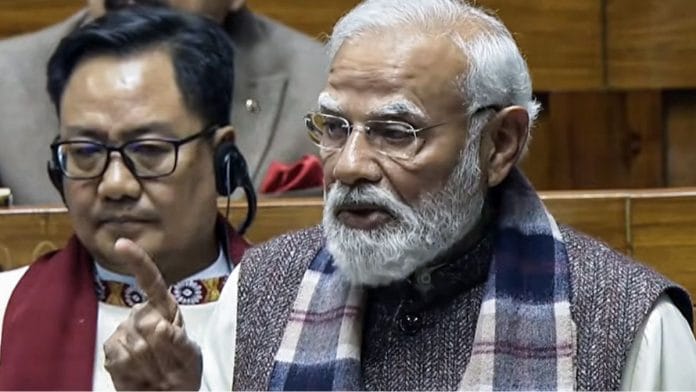



New Delhi: Accusing the Congress of removing some stanzas from the national song, ‘Vande Mataram’, for its “politics of appeasement” that eventually led to the “compromise of the Partition of India”, Prime Minister Narendra Modi attacked India’s first PM, Jawaharlal Nehru. He alleged that Mohammed Ali Jinnah opposed those stanzas, and Nehru agreed with his sentiments.
Both Houses are holding a special discussion on ‘Vande Mataram’, composed by Bankim Chandra Chattopadhyay in 1875, on the occasion of the national song completing its 150 years. Modi, opening the discussion, slammed the Congress and Nehru for doing ‘tukde tukde’ of the song. He asked why the national song was ‘betrayed’, despite being the most powerful symbol of India’s resistance and unity.
The PM’s reference to the ‘Vande Mataram’ composer as ‘Bankim Da’ drew objections from the Opposition Trinamool Congress leaders. Modi then switched to ‘Bankim Babu’.
“The politics of the Muslim League opposing ‘Vande Mataram’ gathered pace in 1937. Mohammed Ali Jinnah raised slogans against it,” Modi said. “Nehru ko apna sinhasan dolta dikha (Nehru saw his throne shaking). Instead of condemning their statements or expressing his and the party’s fidelity towards ‘Vande Mataram’, Nehru started an ‘investigation’ into ‘Vande Mataram’ itself.”
Barely five days after Jinnah had conveyed his opposition, Nehru wrote a letter to Netaji Subhash Chandra Bose, “expressing his agreement with Jinnah”, Modi said. “He said that the background of ‘Vande Mataram’—related to [Bankim Chandra Chattopadhyay’s novel] ‘Anandmath’—could irritate and provoke the Muslims,” PM said. Nehru wrote that the use of ‘Vande Mataram’ would be examined and “that too in Bankim Chandra’s Bengal”, Modi said, adding that the Congress reached a “compromise” on 26 October and truncated the song.
Modi continued that “uss faisale ke peeche chola ye pehna (Behind that decision, he wore this garb..),” that it was for maintaining communal harmony, “lekin Muslim League ke dabaav mai kiya… ghutne tek diye (but it was under the pressure from the Muslim League… they knelt)”.
‘Seeds of Partition’
On the 150th anniversary of ‘Vande Mataram’, it has taken centre stage, months ahead of the West Bengal elections scheduled for 2026.
Modi is leading the BJP’s charge against the Congress’s “sowing of the seeds of Partition” by adopting the truncated version as the national song.
Slamming the Congress, he said the Congress, till today, continues the same policy, with the INC appearing to have become the ‘MMC (Muslim League-y Mao-wadi Congress)’.
The party and its allies try to create controversy over the song, he alleged.
Stressing the importance of ‘Vande Mataram’, he said that such was the power of ‘Vande Mataram’ that the British were forced to impose a legal ban on it.
“There was punishment for singing it and punishment for printing it. Such harsh laws were created to suppress it,” Modi said. Adding, “There was a time when the intellectual strength of Bengal guided and inspired the entire nation. The British understood quite well that the power of Bengal was the focal point of India’s strength. This is why they first worked towards dividing Bengal. They believed that if Bengal broke, the nation would break. In 1905, the British implemented the Partition of Bengal. But ‘Vande Mataram’ stood firm, like a rock. For the unity of Bengal, it became the resounding call, echoing through all streets.”
Heaping praise on Bankim Chandra Chattopadhyay, Modi also said that during that period of British rule, it had become a habit to demean India and Indians. “It was in such a time that Bankim Chandra wrote the lines to shake the nation out of feelings of inferiority and to reveal the powerful form of Bharat”.
“When the Emergency was imposed on the country, and freedom was tried to be suppressed, it was ‘Vande Mataram’ that rose above and defeated those forces. When wars were imposed on the country, it was ‘Vande Mataram’ that inspired our forces…,” he said.
Referring to Mahatma Gandhi’s views, the PM further said that in the weekly Indian Opinion, Gandhi, on 2 December 1905, wrote that Bankim Chandra Chattopadhyay’s ‘Vande Mataram’ had gained popularity across Bengal.
(Edited by Madhurita Goswami)
Also Read: Hugs, car rides, but no deals—Modi-Putin meet exposes weaknesses of both countries