





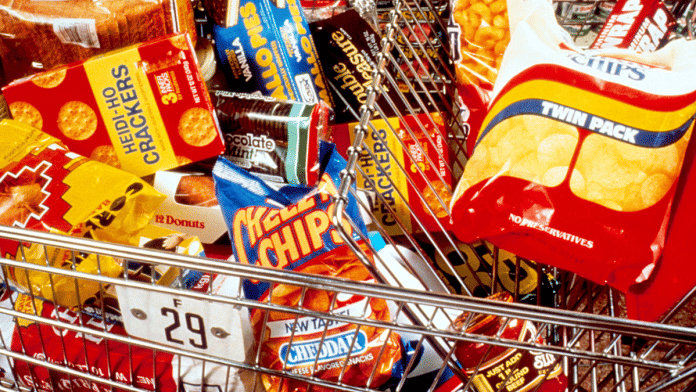



New Delhi: A high-stakes consultation convened Thursday by India’s top food regulator, the Food Safety and Standards Authority of India (FSSAI), laid bare a deep divide over how India should label packaged foods high in fat, sugar, and salt (HFSS). Consumer groups are pushing for clear warning labels while the industry is urging a softer, information-led approach.
The meeting followed last month’s Supreme Court directive, which suggested that all pre-packaged food carry front-of-pack warnings for high sugar, sodium, or saturated fat. In its 10 February ruling, the top court also proposed a positive logo to identify healthier products, giving FSSAI four weeks to respond.
Thursday’s consultation occurred after this deadline had already lapsed. The FSSAI, in an affidavit in court this month, had sought six more weeks to submit its proposal, despite holding multiple consultation rounds over the years.
On 10 February, while reviewing FSSAI’s earlier compliance affidavit, the court stressed that efforts so far had not produced “any positive or good result”. The court also underscored the urgency of addressing what it called a critical public health issue linked to citizens’ right to health. Besides, it noted that clearer, front-of-pack warning labels—already widely used internationally—might require more serious consideration.
Responding in a 13 March affidavit, the FSSAI said that depending on stakeholders’ feedback, it would draft amendments, have them reviewed by its scientific panel, scientific committee, and the food authority, and then send them to the health ministry for approval—a process that could be time consuming.
The regulator also informed the court that it was considering a tabular or pictorial front-of-pack format to flag HFSS content, enabling consumers to make informed choices, and using existing nutrient thresholds to ensure scientific consistency across regulations.
Also Read: Patanjali told to recall 4 tonnes of red chilli powder from market, but no public alert by FSSAI
Industry resists warnings
During the consultation convened by FSSAI Thursday, industry stakeholders broadly supported the idea of front-of-pack labelling but pushed back against warning-style labels, arguing that they are “overly simplistic” and could mislead or “alarm” consumers.
Several participants emphasised that nutrition is a complex issue and cannot be reduced to “high in sugar/salt/fat” tags, which highlight only negative nutrients while ignoring beneficial components, such as protein or fibre.
Industry voices, instead, called for positive or informative labelling, with a stronger focus on portion size-based information, moderation, and consumer education, rather than blanket warnings based on per-100g thresholds.
One of the participants, Rashida Vapiwala, founder of LabelBlind, a nutrition-tech firm working with the government on food labelling compliance, was of the view that the decision should favour mandatory front-of-pack labelling. “India needs it,” she told ThePrint.
But she also pointed to structural gaps. “India currently has no standardised measure to define what constitutes ‘high’ or ‘low’ sugar, fat or salt, and no formal definition of HFSS (high fat, sugar, salt) foods. There has been no decision on what the thresholds are,” she said.
Industry concerns, she said, were “valid”, especially around uniform thresholds based on 100g/ml, which might misrepresent products consumed in small quantities.
A study conducted by LabelBlind, covering 1,305 products across 30 companies, found that one-third of product labels were problematic—21.3 percent were non-compliant and 12.3 percent required verification.
Alarmingly, 50 percent of health and nutrition claims fail in compliance—products carry an average of eight to nine claims, rising to 13 to 15 in staples, such as honey and edible oils.
“This excessive marketing makes informed choices difficult,” Vapiwala said.
The findings, she argued, underscored the need for “a very objective system” that cut through marketing clutter and enabled consumers to make informed choices.
Industry representatives also cautioned that uniform criteria could unfairly penalise traditional or nutrient-rich foods such as dairy products, and stressed that Indian dietary habits must be considered before adopting global models.
A member of the food processing committee at the PHD Chamber of Commerce and Industry (PHDCCI) told ThePrint, “PHDCCI had attended the meeting at FSSAI, where the initial discussion took place. We have now shared the details with our industry members to gather their input on the matter. We expect to consolidate their feedback and then share our opinion.”
The Federation of Indian Chambers of Commerce and Industry (FICCI), which also participated in the stakeholder consultations, declined to comment when contacted by ThePrint.
ThePrint also reached out to Confederation of Indian Industry (CII) for comments. This report will be updated if and when a response is received.
On its part, the FSSAI said further consultations were needed before finalising the framework and that it had sought an additional six weeks from the court to submit a detailed proposal.
Also Read: Coming soon: Norms on monitoring microplastics & limiting exposure through bottled water, food items
Consumer groups push for HFSS labels
As a stakeholder who attended the FSSAI consultations, Dr Arun Gupta, convener of Delhi-based think tank Nutrition Advocacy in Public Interest India (NAPi), said that industry voices dominated the discussion.
“Everyone wanted to discuss other measures, but did not want to talk about warning labels,” he told ThePrint.
He added that the same industry that designed products to encourage overconsumption—and spent heavily on advertising to drive sales—was now resisting a basic public health measure meant to inform consumers.
NAPi, which leads a group of 29 public health and consumer organisations, submitted to FSSAI that warning labels on packaged foods high in fat, sugar, and salt (HFSS), as part of India’s front-of-pack labelling policy, must be mandatory.
The groups argued that warning labels were the most effective way to guide consumers. They also highlighted global precedent, pointing out that multiple countries—from Chile to Canada—use similar “high in” warning systems in varying shapes and languages.
Representing the petitioner 3S and Our Health Society in the Supreme Court, Advocate Rajiv Shankar Dwivedi said, “First identify the poison as poison. If a product is high in sugar, say it clearly—don’t hide behind complexity. People, especially mothers, have the right to know what they are feeding their children.”
Echoing this, Nilanjana Bose, Food and Nutrition Project Head at Consumer Voice, cautioned against so-called “positive” or star-based labelling systems that could mislead consumers. She said such systems could allow unhealthy products to appear healthier by adding nutrients, such as iron or vitamins, without reducing harmful elements, including sugar or salt.
“We are not asking people to eat or not eat—we are simply giving them the real picture. Labels must clearly indicate when a product is high in sugar, salt*,* or fat, and should be backed by simple, recognisable graphics and made mandatory,” she added.
How the matter landed in SC
The push for front-of-pack labelling has extended for more than a decade—moving from courtrooms to policy drafts and back again.
It goes back to a 2010 petition by the Delhi-based Uday Foundation in the Delhi High Court, seeking clearer food guidelines for schoolchildren. The case sparked early judicial attention on how food information was communicated to consumers, especially children.
In 2018, the idea of front-of-pack labelling formally entered policy debates as India began overhauling its older packaging and labelling rules, said Advocate Harsh Hiroo Gursahani, a lawyer representing the food industry who took part in the FSSAI stakeholder consultations.
“These discussions came up when the 2011 packaging and labelling regulations were being split into separate frameworks for labelling and display, advertising and claims, and packaging,” he said. “Because the entire labelling regime was under review, FSSAI decided to hold back and revisit FOPL later.”
That overhaul culminated in the 2020 labelling and display regulations, which introduced changes such as mandatory declaration of recommended dietary allowance (RDA) per serve percentages. But the question of simplified, front-facing nutrition warnings remained unresolved.
In parallel, the FSSAI explored multiple formats—from traffic light systems to star ratings—backed by studies, including one by the Indian Institute of Management Ahmedabad. The latter recommended a star-rating model, which was incorporated into draft regulations released in 2022.
However, the draft soon faced resistance from industry and some experts.
“The principal problem was not the idea of labelling itself, but the science behind the star rating—how exactly those stars were being calculated,” Gursahani said. “If you applied the formula, many traditional foods would automatically get low ratings, while reformulated packaged products could score higher.”
As the regulatory process stalled, the issue returned to litigation. In 2024, a public interest petition was filed in the Supreme Court by 3S and Our Health Society, a Kerala-based public health advocacy group working on nutrition, non-communicable diseases, and consumer awareness, seeking mandatory front-of-pack warning labels on foods high in fat, sugar*,* and salt. When the matter came up, FSSAI informed the court that it was in the process of finalising the 2022 draft regulations.
In April 2025, the court disposed of the petition with directions to FSSAI to complete the exercise within three months and place the final framework on record. But delays persisted. By early 2026, the regulator had informed the court there was still no consensus among stakeholders on the proposed Indian Nutrition Rating star system, and that further consultations, studies, and revisions were being undertaken.
Currently, 44 countries have adopted front-of-pack labelling—16 of them mandating it—and experts emphasise that no single international model can be directly applied to India due to its demographic diversity, linguistic variation, and differing literacy levels.
(Edited by Madhurita Goswami)
Also Read: Is Malhar the answer to Halal? Food standards shouldn’t be a Hindu-Muslim issue