








New Delhi: People who stop taking Glucagon-like peptide-1 (GLP-1) drugs after using them for some time regain, on average, roughly 60 percent of the weight they had lost within a year. However, the pace of regaining weight slows over time, and nearly 25 percent of the original weight loss is expected to be retained in the long term.
This has been found in a new study by researchers at the University of Cambridge.
GLP-1 receptor agonists, which prompt the body to produce more insulin, mimic a natural hormone which helps control blood sugar. In higher amounts, it interacts with parts of the brain that reduce appetite, helping people eat less and lose weight.
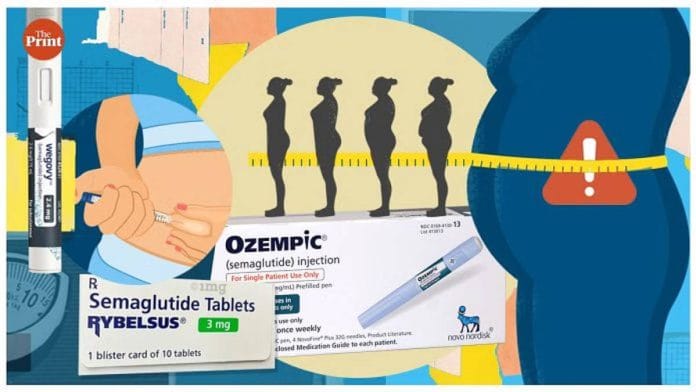
Semaglutide, the active ingredient in popular weight loss drugs, including Ozempic and Wegovy, belongs to the class of medications known as GLP-1 receptor agonists.
The findings of the Cambridge study, which tracked weight changes for one year after treatment discontinuation, were published Wednesday in the journal eClinicalMedicine.
Popular weight-loss drugs such as Ozempic and Wegovy, both developed by the Danish pharmaceutical company Novo Nordisk, have transformed how doctors treat obesity.
While Ozempic was initially approved to treat Type 2 Diabetes, Wegovy was approved specifically for chronic weight management.
“When people take GLP-1 drugs, they can lose a significant amount of weight. But once the medication stops, appetite returns, and the body often tries to regain that weight,” said Dr Monika Sharma, an endocrinologist at Aakash Healthcare Super Speciality Hospital.
Researchers at the University of Cambridge have noted that prior to their study, no large-scale trials tracked weight changes for more than a year after patients discontinued treatment.
Many patients eventually stop taking the drugs, often because of side effects or high costs, making it important to understand what eventually happens to patients’ weight once their treatment ends.
Not all lost weight comes back
To examine what happens after treatment ends, researchers reviewed 48 previous studies, including 36 randomised controlled trials and 12 non-randomised studies.
Most studies followed patients for only a short period after they stopped treatment. To estimate longer-term changes, the researchers focused on six trials involving more than 3,200 participants that tracked patients for up to 52 weeks after discontinuing the drugs.
Using this data, they modelled how body weight changed after treatment ended.
The model showed that weight regain happened most rapidly in the first few months after stopping the medication. By the end of 52 weeks, people had regained nearly 60 percent of the weight they had lost.
After nearly 60 weeks, the regain began to level off. Over the long term, the researchers have estimated that people are likely to regain nearly 75 percent of their lost weight, indicating that roughly a quarter of the original weight loss is maintained.
For example, someone who lost 20 percent of their body weight while taking the medication might still maintain a weight, which is five percent below their starting weight, after stopping the medication.
“Drugs such as Ozempic and Wegovy act like brakes on our appetite, making us feel full sooner, which means we eat less and therefore lose weight. When people stop taking them, they are essentially taking their foot off the brake, and this can lead to rapid weight regain,” said Brajan Budini, a medical student at the University of Cambridge and one of the study’s authors.
Researchers also noted that it was still unclear whether the regained weight was mainly fat or included muscle. Previous studies have suggested that up to 40 percent of the weight loss during treatment is lean body mass, including muscle.
Why lifestyle changes are still important
Obesity and related metabolic diseases are rising steadily in India. An estimated 135 million people in the country are living with diabetes. According to the National Family Health Survey (NFHS-5) (2019–21), 24 percent of women and 23 percent of men in India are overweight or obese. This is the reason weight-loss medicines are gaining popularity in the country, especially as the patent for Semaglutide—the key ingredient in drugs such as Ozempic and Wegovy made by Novo Nordisk—is expiring in March 2026, potentially allowing cheaper generic versions to enter the market.
Doctors said the findings of the Cambridge study shine a light on the significance of long-term care and lifestyle support for people using weight-loss drugs.
Dr Dheeraj Kapoor, head of endocrinology at Kokilaben Dhirubhai Ambani Hospital in Mumbai, said that obesity should be treated as a chronic disease rather than a short-term condition.
“Long-term success cannot rely on medication alone. Patients need nutrition support, physical activity, sleep and regular medical follow-up,” Dr Kapoor said.
Dr Sharma added that maintaining weight loss usually requires a combination of medication, dietary changes, regular exercise, and ongoing medical supervision.
The researchers have noted that longer-term studies are still required to understand how weight changes several years after people stop GLP-1 medicines.
(Edited by Madhurita Goswami)
Also Read: As semaglutide goes off patent, weight-loss gold rush begins. Pharma bets big, court case lingers