





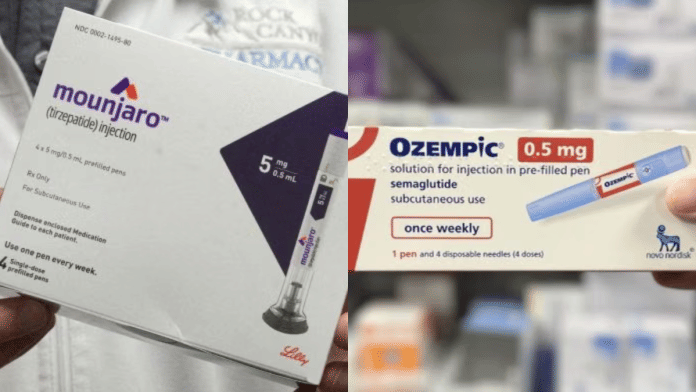



New Delhi: Popular anti-obesity drugs work in Indian patients, whether with or without type-2 diabetes, but patients taking Tirzepatide, sold as Mounjaro, lose significantly more weight than those taking Semaglutide, sold as Ozempic or Wegovy, a first such retrospective cohort study on Indian patients, conducted at a tertiary care hospital in New Delhi, has found.
The study, published Monday in the Indian Journal of Endocrinology and Metabolism, also found that patients without diabetes lost more than double the weight of those with the condition.
The study, conducted by researchers from the Department of Endocrinology and Diabetes at Max Super Speciality Hospital in New Delhi and the Department of Public Health at Adama Hospital Medical College in Ethiopia, found that younger patients and those who have never taken these drugs before are likely to lose weight more quickly.
Over a period of six months, researchers tracked 150 overweight or obese adults, examining not just how much weight patients lost on these drugs, but how quickly.
The most striking finding was how diabetes status shapes outcomes:
Patients without diabetes lost 11.21 percent of their body weight, which was more than double the 5.48 percent lost by diabetic patients. Among diabetic patients, just 23 percent achieved the 10 percent weight loss threshold. Among those without diabetes, 54 percent did.
“Globally, we’ve consistently seen that people with diabetes tend to lose less weight, though the reasons aren’t fully understood. One important factor is the use of concomitant medications — such as insulin, sulfonylureas, or pioglitazone — which can promote weight gain and blunt weight loss,” Dr Ambrish Mithal, Chairman, Endocrinology and Diabetes, Max HealthCare, and a co-author of the study, told ThePrint.
The authors said the findings could help doctors personalise therapy and set expectations when initiating newer GLP-1/GIP receptor agonists.
Both semaglutide and tirzepatide belong to a class of drugs called GLP-1 receptor agonists. GLP-1, or glucagon-like peptide-1, is a hormone naturally produced in the gut after eating — it signals the brain to reduce hunger and helps the body regulate blood sugar. These drugs mimic that hormone to produce the same effect.
Tirzepatide goes a step further by targeting a second gut hormone receptor called GIP (glucose-dependent insulinotropic polypeptide), which plays a role in insulin release and fat metabolism. This dual action is believed to make it more potent than semaglutide, which targets only GLP-1.
Most evidence on these drugs comes from Western populations, which differ from Indians in body composition, insulin resistance, and metabolic risk. This study, the authors said, aimed to fill that gap with ground-level data from routine clinical practice.
Also Read: Fat-busting drug Mounjaro launched in India. Here’s how much it will cost
How much weight did patients lose
The study found that on average, Indian patients lost 8.2 percent of their body weight over roughly six months. These numbers were lower than the headline figures from global clinical trials — the landmark STEP trial for semaglutide reported around 15 percent at 68 weeks, and tirzepatide trials showed 15-21 percent over 72 weeks.
But the authors note that at a comparable follow-up duration, those same trials showed about 10-12 percent at 24 weeks, putting the Indian real-world numbers in a similar range.
The gap between the two drugs was notable. Patients on tirzepatide lost a median 8.6 percent of their body weight, compared to 5.6 percent for those on semaglutide. Nearly half of tirzepatide patients — 47 percent — crossed the 10 percent weight loss threshold, compared to just 21 percent of those on semaglutide.
On average, the median weight loss across all patients was 8.2 percent. This means half the patients lost more than this, and half lost less.
But a median figure alone does not capture the full picture. Clinically, what matters is how many patients crossed meaningful thresholds.
On that count, 73 percent of all patients lost at least 5 percent of their body weight, considered the minimum clinically meaningful threshold. But only 41 percent crossed the 10 percent mark, the level researchers define as “substantial” weight loss.
Beyond the amount of weight patients lost, the study also tracked how long it took them to lose 10 percent of their body weight, or what researchers call a “time-to-event” analysis. This matters because an earlier response tends to improve patient motivation and long-term adherence to treatment.
The median time to reach the 10 percent mark was 9.5 months overall. But drug choice made a significant difference here, too. Tirzepatide-treated patients got there in 8.61 months on average, and those on semaglutide took 11.40 months.
Who responds fastest
Three factors independently predicted a faster response: younger age, tirzepatide use, and no prior GLP-1 drug therapy.
Each additional year of age was associated with a 3 percent reduction in the likelihood of reaching the threshold sooner — younger patients tend to have higher metabolic rates, more muscle mass, and greater physical activity, all of which aid weight loss.
Patients previously on such medication responded 2.6 times more slowly than first-time users, possibly due to “receptor adaptation”, meaning the body may adjust to the drug over time, reducing its effect.
Side-effects & caveats
Gastrointestinal side effects were common, with nausea in 31 percent of patients, diarrhoea and constipation in 25 percent each, and bloating in 14 percent.
But no patient had to stop or switch treatment because of them, and rates were not significantly different between the two drugs.
The authors caution that the study is small, retrospective, and conducted at a single centre. It lacks data on factors like diet, physical activity, and adherence, while unequal group sizes, especially a small semaglutide subgroup, limit reliable comparisons.
Dosing variations further weaken the conclusions and the apparent advantage of tirzepatide needs confirmation in larger, prospective studies, the authors cautioned.
Besides, Dr Mithal said that these findings should not be interpreted as the maximum achievable benefit.
“A key point to note is that this is based on median six-month data. This is not peak weight loss — we expect weight reduction to continue over a year or longer. So, longer-term data, particularly at one year, will provide a clearer picture,” he said.
“The observed association favouring tirzepatide requires cautious interpretation,” the authors wrote, calling for large prospective studies with balanced group sizes and standardised dosing.
(Edited by Sugita Katyal)
Also Read: Dozen drugmakers line up Ozempic copies, triggering price crash in India. Generic GLP-1 Era begins