



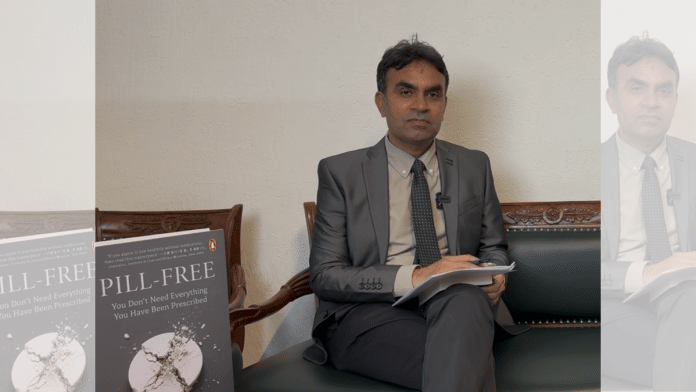
New Delhi: A patient walks into a clinic with a prescription carrying 19 medicines. Another undergoes a series of tests simply because they are part of a “full-body” health package. A third is advised to do an invasive procedure after a risk factor is detected, even when there are no symptoms.
These, according to public health expert and senior consultant physician Dr Chandrakant Lahariya, are signs of a growing problem in Indian healthcare.
“We have a tendency to test, prescribe and intervene more than what may be necessary,” he said in an interview with ThePrint Friday.
In his new book, Pill Free: You Do Not Need Everything You Have Been Prescribed, Lahariya argues that advances in medicine have been accompanied by a tendency towards over-medicalisation, driven by fragmented care, patient expectations, time pressure on doctors and commercial interests in healthcare.
In India, patients continue to bear a significant share of healthcare costs themselves. According to the latest National Health Accounts estimates released by the Union health ministry, the out-of-pocket expenditure by households accounted for 43.4% of total health expenditure in 2022-23.
Lahariya said that the concern is not only the number of medicines a person takes. Multiple medicines can increase the possibility of side effects, and medication errors, particularly among older patients. Unnecessary testing can also lead to abnormal results that trigger further investigations and procedures, he said.
The book, he stressed, is not an argument against medicines. It is about using the right medicine, in the right dosage and for the right duration.
Also read: FSSAI seeks more time from SC to work on front-of-pack labels for foods with high fat, sugar & salt
‘More tests don’t always mean better care’
According to Lahariya, there are five factors behind ‘over-medicalisation’.
One is the rapid expansion of medical technology, which has made a growing number of tests, scans and procedures available. Another is fragmented care, where patients see several specialists and end up with multiple prescriptions without one doctor having an overview of all the medicines being taken.
“The patient is taking five different prescriptions from five different specialists,” Lahariya said.
He also pointed to patient expectations. Some patients, he said, believe a doctor has not done enough unless they leave with a prescription or a list of tests.
Time constraints add to the problem, he said. A detailed clinical history and physical examination can take time, while ordering laboratory tests may appear to offer a quicker route to a diagnosis.
The fifth factor, according to Lahariya, is commercialisation, including diagnostic centres selling bundled packages of tests.
He was particularly critical of mass preventive screening and described it as “one of the biggest healthcare scams”.
Screening can help detect certain diseases early, but, he said, medical guidelines generally distinguish between targeted screening for people at appropriate ages or risk levels, and indiscriminate testing of people without symptoms.
Lahariya said healthy adults below 30 generally do not need universal full-body check-ups. For older adults, he suggested that such assessments could be spaced out, unless a person has a family history, symptoms or other risk factors.
He also questioned screening camps where people are told they have an abnormal result but are not guaranteed confirmatory testing or treatment.
“Many corporate hospitals conduct such camps through non-governmental organisations without committing to follow-up care, it is borderline unethical,” he said.
Supplements, statins & unnecessary procedures
Lahariya also raised concerns about what he sees as excessive use of supplements, including vitamin D, vitamin B12 and magnesium.
He argued that many people taking supplements could meet their nutritional requirements through a balanced diet, and cautioned against treating supplements as universally necessary without establishing a deficiency or other indication.
He similarly described statins as “the most overused medication” in India.
Statins lower low-density lipoprotein, or LDL, cholesterol and are prescribed to reduce the risk of heart attacks and other cardiovascular events. Lahariya argued that a high LDL level is a risk factor rather than a disease by itself, and that treatment decisions should take a person’s overall cardiovascular risk into account.
He also criticised what he called “preventive angiography” and unnecessary surgeries, including gallbladder removal and knee replacement.
“Angiography, gallbladder removal, and total knee replacement are some of the most frequently prescribed procedures,” he said.
“Though they can be necessary and life-saving when clinically indicated, such invasive interventions are often being used without sufficient clinical justification, particularly when risk factors could instead be addressed through appropriate medical treatment and lifestyle changes,” he added.
For people to reduce their pill burden, he recommended having a family physician who can oversee their treatment, seeking a second opinion before major or irreversible decisions, slowing down non-emergency treatment decisions, and combining medication with lifestyle changes.
He also suggested habit-building, investing in the health of the next generation and being selective about sources of health information.
“In today’s time, when we are having excess lab investigations, the approach has become to treat the lab reports. While in reality, we should treat the individual,” Lahariya said.
(Edited by Ajeet Tiwari)
Also read: What smoking can teach sustainability—design works where guilt doesn’t
Kudos to Dr Lahariya! He spoke the most unpleasant big truth; very very big truth. Indian Health industry, especially the Allopathic-based medical care is looting the Indians of all strata. Gone are the days when medical profession was considered a noble profession and the few who joined it had a mind-set of providing health-care as “SEWA” i.e. to “SERVE”. Today’s allopathic doctors are messengers of death.