








Gurugram: Asian Institute of Medical Sciences in Faridabad received 12,019 square metres, nearly three acres, of government land for Rs 49.87 lakh in September 2007. In return, it was supposed to treat poor patients free of cost.
However, the data uploaded on the HSVP portal tells a different story: One IPD (indoor patient department) admission, zero OPD (outdoor patient department) visits, and zero rupees of recorded benefit till date. That’s the data for five years.
Metro Heart Institute with Multi-Speciality, also in Faridabad, got 16,185 sq m, about four acres, at Rs 2.67 crore in October 2005. Its portal data shows just three patients treated, all OPD, no monetary benefit recorded. This again is the data for five years.
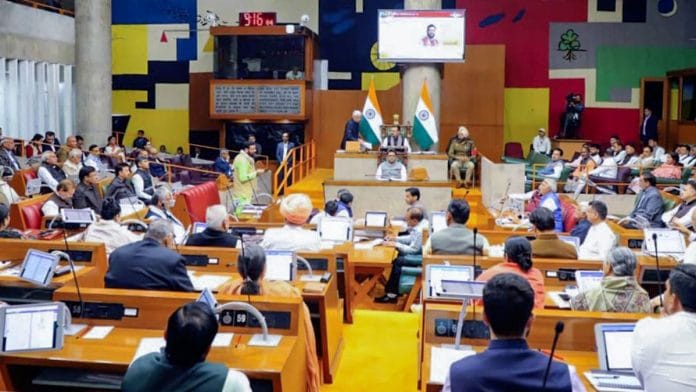
These facts came out in a government reply to a question in the Haryana Assembly Monday. MLA Aftab Ahmed from Nuh had asked how many hospitals in Gurugram and Faridabad had received government land on concessional rates, what the terms were, and, crucially, how many poor patients had actually been treated under those terms in the past five years.
According to the government’s reply, Haryana Shehri Vikas Pradhikaran (HSVP, formerly HUDA) had allotted sites to 11 hospitals—four in Gurugram and seven in Faridabad. The reply also reveals that most of these hospitals, which got land from the government on highly subsidised rates, have failed to fulfill their obligation to treat poor patients free of charge.
This has come months after the Supreme Court, in August 2025, issued notices to the Centre, all state governments, and Union Territories on a PIL filed by Magsaysay Award-winning social activist Sandeep Pandey, who had alleged in his plea that large private hospitals across the country, many of which had been given public land at concessional or token rates, were not honouring their obligation to provide free treatment to EWS and BPL patients.
The hospitals and the land they got
In Gurugram, HSVP allotted land to four hospitals, Artemis Medicare Services, Fortis Heart and Multi-Speciality Hospital, Medanta-The Medicity, and Sanjivani Life Care Medical Centre—a combined area of roughly 66 acres, allotted for a total of about Rs 13.57 crore. Medanta alone accounts for 43 of those acres, allotted in 2004 for Rs 6.70 crore.
In Faridabad, seven hospitals were allotted land—Anshu Hospital, Metro Speciality Hospital (Metro Hospital), QRG Hospital, Asian Hospital (Blue Sapphire Health Care), Sarvodaya Hospital (a unit of Anshu Hospital), Metro Heart Institute with multi-speciality, and The Metro Speciality Pvt. Ltd.—23 acres altogether, for a total of approximately Rs 8.42 crore.
What the government had promised
The state’s policy on free treatment for the poor has gone through two main iterations, one in 2008 and a revised version in December 2022.
The 2008 HUDA policy circular (dated 13 August 2008) required hospitals allotted land in HUDA sectors to provide free outdoor treatment to 20 per cent of their total outpatient load, on a first-come-first-served basis.
For indoor patients, they were required to reserve 10 per cent of total beds free of cost for the economically weaker sections.
Super-speciality hospitals got a slightly different deal. They were to charge subsidised rates (30 per cent of normal charges) for 20 per cent of their functional beds, in addition to free OPD for 20 per cent patients.
Eligibility under the 2008 policy was limited to BPL card holders, Class IV government employees, and those with monthly incomes not exceeding Rs 5,000, and only for those domiciled in Haryana.
The 2022 policy revised and consolidated these guidelines. The income ceiling was raised from Rs 5,000 to Rs 15,000 per month. Super-specialty hospitals were asked to reserve 20 per cent of total functional beds and follow a slab-based subsidy system: Treatment free if the bill is up to Rs 5 lakh; 10 per cent of normal charges for bills between Rs 5 lakh and Rs 10 lakh; and 30 per cent of normal charges beyond Rs 10 lakh. The eligibility was expanded to include Ayushman Bharat cardholders and family identity cardholders.
Both policies required hospitals to maintain separate registers, submit quarterly reports, and upload patient details on the HSVP portal.
A monitoring committee, comprising the HSVP Administrator as chairperson, the district civil surgeon, district Red Cross Society president, and an estate officer, was supposed to meet quarterly to review compliance.
What the hospitals actually did
The answer to MLA Aftab Ahmed’s question about how many poor patients were treated is where things get uncomfortable for both the government and the hospitals.
As per the government’s reply, out of 11 hospitals mentioned, only 8 hospitals are entering data on the HSVP portal.
Three hospitals, Fortis, Sanjivani Life Care, and one Metro unit, are simply not uploading data at all.
Of the eight that are, the aggregate numbers across all years available on the portal show 8,086 total patients treated, with 7,445 OPD visits and 641 IPD admissions. The total monetary benefit recorded is Rs 5,00,92,123.
The hospital-wise breakdown is revealing. Artemis treated 2,914 patients (2,639 OPD, 275 IPD) with a recorded benefit of Rs 58.61 lakh. Medanta treated 751 patients (626 OPD, 125 IPD) with benefits of Rs 3.89 crore. Asian Institute of Medical Sciences in Faridabad shows just one patient, one IPD admission, zero OPD, with zero recorded benefit.
Metro Heart Institute (one entry) shows just three patients. QRG Hospital shows 913 patients but zero monetary benefit recorded. Sarvodaya Hospital shows 2,915 patients, all OPD, zero IPD, and again, zero benefit amount.
Not just in Haryana
When the bench of Chief Justice B. R. Gavai and Justices N. V. Anjaria and Alok Aradhe was hearing the PIL filed by social activist Sandeep Pandey in August, senior advocate Sanjay Parikh, appearing for the petitioner, had told the court that CAG reports across multiple states had documented persistent non-compliance.
In Maharashtra, out of 113 public trust hospitals only 11 were test-checked and most were found in default. In Odisha, hospitals including Apollo received land worth Rs 45.68 crore at a concessional price of Rs 3.28 crore but failed to meet their free treatment obligations. The petition specifically cited a Haryana case where out of 64,000 admitted patients, only 118 were EWS patients treated free in 2017.
(Edited by Viny Mishra)
Also read: Why nearly dozen multi-speciality private hospitals in Delhi aren’t too keen on AB-PMJAY empanelment