





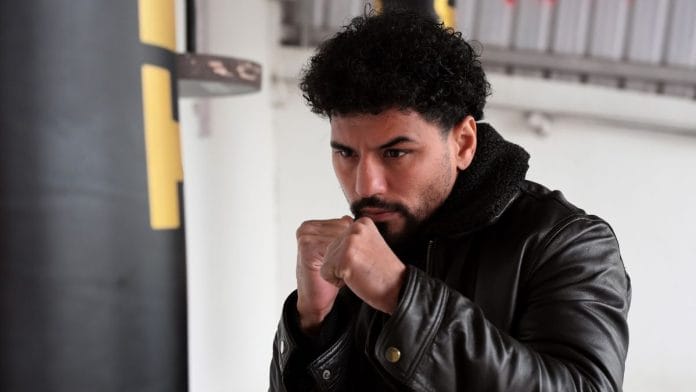



Yamunanagar, Haryana: The clip is barely long enough to explain itself. It shows Indian professional boxer Neeraj Goyat brushing past his opponent after a December bout in Dubai, his body language tense, his face set, the handshake conspicuously missing. Within hours, the clip was edited and packaged to present Goyat’s abrasive, nationalistic and hostile side — it was also proof of poor sportsmanship.
The fight itself was routine. Goyat won 3-0. The moment after it became the headline.
“He tried to demean India and Indian boxing, saying we can’t produce good boxers,” Goyat, 34, said. “That is why I refused to shake hands.”
A second video, recorded seconds later, shows a heated exchange with American boxer Anthony Taylor at a press conference after their Misfits Boxing bout. “Don’t talk about my country. India tera baap hai (India is your father),” Goyat said and hurled a bottle at him. The line was repeated, memed and flattened into a catchphrase on social media.
For Goyat, it was a spontaneous reaction. For the internet, it was a ready-made identity — an athlete unable, or unwilling, to contain his temper once the bell had rung. But for Goyal, that belief — that controversy is now a tool — runs through much of his public career.
“Every time I’m in the headlines, whether for drama or challenges, it pushes boxing into discussions people normally don’t have. That’s good for the sport,” said Goyat.
Indian sport is no stranger to rage, rebellion or public breakdowns — from on-field flare-ups by Virat Kohli to the infamous Sreesanth slap that defined Harbhajan Singh for years. For male athletes, anger and confrontation have long been normalised as part of sporting folklore. For women like Mary Kom and Smriti Mandhana, personal lives have increasingly become the battleground. Goyat’s case sits at a different, uneasy intersection.
This time, the controversy is neither about performance nor private life but about behaviour off the field, after the contest is done. It is about how visibility itself is now produced in Indian sport: through clipped videos, confrontational soundbites and viral conflict and how professional boxing, a sport that already struggles for space in the national conversation, is learning to survive in that attention economy.
“I am happy if people talk about boxing because of me, even if it comes with controversy,” Goyat said.
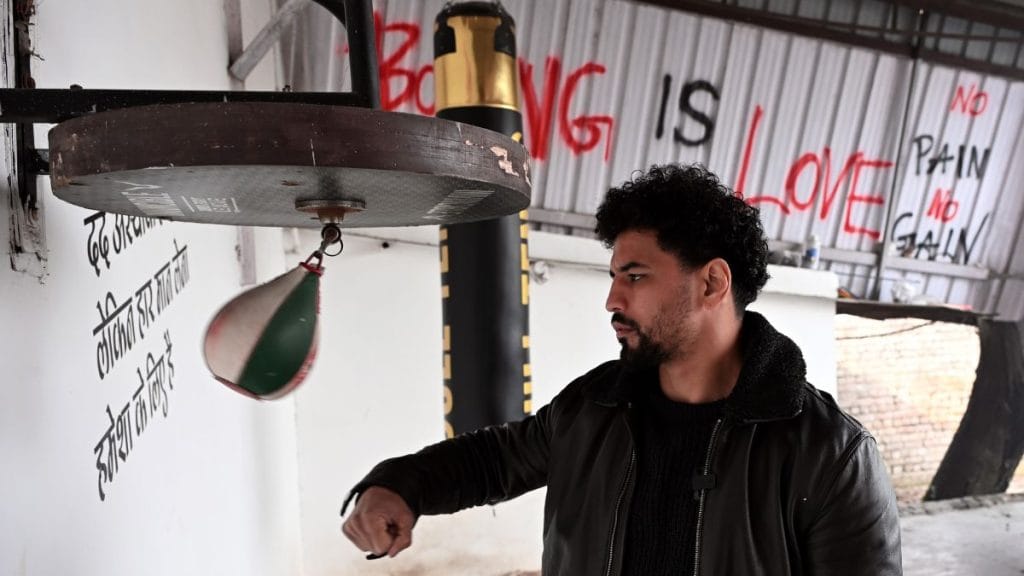
A boxer and a spotlight
Neeraj Goyat grew up in Yamunanagar, surrounded by a strong sporting culture. He dabbled in several sports before setting his mind on boxing.
He became the first Indian boxer to enter the World Boxing Council’s global rankings and went on to win the WBC Asia title three times between 2015 and 2017. He also became the first Indian boxer to defeat China’s Xu Can on Chinese soil, years before Can went on to win a world title.
At 14, he started training at the Army Sports Institute in Pune, after being picked from the state circuit in Haryana.
“When he first came in, he didn’t talk much,” recalled his coach from Pune, Narendra Rana. “But his power was evident in the ring.”
Those who grew up with him say his public confidence today masks a far quieter personality.
“He is the most shy and least talkative person among friends,” said Shivam Suppal, one of his childhood friends. “He still laughs at the same silly jokes. Nothing has changed in 20 years.”
In a sport where most Indian boxers struggle to secure international bouts, Goyat has built a career by travelling constantly, even more than some of India’s better-known professionals like Vijender Singh — fighting in Asia, Europe and the Americas, often outside the domestic federation ecosystem.
That independence has helped him, but it has also pushed him towards a different model of survival: visibility.
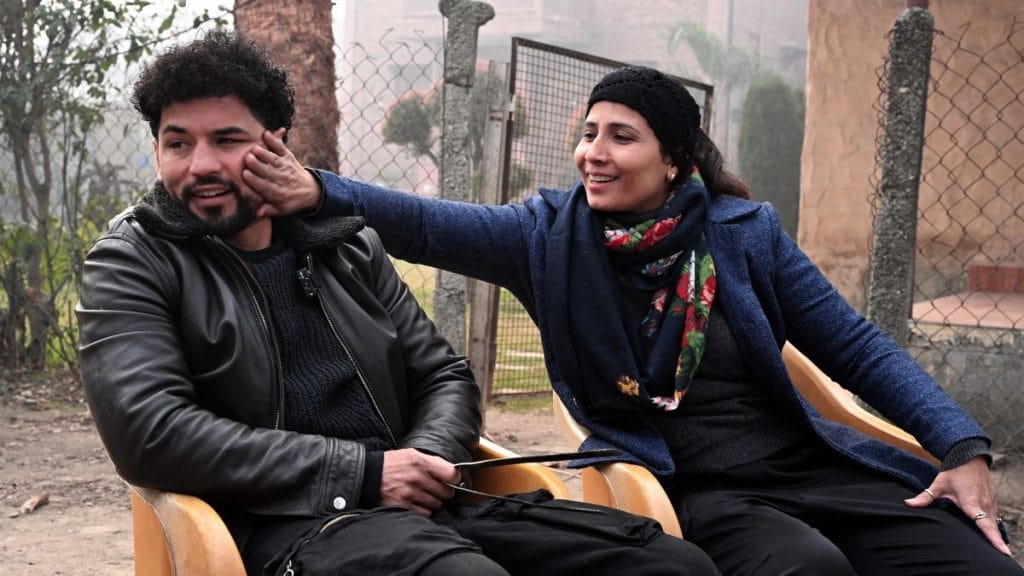
Pivot to reality television
In 2024, Goyat entered mainstream entertainment when he appeared on Bigg Boss OTT Season 3 in June 2024 and was eliminated early after clashes with other participants.
The pattern repeated itself the following year on Battleground, a fitness-based reality programme, where a verbal argument with influencer Rajat Dalal escalated into a physical altercation during filming. Crew members had to intervene and clips of the fight spread online within hours.
“My fights and arguments are just about expressing different opinions,” Goyat said. “They end there.”
Boxing, Goyat insists, should not be equated with aggression.
“In the ring, we don’t beat people out of anger,” he said. “We fight with technique.”
Yet much of the attention around him now comes from moments that sit outside the technical craft of the sport.
In another widely circulated incident, he publicly challenged influencer Abhishek Malhan to step into a boxing ring. The video, filled with taunts, split audiences between those who accused Goyat of intimidating a non-professional and those who applauded the challenge as an attempt to popularise boxing.
“Mere saare influencer bhaiyo, jo apni maa ka doodh pee rakha hai, boxing ring mein utro (My influencer brothers, whoever has had their mother’s milk, enter the ring),” Goyat said in one of his videos.
That trade-off — attention in exchange for friction — is central to Goyat’s public strategy.
“I only wanted influencers to promote sports and boxing,” he said later. “If controversies help, I am okay with that.” Malhan and Goyat shared a stage together later in 2025.
Goyat has also appeared in the critically acclaimed film Mukkabaaz (2017) and played a boxer in Toofaan (2021), where he also trained actors for boxing sequences. He has also trained actors Ram Charan for RRR (2022) and Varun Tej for Ghani (2022).
Away from the cameras
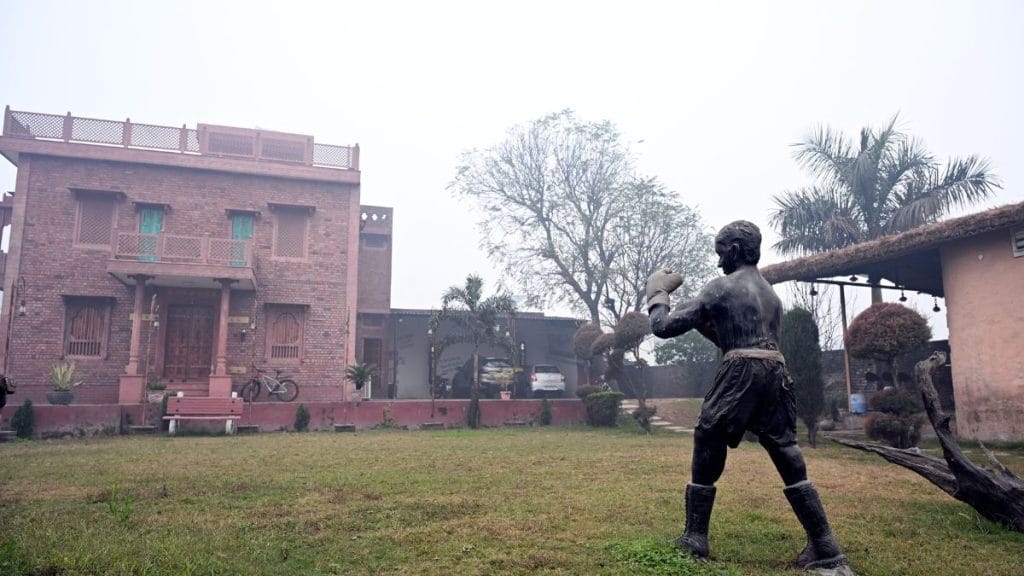
At the entrance to Neeraj Goyat’s red-sandstone house in Yamunanagar, a black-stone statue of a child frozen in a boxing stance stands beside a hanging punching bag. The walls carry familiar gym slogans — “Boxing is love” and “No pain, no gain” — while his name is stylised as GO(Y)AT, a nod to the ‘GOAT’ tag.
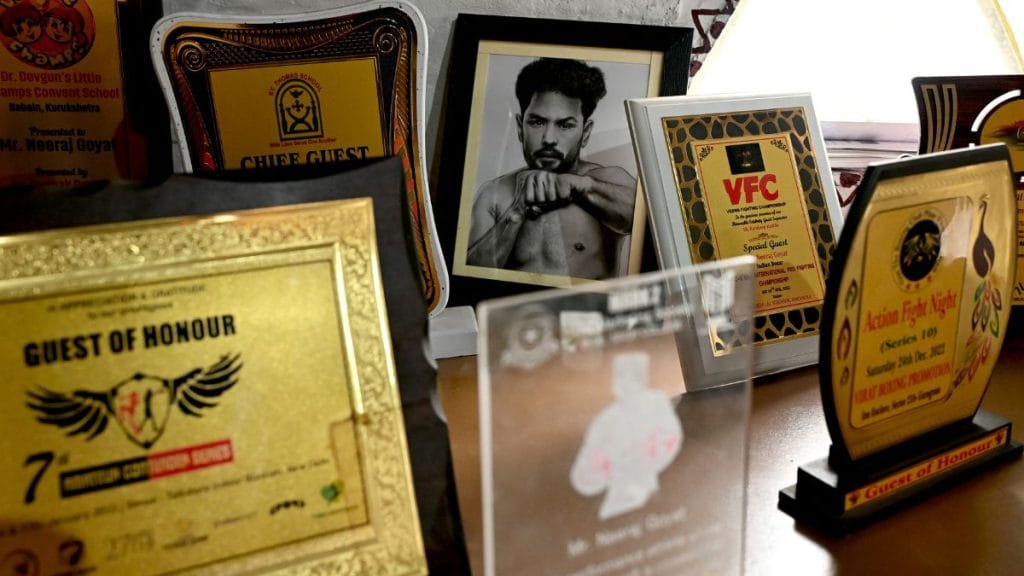
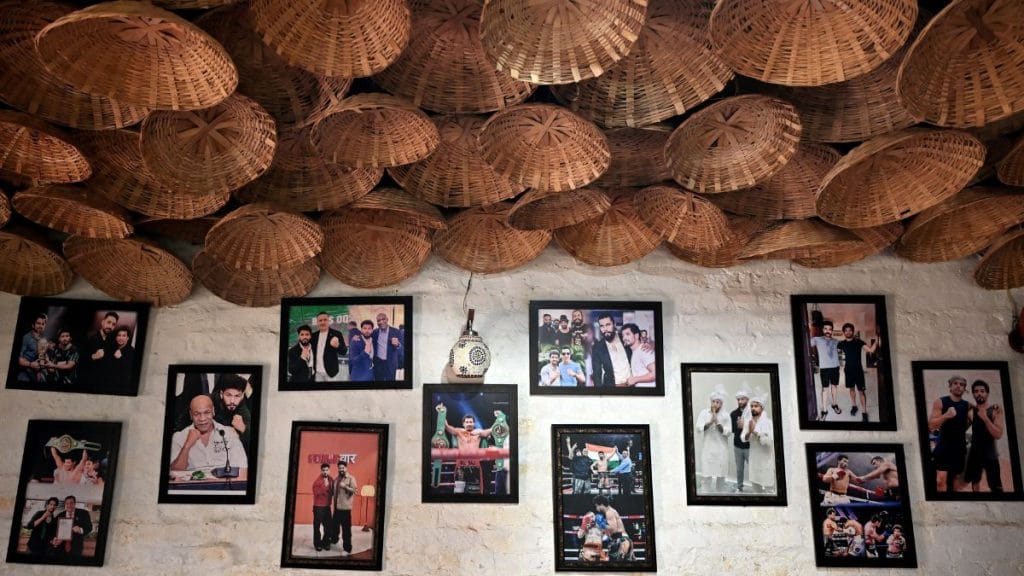
A short walk inside leads to an open gym and a separate “Room of Fame”, where medals, certificates and photographs line the walls — including images of fighters such as Mike Tyson and actors like Farhan Akhtar.
“Fights always fascinated me. Whenever there was a fight, I would stop and watch it,” Goyat said.
Behind Goyat’s house, friends and relatives gather around a bonfire in the open courtyard on one winter evening. Goyat sat roasting sweet potatoes, teasing his friends and laughing while others spoke for him.
“He is still the kid of the house, always sticking close to our mother, avoiding family gatherings,” said his sister, Parveen Sanghwal. “He was always good at sports, and our parents never forced him to study.”
Neighbours describe him as accessible and consistent, still living in the same locality and spending evenings with the same group of friends.
During festivals, they say, he distributes sweets and essentials in nearby neighbourhoods.
“This is the real Neeraj when he’s away from the glare of cameras and online drama—generous, warm, and deeply loyal to the people around him,” his friend Shivam said.
In 2022, during the peak of the Russia-Ukraine war, Goyat and his team used contacts within the boxing community in Ukraine to help Indian students move out of conflict zones. He says they created WhatsApp groups, coordinated transport and helped students travel from Kyiv to Lviv and onwards to Poland.
“We helped more than 300 students reach safer places, provided food and shelter,” he said. “I can’t see people in trouble. If someone asks me for help, I feel compelled to do something.”
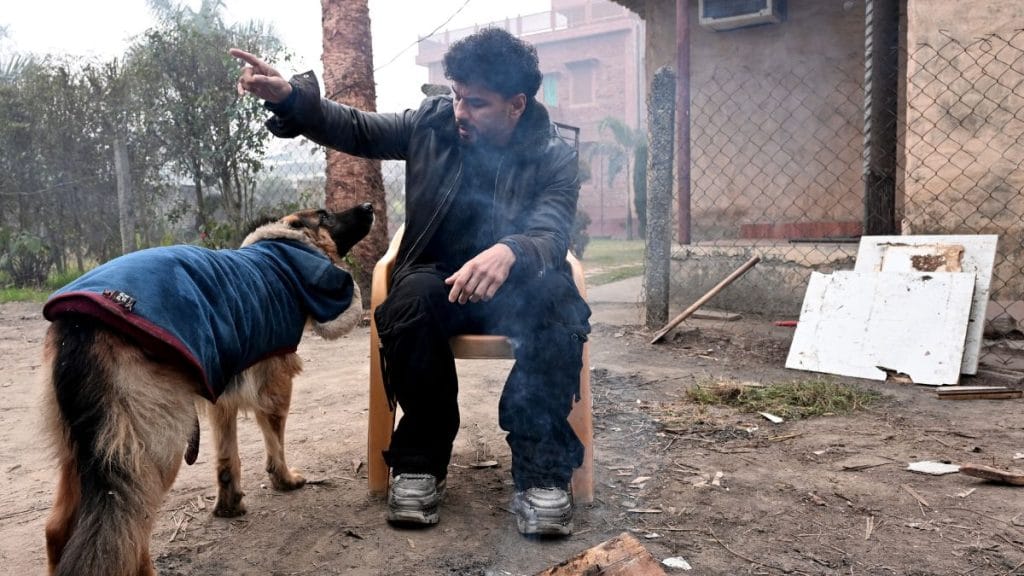
As they traded stories, Goyat stood up and walked towards his German Shepherd, scanning the ground for two snakes he says live on the property and which he casually refers to as his “pets”.
“Besides boxing, animals make me the happiest,” he said. “You don’t have to put in extra effort to keep them happy.”
Also Read: Meet Aishwarya Sengar, Unnao rape convict’s daughter & defender. ‘I’m a feminist’
A carefully built image
Goyat is among the most followed Indian boxers on social media. His accounts blend training clips, travel vlogs, short motivational videos and lifestyle content.
He switches between Hindi, Haryanvi and English, often opening videos with casual greetings while walking through foreign streets before showing short sequences from gyms or arenas.
“Ram Ram bhai, is waqt hum hai America me (we are now in the US),” he says in Haryanvi in one video.
In another clip, he addresses a persistent myth among new boxers — that the nasal bone must be surgically removed to fight professionally.
“You don’t have to remove any bone for boxing,” he says plainly. “This is a misconception.”
In others, he walks alongside religious processions, joins long-distance pilgrimages like Kanwar Yatra or films himself working out in hotel corridors between fights.
The reach is significant. His Instagram following runs into the millions; his YouTube channel has hundreds of thousands of subscribers. His net worth is estimated to be between approximately Rs 8 crore to Rs 25 crore.
For many young boxers, he is one of the few professionals whose career they can follow in real time.
“New boxers look up to him,” said Ajay Sai, an international boxer and certified coach. “He gives tips, shares his matches and stays connected with the audience.”
Different sides of Neeraj
Unlike controversies where public discussion often shifts towards private life, Goyat’s controversies have largely amplified his professional visibility.
Within the boxing community, he is being closely watched.
“His discipline and his vocal pride in his country, language and culture are examples we give young boxers,” said Ajay Sai.
He has not lost sponsorships because of them. If anything, his public profile has expanded.
“Controversy doesn’t bother me because most people react before knowing the whole story. But the truth eventually comes to light—it always does, especially with the support of my fans,” Goyat said.
He insists his public and private persona are not the same.
“I’m not just what you see in the ring. I have a different life around my people and for my people,” he said. “People are always different from how others show them.”
(Edited by Stela Dey)