





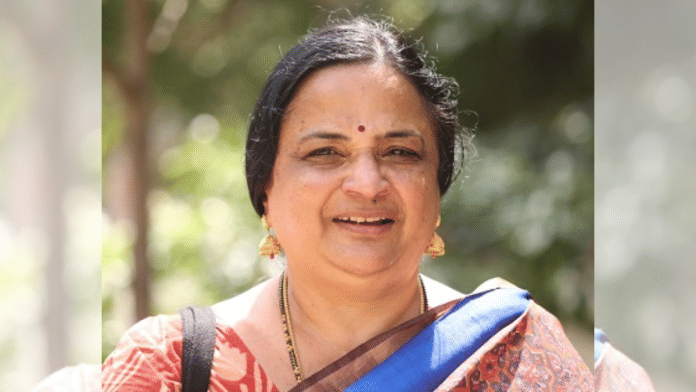



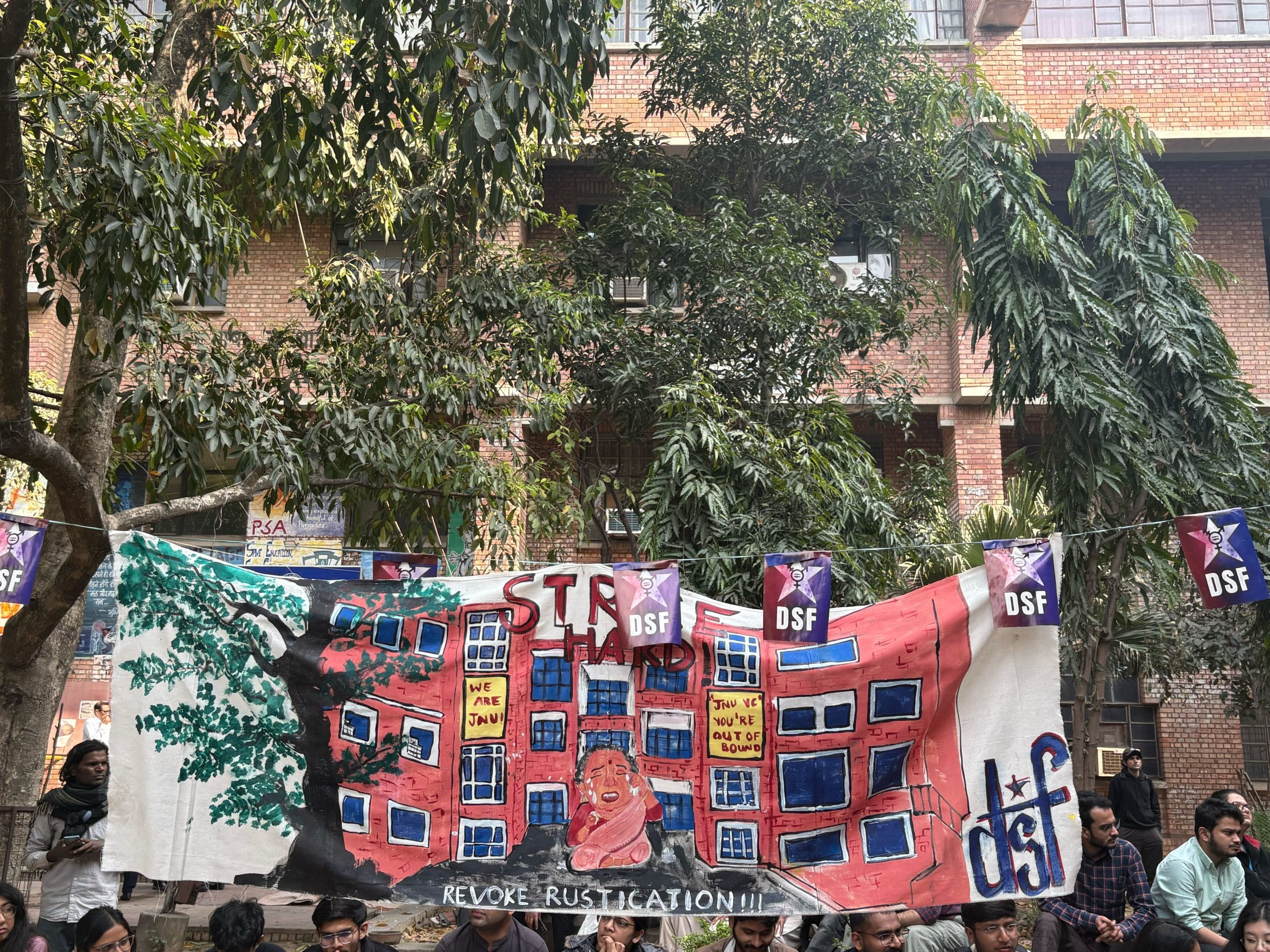
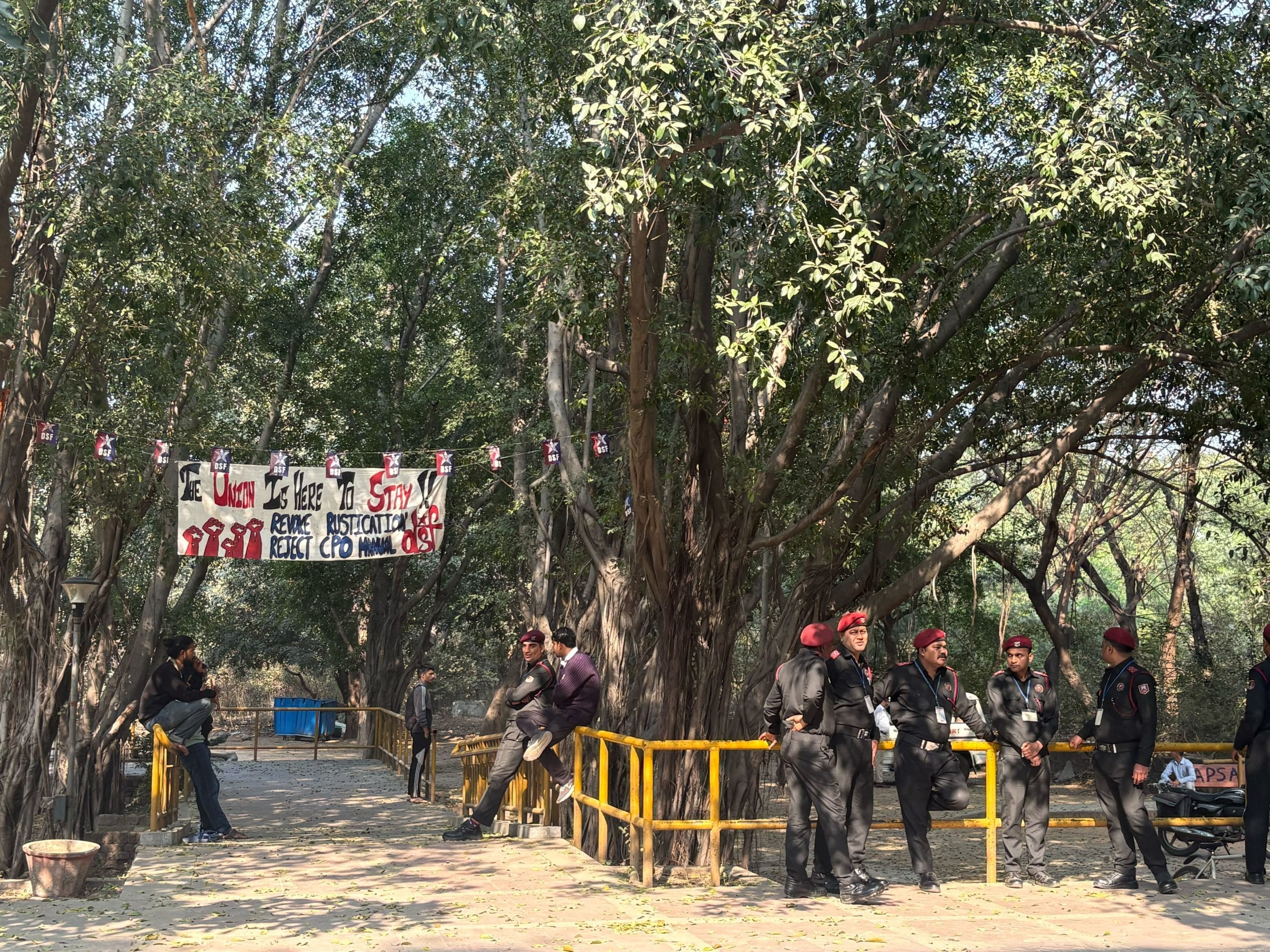
New Delhi: At Jawaharlal Nehru University, students are once again on strike, refusing to leave until Vice-Chancellor Santishree Dhulipudi Pandit submits her resignation.
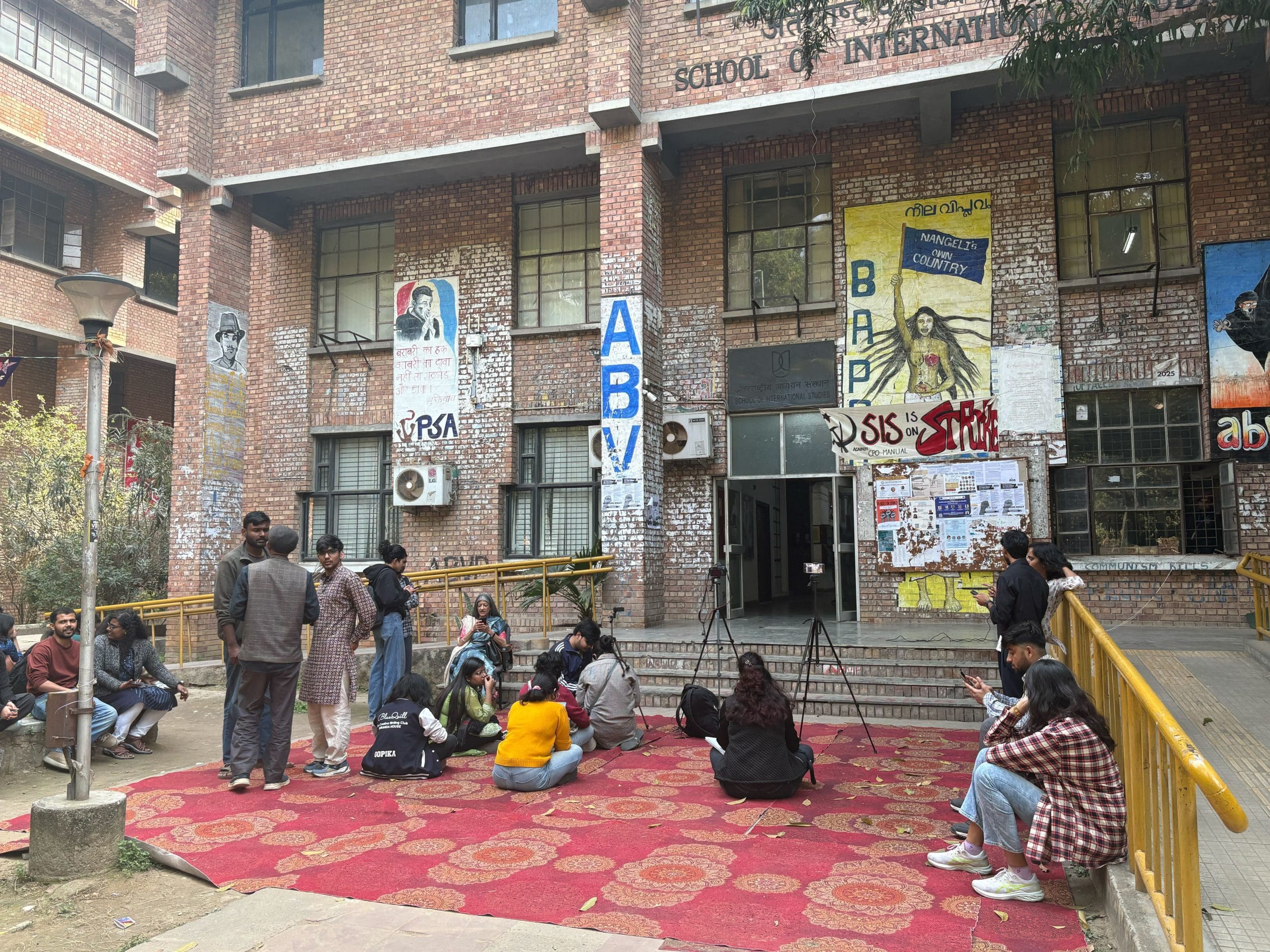
Posters about the strike cover walls across the campus, and some professors have even moved their classes outdoors to accommodate the students on strike. They continue teaching on steps and lawns, holding lectures amid the unrest. Everywhere, the conversation revolves around when the VC will finally meet the students — most of whom have never met her in person.
“When she came in, we all had so much hope,” said one student, referring to Pandit, JNU’s first woman VC. “We thought things would finally change.”
Others fall silent, reflecting the quiet disappointment that lingers across the campus nowadays.
Comparisons with former VCs have become routine, and this frustration isn’t limited to the “Left”; members of the Akhil Bharatiya Vidyarthi Parishad (ABVP) have also voiced their dissatisfaction with Pandit. Many believe she has fallen short in her leadership. Several professors said recruits are struggling to teach effectively, while many accomplished scholars remain stuck in their initial positions, with little recognition or career advancement in sight. The frustration among the faculty is palpable, even if most choose to stay publicly silent.
The university stands at a critical point, even though it has been led for the past three-and-a-half years by one of its own alumni.
Allegations have been made against the VC, accusing her of blocking recruitment for OBC, SC, and ST posts on grounds that no suitable candidates were found during her tenure.
Some have accused her of favouritism and of making what many regard as a controversial remark about caste.
“There is a permanent victimhood, and you cannot progress by always playing the victim card. This was done by the African Americans; the same thing was brought for the Dalits here. By turning someone into a devil, it is not easy to progress. It is a temporary kind of drug,” she said during a recent podcast interview.
ThePrint reached out to Pandit’s office on 21 and 23 February via mail, requesting an interview to learn about various issues on campus, including the recent rustication notices sent to five JNUSU students, library conditions, reduced academic/executive council roles, dismantling of GS CASH for ICCs, budget priorities, and student demands. ThePrint also tried contacting the registrar by phone and sent messages via WhatsApp to the VC’s media coordinator. As of now, ThePrint has not received any response from the university.
JNU’s struggles reflect a broader trend. Across the country, protests and allegations of insensitivity, corruption and political bias have put university leadership under scrutiny.
In Assam’s Tezpur University, students staged a 100-day protest against Vice-Chancellor Shambhu Nath Singh over his prolonged absence and alleged financial irregularities in August 2025. In Rajasthan, five university vice-chancellors were removed or compelled to resign in December 2025 due to allegations of financial irregularities, administrative overreach, and controversial statements in public. It was during the tenure of Governor Haribhau Bagde, who serves as chancellor of the state universities.
These battles mirror larger Centre–state tensions, sharpened further by the University Grants Commission’s (UGC) 2025 draft regulations, which overhauled higher education across the nation and aligned it with the National Education Policy (NEP) 2020.
“The role of VCs in Indian universities is undergoing a major transformation. While they often face protests for being insensitive, corrupt, or insular, they also encounter state-level hurdles during appointments,” said Rakesh Batabyal, historian and associate professor at JNU.
“Historically, JNU has been led by some of the country’s most respected academics, whose impact went beyond enhancing the university’s academic standing. They fostered a campus where students, teachers, and staff — despite differences — felt empowered to learn, speak, and grow,” said Batabyal.
Also Read: ABVP, Left groups trade charges after midnight scuffle at JNU. Campus tense, no complaint filed yet
The atmosphere in JNU
Many described the current mood of the university as “uneasy” — a mix of fear, anger and, for some, a lingering hope that accountability may yet come.
N Sai Balaji, former president of the Jawaharlal Nehru University Students’ Union (JNUSU), described the situation as “larger than administrative friction”. He called it “a political and ideological attack on JNU.”
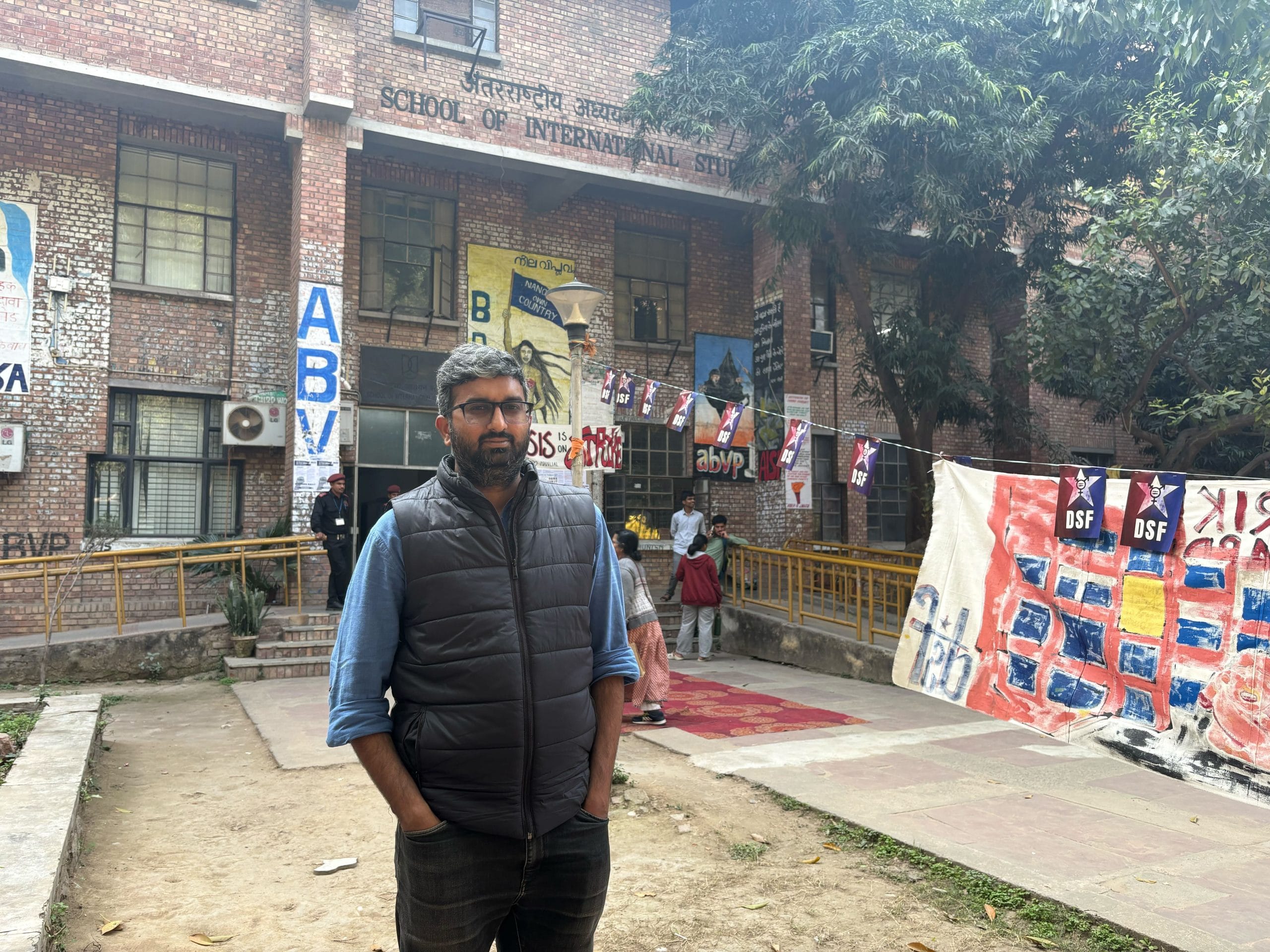
“She used to say ‘I am from JNU, I understand JNU well, and I want the conversations and dissent here to continue smoothly’,’” said Balaji.
Years later, he accused Pandit’s tenure of being marred by corruption, authoritarianism, and caste-based bias.
After her appointment, a press note was released meant for students and faculty. “The immediate priority of this administration is to ensure clean governance, a student-friendly atmosphere, and a gender-sensitive environment that promotes academic excellence,” the press note read. She also emphasised that her focus would be on developing an India-centric narrative.
Shortly after her appointment, her older, unverified X account was deleted. Some of her previous tweets, however, resurfaced. “Shocking – Tamil Nadu has become another den of extremists. Where are the Periyarists and rationalists? How can radical Islamists and fanatical Christians be allowed free rein?” she wrote in the tweet.
Balaji pointed to her earlier attempt to become Vice-Chancellor of Meghalaya’s North-Eastern Hill University in 2021. He said that documents from that selection process referred to a penalty imposed during her time at Savitribai Phule Pune University. At Pune, she faced a penalty for irregularities in admitting Indian students to PIO-reserved seats.
“Punishment of withholding next increment permanently w.e.f. 01.07.2011… has been imposed,” read the proceedings of the NEHU VC selection committee in January 2021. Despite this, she was later appointed vice-chancellor of JNU.
“How did she become JNU VC with the same vigilance report? This means the committee knowingly made a corrupt person the vice-chancellor,” Balaji said.
But the unease on campus is not limited to questions about the VC’s appointment. Serious allegations about the university’s non-teaching recruitment process have deepened the crisis.
On 24 March 2025, Neeraj Singh Negi wrote to Pandit alleging large-scale irregularities in appointments made under the recruitment drive in 2023. He alleged systemic manipulation in the selection process, raising concerns ranging from examination standards to alleged bribery and conflict of interest.
“You will be shocked to know that this recruitment process was full of corruption & bribe. Mostly, candidates have been selected by giving bribes ranging from Rs 13 lakh to Rs 20 lakh,” Negi wrote in his email.
Pandit took charge as Vice-Chancellor of JNU on 7 February 2022.
He also pointed to the use of a common question paper across different cadres and described the hiring as unfair. The same set was used for junior assistant and section officer despite differing qualifications, favouring prepped candidates from Sonipat/Panipat exam centres, where 12 of 25 hires are from these districts, including three from the same family/coaching syndicate (e.g., Gupta siblings: Ravi, Neha, and cousin Amit).
Negi questioned the merit lists where Scheduled Caste candidates were passed over (for example, someone scoring 85/100 was ignored while a general candidate with 72/100 was selected).
The written examination had been conducted by the National Testing Agency (NTA), an external body.
In May 2025, the registrar’s office responded that the allegations were serious, but that action would depend on “relevant documentary evidence” showing the involvement of any university official.
Negi said that the UGC had already instructed JNU to act quickly. He demanded the immediate transfer of the official he accused, Bane Singh Meena, deputy registrar (Administration), along with a point-by-point response to each of his concerns. He warned that if no action was taken within ten days, he would take the matter to the Central Vigilance Commission and push for a CBI investigation.
The reports of alleged irregularities first surfaced in newspapers in 2024, months before Negi raised the matter.
For now, the issue is unresolved, and no formal inquiry results have been released.
Also Read: From ‘azadi’ to biometrics—a new wave of protest takes shape at JNU
Tenure at JNU
When Pandit took charge as VC of JNU in February 2022, she made history as the university’s first woman VC.
“We were happy when she took charge. We had real expectations. JNU has faced massive funding cuts. We also hoped things would change administratively. Under Jagdish Kumar, promotions had been stalled. We expected that to be corrected,” said Brahma Prakash, assistant professor at the School of Arts and Aesthetics.
An alumna of Presidency College, Pandit studied History and Social Psychology. She later completed her MPhil and PhD in International Relations from JNU in 1990. While also pursuing a post-doctoral research in Peace Studies at Uppsala University.
Pandit’s academic career began at Goa University in 1988. In 1993, she joined Savitribai Phule Pune University as a faculty member in Political Science and later became its VC in 2021. She has also worked for the UGC and the Indian Council of Science Research.
Pandit is also the author of several books on foreign policy, governance and regional politics. Her most recent publication, Reflections of an Unconventional Mind (2025), is a commentary on philosophy, women’s empowerment and political questions.
Her appointment to JNU was cleared on 6 February 2022, by then President Ram Nath Kovind, acting as the university’s visitor, following a recommendation by a search panel chaired by M Jagadesh Kumar.
Since taking office, she has pushed to bring JNU in line with the NEP and has expanded multidisciplinary programmes and introduced traditional Indian knowledge systems into the curriculum.
But many students on campus said that “the only thing she has done so far is organising RSS events on campus.”
During her tenure, JNU has hosted a series of events that some students said “blur the line” between academic inquiry and religious propaganda on a publicly funded campus.
Among them was a large-scale programme held at the University’s Convention Centre in collaboration with ISKCON Delhi, which included a kirtan and an invocation ceremony, which was attended by Pandit. In August 2023, JNU also partnered with ISKCON Delhi’s Institute for Science and Spirituality and Central Sanskrit University to host the International Conference on Vaishnava Vedanta.
“Prasad and copies of the Gita are distributed to students at these events. Just imagine what would happen if someone started gifting the Quran tomorrow. In the name of spirituality, they are turning it into a Shakha-style march,” said a student sitting outside the School of Arts and Aesthetics.
In March 2023, JNU hosted a two-day “Garbh Sanskar” workshop, organised by the Samvardhinee Nyas, an affiliate of the Rashtriya Swayamsevak Sangh (RSS). The programme focused on prenatal education and encouraged expectant mothers to absorb cultural and spiritual values during pregnancy. It promoted practices such as chanting Gita shlokas and Ramayana chaupais.
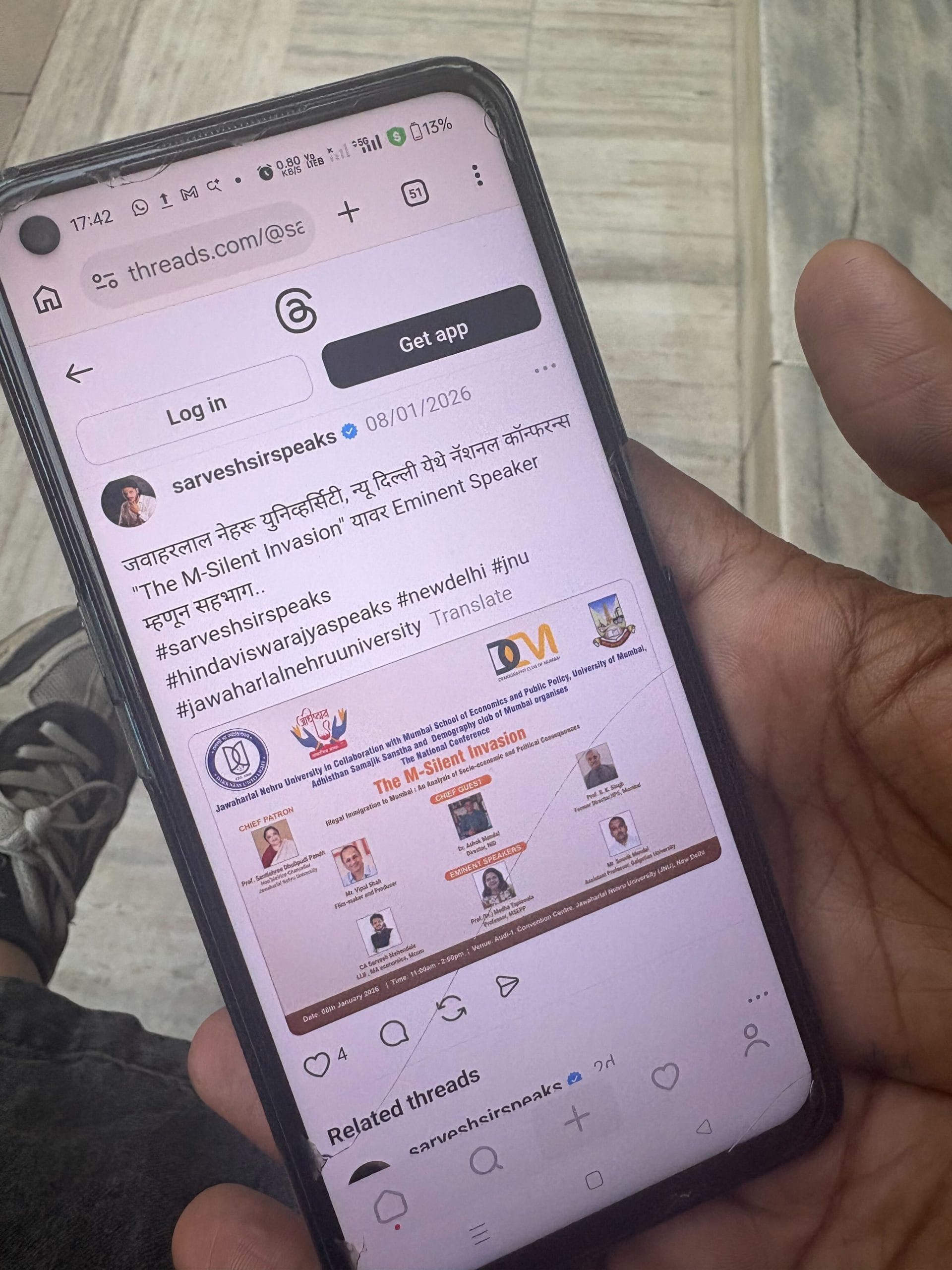
“The university also organised an event titled ‘M-Silent Invasion’, where filmmaker Vipul Amritlal Shah was the chief guest. Who is he to be invited in that capacity after making films like The Kerala Story 2, which many see as propaganda,” said Aditi Mishra, president of the JNUSU.
Also Read: JNU—the making and unmaking of an Indian university
Taking a step further
Professors and students allege that Pandit has undermined the very values and spirit that JNU has long stood for.
During M Jagadesh Kumar’s tenure as vice-chancellor (2016–2022), he banned protests near the administration block, and enforced mandatory attendance even for PhD students, raised hostel fees in mid-2019, imposed curfews that sparked clashes, and disbanded the elected Gender Sensitisation Committee Against Sexual Harassment (GSCASH) in 2017 in favour of an internal complaints committee.
“These moves eroded JNU’s tradition of protest and autonomy,” said Mishra.
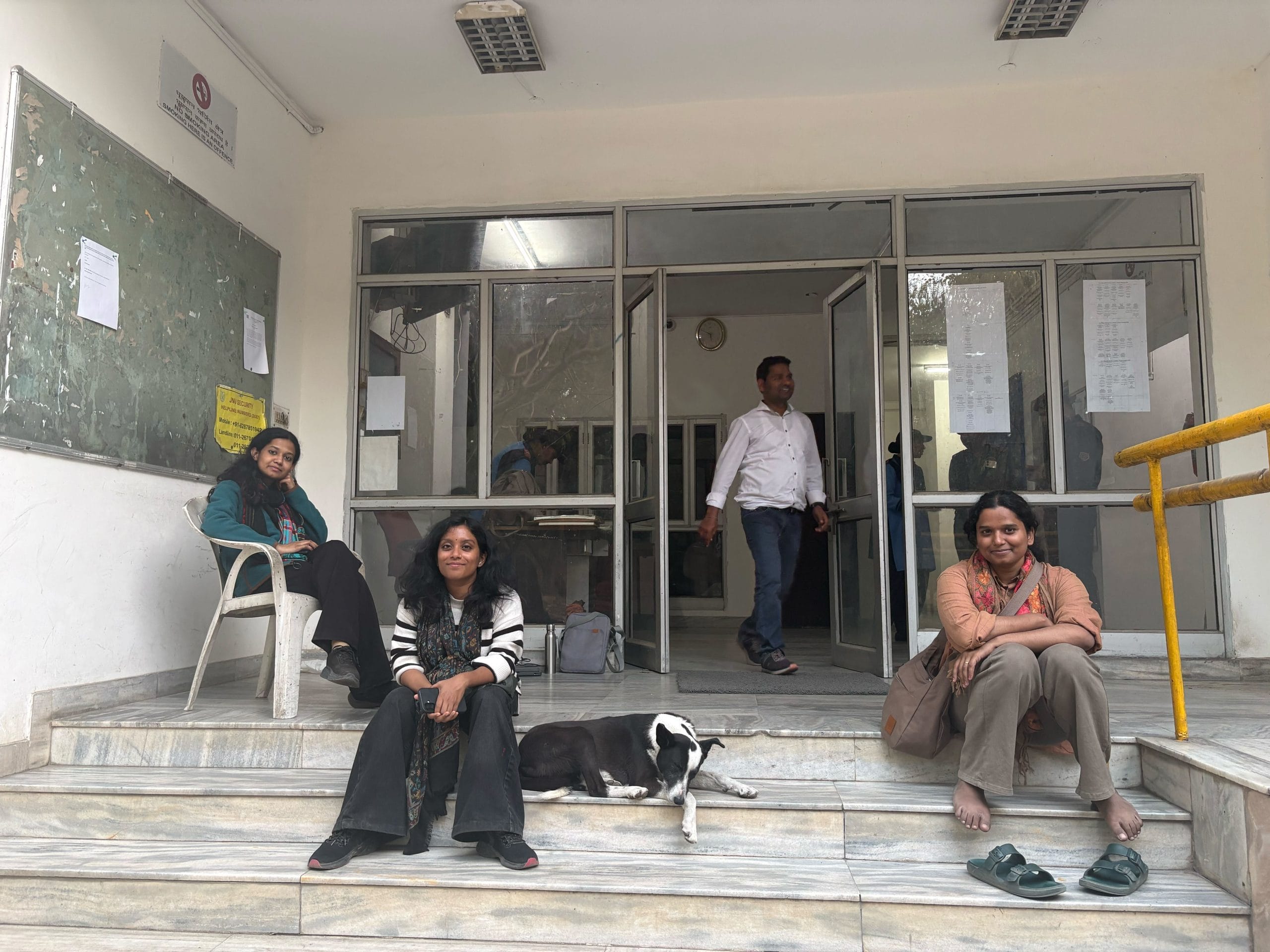
Pandit, Kumar’s successor, also oversaw controversial changes, including the introduction of the Chief Protocol Office (CPO) manual.
“She introduced the CPO manual through her loyal followers without consulting anyone, yet now she opposes it publicly while fines under the manual continue. Sometimes reaching lakhs of rupees for students, without any incidents of violence or misconduct. Even ABVP members have fines of Rs 4-6 lakh. I, too, face Rs 25,000 fine for peaceful protests,” said Rajeshwar Kant Dubey of JNU’s National Executive Committee.
Dubey said that she has shown an “anti-student” and “anti-Hindi attitude”. In the recruitment process, candidates from UP and Bihar have faced discrimination, while many appointments favour candidates from south India, including her home state Tamil Nadu, he alleged.
“One candidate applying for an assistant professor job was told to speak in Tamil or leave, despite being eligible. Multiple people, at least 15-20, have reported a similar experience over the past two years,” Dubey said.
He also accused her of appointing Left-leaning individuals disproportionately to major positions and committees.
This view, however, is not widely shared among professors and students, many of whom said that she tends to favour candidates affiliated with the RSS.
“There are also concerns over financial management. In 2023, Rs 56 crore was allocated for infrastructure, but there is no clear account of where that money went. Hostels and basic facilities remain in poor condition, despite promises of development,” said Dubey, adding that the AVBP has filed formal complaints with the registrar’s office about the irregularities, but no action has been taken so far.
Also Read: ‘This is Pune, won’t let it turn into JNU’—how BJYM stormed college event over a Bangladesh flag
Problems faced by JNU professors
Sitting in his office, Indian cultural theorist and JNU professor Brahma Prakash recalled a time when universities used to follow democratic norms. Deans and chairpersons used to be appointed on a rotation basis in order of seniority, and everyone had a voice.
“Now, only a few deans speak of the issues, while others remain silent. Democratic debate has disappeared,” he said.
Prakash said that the executive council and academic council meetings are now online, mics are muted, and anyone trying to speak – whether on syllabus changes, entrance exams, or new courses – is silenced.
“Infrastructure at JNU is in crisis. Professors face blocked promotions. Promotions now appear biased, favouring certain ideological groups over professionalism and credentials,” he added.
The academic stressed the problematic nature of the recruitment process. He said that positions remained unfilled or marked “Not Found Suitable,” especially in OBC and SC/ST categories.
“I am facing delays in my promotion despite 12 years of service here. Even after Executive Council approval and the VC’s verbal acknowledgement, formal letters were withheld, and meeting the VC in person can take months,” Prakash said.
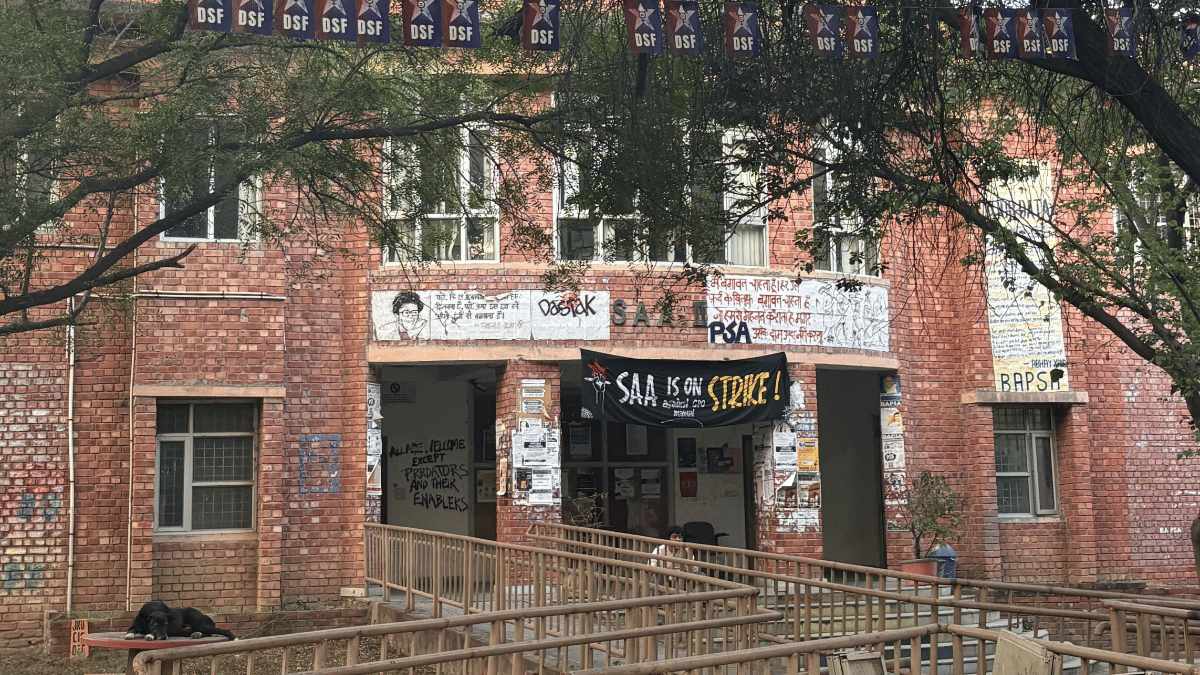
He told ThePrint that after his selection for the position of professor (OBC) and approval in the EC he was denied the joining letter and instead a call was made to him from the administrative office.
During Jagadish Kumar’s tenure as chairman of the UGC, 48 teachers faced disciplinary actions in 2018, including suspensions, show-cause notices, and fines. The protests that erupted were sparked by unfilled OBC/SC/ST seats, lack of transparency in administration, and other ongoing grievances, including a one-day sit-in on the Mahatma Gandhi Road in New Delhi. But in 2019, the high court halted coercive steps like suspensions. The decision was widely seen as a victory for the professors.
Yet even today, JNU professors continue to face similar pressures, with some still being asked to submit apology letters.
Professor Pradeep Shinde said that at the Centre for Informal and Labour Studies, positions meant for SC candidates were arbitrarily transferred to EWS by Pandit. He added that he is planning to challenge this in court.
Shinde has been working as an assistant professor since 2013, and typically, after 5 years, one becomes eligible for promotion to become an associate professor. There are three stages, each with incremental benefits.
He alleged that during Jagadish’s tenure, the administration systematically interfered with promotions. Candidates with strong publications were denied opportunities, with many assistant professors appointed improperly and without the required merit.
Also Read: ‘Slogans against Modi, Shah’: Full-blown BJP versus Opposition slugfest over JNU campus protest
Concerns about fairness and representation
One of the members of the administration told ThePrint on the condition of anonymity that Pandit allegedly extended the tenure of the School of International Studies (SIS) dean after completion of the first term.
“This undermined the chances of other senior faculty members and was also a breach of democratic principles. There are accusations that the VC’s handling of the OBC and SC/ST appointments was flawed, claiming that no suitable candidates could be found. In SIS, out of 47 Professors, 40 are from the Brahmin caste, this was raised by the student union,” he said.
He also mentioned that several professors praised her for being present for most of the interviews during the recruitment process.
But concerns about fairness and representation persist.
An email was sent to Pandit in September 2025, requesting re-verification of the teaching and academic experience of an assistant professor at Centre for West Asian Studies, School of International Studies.
The complainant, Rajendra Prasad, is an assistant professor in the Department of Political Science at Sambhu Nath College, stated that after appearing before the selection board on 15 September 2025, the board noticed possible discrepancies during the document verification. They questioned whether the assistant professor meets the minimum experience requirements outlined in the 2018 UGC Regulations.
According to the mail, the assistant professor’s five-year tenure as a research analyst at the Manohar Parrikar Institute for Defence Studies and Analyses may not qualify because the position is at Pay Level 6, whereas the UGC requires Pay Level 10 or higher for teaching or academic experience to be counted toward associate professor eligibility. The assistant professor’s additional experience as a research fellow at the Indian Council of World Affairs, while academically relevant, still falls short of the mandatory eight-year experience.
Prasad urged the university to carefully re-verify the application to ensure that the recruitment process was transparent and fair. He also noted that another assistant professor’s appointment at the Centre for West Asian Studies is already under challenge.
Another example is the recruitment of an assistant professor in the sociology department.
“He did his PhD in geography, but ended up teaching a core Sociology paper in our first semester. The course covered the major founding fathers of Sociology. The class with him was really difficult to attend. Thankfully, it was a collaborative paper, so another experienced professor also taught one of the thinkers,” said Deepali, a first-year MA Sociology student.
She said that he struggled to explain the basic concepts, and his classes were confusing. Sometimes, he would go off-topic, even talking about the Upanishads for no clear reason.
At the university’s canteens and dhabas, professors asked students for updates on the strike. They whisper in near inaudible tones.
“The VC isn’t that bad. She must be under pressure from above as well as from the union — she’s stuck in between,” one professor could be heard saying.
(Edited by Insha Jalil Waziri)
JNU must be shut down. No new batches must be inducted. It has done enough for the country – served it with distinction. But then every good thing does come to an end – sooner or later. It was good while it lasted – everyone had fun. Now it’s time to pack up and leave – possibly for greener pastures in US/European academia.