





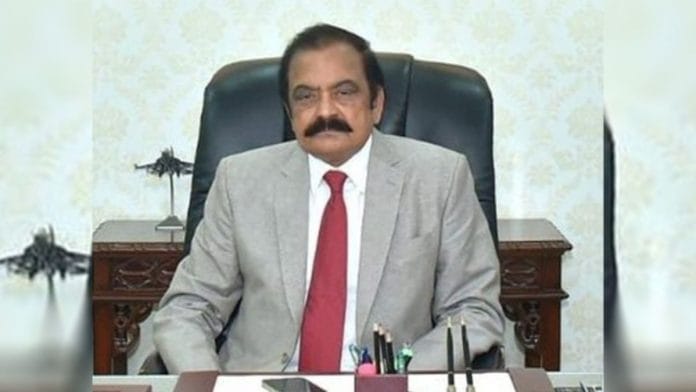



New Delhi: The forum honouring Pakistan’s most respected human rights defender witnessed one of its most controversial moments when Rana Sanaullah, an adviser to Prime Minister Shehbaz Sharif, said that supporters of the Balochistan Liberation Army had effectively forfeited their human rights and could therefore be forcibly disappeared.
Sanaullah was speaking at a session titled ‘Is There a Political Will to Solve the Crisis in Balochistan?’ at the Asma Jahangir Conference 2026 on Sunday. Responding to points raised by other speakers regarding the treatment of people from Balochistan, he said that during security operations, even common people found to be associated with the BLA would be punished.
“If incidents like those on 31 January occur, then security forces will take action, and there is a possibility that some of the people taken into custody could be innocent,” he said. On 31 January, an attack took place in Balochistan that was later linked to the Balochistan Liberation Army (BLA), targeting state security personnel and civilians.
The annual gathering, which brings together human rights defenders, diplomats, journalists, victims’ families, and international observers, saw strong reactions to these statements. Many members of the audience walked out in protest. Karachi-based artist and activist Sheema Kirmani asked Sanaullah to “Shut up” while his speech was on.
“Asma’s name is a symbol of people’s rights, resistance, defiance, and justice. If, at this conference, you give a platform to those who justify state violence, then we will not sit and listen to it. If Asma had been here, she herself would have walked out and would not have allowed such people to speak,” Kirmani said in an interview with Dawn.
A state in denial
For years, families, particularly in Balochistan, have accused Pakistani security agencies of abducting students, activists, journalists, and political workers, often without charges or warrants. Despite repeated denials from state institutions, human rights organisations — both domestic and international — have documented thousands of such cases.
“Whenever I go to my area, four or five people come [up to me] daily, complaining about a missing person,” said National Party leader Dr Abdul Malik Baloch at the Asma Jahangir Conference.
The conference has historically been one of the few platforms where these families of the missing people are heard and where they can speak without fear of security threats. In this context, Sanaullah’s remarks highlight how openly ordinary citizens are being threatened. It also once again highlighted how the sensitive topics, such as enforced disappearances, was discussed as another political issue.
“The PM adviser is now openly calling for enforced disappearances before HRDs, diplomats, and UN officials, while victims’ families sat in the room. This confession of military-elite coordination in crimes against humanity is emboldened by the impunity they enjoy,” said Abdullah Abbas Baluch, who identifies himself as Executive Director at the Human Rights Council of Balochistan, on X.
Groups such as the BLA carry out attacks against the state, security forces, and projects such as the China–Pakistan Economic Corridor (CPEC), fighting for Baloch rights and independence. The government, instead of primarily addressing political grievances such as enforced disappearances, lack of development, and demands for autonomy, has largely treated the issue as a security problem and has consistently relied on force to manage the situation.
Also read: Pakistan crackdown on manhole cover thefts. ‘Full blown emergency’
Pakistan’s civil-military imbalance
Rana Sanaullah’s statement reverberated beyond the conference venue and onto social media. Activists and commentators described the remarks as far more serious than a mere political gaffe.
The backlash also merged into a broader critique of Pakistan’s civil-military imbalance.
“Rana S. is a civilian front for a military dictatorship whose real master is Asim Munir. To cling to power, they murder, abduct, jail critics, plunder homes, and terrorize the nation,” another user wrote on X.
Many on social media also pointed to the political hypocrisy embedded in the statement, sharing photos of Chief Minister of Pakistan’s Punjab Maryam Nawaz sitting in solidarity with families of missing persons.
“He seems to have forgotten that Maryam Nawaz sat in solidarity with the families of missing persons. He also forgot that his own government announced a compensation package for those same families,” wrote a user named Shagunblitz.
(Edited by Ratan Priya)