





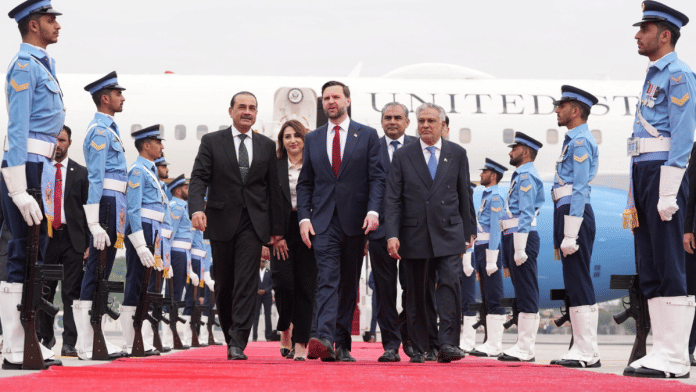



New Delhi: A day after Pakistan hosted the US-Iran peace talks, Pakistani journalists are targeting their government for not having received any access to information while the negotiations were on in Islamabad. They feel insulted and ignored.
Senior Pakistani journalist Mubashir Zaidi slammed his own fraternity and called out the ‘WhatsApp journalism practised’ in their country.
“Most Pakistani journalists lack experience in international events or diplomacy. But it’s important to note that American and Iranian journalists were being given information by their diplomats, whereas our journalists were not given any information. They’re addicted to WhatsApp anyway, but since no WhatsApp messages came through, they’re left without any information”, Zaidi wrote on X.
Soon, others joined in. Investigative journalist Saadia Mazhar called it a failure on the part of government agencies that had infiltrated Pakistani media houses.
“Our ministry also lacks experience in international events—those arrangements that were flashy for them are standard by default in major events… our government has silenced everyone by giving money to institutions to hire people of their choosing, and no one gives any importance to the news in this regard”, she added on X.
Soon, the digital space of Pakistani media became a larger discourse on credibility. Dissent, according to many senior journalists, has effectively been curtailed in newsrooms across the country.
“The credibility of news channels has been sunk by appointing the unqualified. Reporting has long since ended and shifted to WhatsApp. Professional editors were not to their liking; they were forcibly removed. Now, news channels are mostly controlled by anchors, former government officers or admins, and HR’s smooth-talking spokespeople,” Pakistani journalist Imran Mir wrote on X.
Soon, it extended to larger issues—like the sleep patterns of senior journalists. Everybody had a bone to pick.
“Our journalists don’t even know how to use a gadget. They are accustomed to cameramen and other supporting staff and cannot work as one-man operations. Our journalists also fall asleep quickly, and according to sources, some mega-senior journalists have even been found taking naps,” Pakistani news producer Aatif Khattak said on X.
Pakistani journalist Azaz Syed called it ‘unprecedented control of mainstream media’.
“During the Iran-US talks, the same control was maintained—no news was allowed to air—despite objections being raised over reports of Iranian planes arriving at Noor Khan Air Base, even though the record of those planes’ arrival was visible online to the entire world. Those in control were depriving Pakistanis of information, but JD Vance’s arrival was being broadcast live across the world, including in the US and India, while the Foreign Office spokesperson released the news and footage an hour later. Sir, this is Pakistan’s media—consider its reporting constructive. Yes, there are issues with readiness at certain points, but imposing information blackouts and such restrictions is harming the country. I hope you will make an effort to understand this perspective,” Syed said on X.
Also read: Pakistan doesn’t want Asha Bhosle tribute on TV. Don’t take us back to Zia era, journalists say
‘Embarrassing the host country’
A few, however, also came to their defence. Awais Yousaf Zai, in a long post on X, rained down hard on the criticism.
“There were high-level delegations from both countries engaged in talks, so reporting on them with guesswork was tantamount to sabotaging the negotiations or embarrassing the host country on the global stage. There was only one proper way to report: to share only verified news, which could only come from the individuals involved in the delegation. And that’s exactly what happened. The news should have emerged in the same way—with members of both countries’ delegations briefing the media or directly reaching the public through social media posts”, he wrote on X.
The lack of access for journalists by the Pakistani government also made global headlines.
AFP in an article Saturday titled, “Buffets, baristas, but no briefings” reported that journalists “were bored out of their minds”.
“By sunset, the ‘Islamabad Talks’ had produced press releases, a memorable food spread and impressively fast internet in a country driven with tech challenges. Whether they produced anything more substantive remained, for those inside the hall, just beyond their reach,” the article noted.
(Edited by Saptak Datta)