





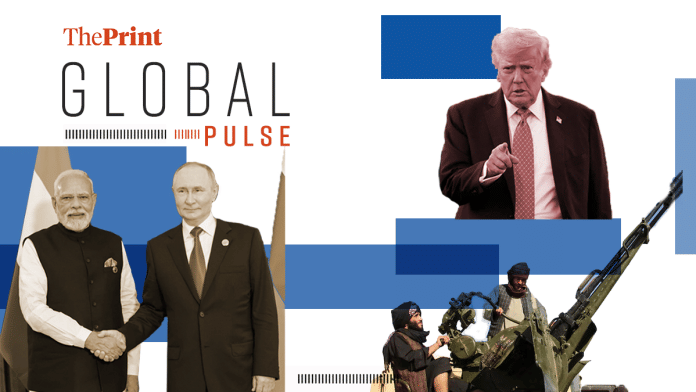



New Delhi: Russian President Vladimir Putin’s upcoming visit to New Delhi amid strain in India-US ties has attracted the attention of global media which says “New Delhi will have to do some extreme contortions” if it plans to cut a deal with Moscow without further alienating the west.
In Financial Times’ India business briefing, Veena Venugopal looks at Russian Putin’s forthcoming visit, at the heart of which is a question—will India buy more arms from Russia?
“In August, the head of Russia’s agency for military co-operation, Dmitry Shugayev, said the two countries were discussing the S-400, Moscow’s advanced long-range surface-to-air missile defence system. These were reportedly very effective during Operation Sindoor in May,” she writes. “In 2018, India paid $5bn to acquire five S-400s despite the threat of US sanctions, using a complicated financial structure to manage the risk of American ire.”
Putin’s December 5-6 trip and the possibility of more weapons purchases come at a time when the India-US relations are going through a rough patch.
“Donald Trump, who has taken a belligerent tone with regard to India’s continued business ties with Russia, is unlikely to view any deal with Moscow kindly. Imports of Russian crude, which India has cut in the past few weeks to placate Trump, are also likely to come up with Putin,” reads the newsletter, which ends on an cautionary note. “New Delhi will have to do some extreme contortions if it plans to cut a deal with Moscow without further alienating the west — if such a thing is even possible.”
Rick Noack, the Washington Post’s Afghanistan Bureau Chief, analyses the escalating tensions between Afghanistan and Pakistan, and the India-sized wall in between.
“Afghanistan and Pakistan appear headed toward a new military escalation amid deadly attacks on both sides of the border and mounting frustration in Islamabad over Indian outreach to the Taliban,” he writes. “Pakistan has accused both its archrival, India, and the Taliban of supporting the TTP (Tehrik-e Taliban Pakistan). New Delhi and Kabul reject the claim. But their deepening ties have prompted fears in Islamabad that its neighbors are plotting against it.”
The piece also addresses India’s “courting” of the Taliban. “New Delhi has stopped short of officially recognizing the Taliban-run government, a step only Russia has taken. But it has upgraded its mission in Kabul to an embassy, launched a joint chamber of commerce, and agreed to establish airfreight corridors between Afghanistan and India,” Noack writes.
Analysts also tell The Post that the Taliban could emerge as a useful partner for New Delhi, as it has “few other friends” in the region.
“Afghanistan has long been a battleground for India and Pakistan influence,” Michael Kugelman, a senior fellow at the Asia Pacific Foundation of Canada, has been quoted as saying. “With Pakistan now on the defensive, given its crisis in ties with the Taliban, India sees an opportunity.”
In the BBC, Soutik Biswas reports on a study by the University of Melbourne, conducted in partnership with India’s Supreme Court, which highlights caste-biases in the language used by the court, arguing that the court often reinforces caste hierarchies.
The study examines constitution bench rulings—decided by five or more judges —from 1950 to 2025. “These rulings are especially important because they set legal precedents, are taught in law schools, invoked in courtrooms and cited by later benches,” says the report.
“It (the study) found that while these landmark decisions often upheld Dalit rights, their language could be ‘demeaning or insensitive’,” notes Professor Farrah Ahmed of Melbourne Law School, a co-author of the study.
Certain judges referred to Dalits as “ordinary horses” while calling upper caste citizens “first-class horses”, says the report. The origins of caste have also been described as “benign”––a mere system of labour organisation.
“‘I think the judges were genuinely unaware of the implications of the language they were using, and what it revealed about their deeply held attitudes. I don’t think, in any of these cases, that there was an intention to insult or demean Dalit people,” Professor Ahmed told the BBC.
(Edited by Ajeet Tiwari)
Also Read: Yogi’s development politics & how it’s paired with a side of ‘blunt & forceful Hindu nationalism’