





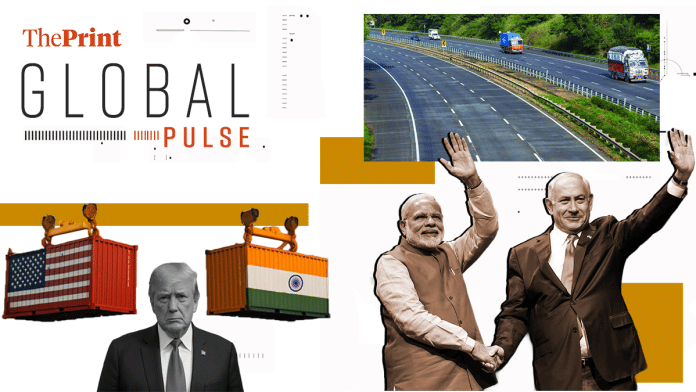



New Delhi: Prime Minister Narendra Modi began his two-day visit to Israel Wednesday, drawing much attention from the local and global media to his second State visit to the country.
And as Modi touched down in Tel Aviv this evening, IDF Air Defence Command chief & ex IDF spokesperson Ran Kochav writes in The Jerusalem Post on the India-Israel ties, focusing mainly on defence links.
Kochav argues that India and Israel confront the same issue at this moment in geopolitics. “How to defend societies and critical infrastructure against air and missile threats”.
To that end, he proposes an alternative way to approach this visit — to look at it not as a “test of political warmth”, rather as a “capability checkpoint”. “Can Israel and India translate diplomatic proximity into practical mechanisms that reduce the cost asymmetry of modern air defence?”
He further says that the “last few years” are proof that air and missile defence is no longer playing a supportive role in warfare. “It is a national strategic instrument that buys decision-makers time, maneuver space, and crisis stability while denying adversaries an outsized strategic payoff.” He gave the example of Operation Sindoor.
Kochav also flags what he termed “gaps” in India’s air defence systems. He says that while India does possess warning systems for “flying threats” like the “kamikaze” drones, availability remains an issue.
To resolve the “gaps” in India’s and Israel’s defence systems, he suggests addressing the real constraints. “The real ceiling is industrial, not diplomatic,” he writes.
He says that Israel “respects” India’s strategic choice to manufacture defence equipment domestically rather than relying on supply chains outside the country.
This choice has been visible in India’s defence deals, most recently with France.
“A deeper India-Israel defense relationship requires disciplined design: an alignment with India’s production imperative, and an Israeli posture that prioritizes integration, sustainment, and ecosystem-building over one-off sales,” Kochav writes.
Had an excellent meeting with Prime Minister Netanyahu. Expressed gratitude to him for the warm welcome earlier in the day. It is a delight to be back in Israel after 9 years. We discussed a wide range of subjects aimed at boosting bilateral ties. Sectors such as technology,… pic.twitter.com/uh1cyL411c
— Narendra Modi (@narendramodi) February 25, 2026
Hagai Amit of Haaretz also reports on the big talking point this week: Modi’s Israel visit. “Modi’s arrival is expected to kick off deals worth billions of dollars.” This is Modi’s second visit to the country since 2017. As the visit comes eight years later, a lot is expected to change, Amit writes.
“This time, the focus is not ‘peace technology’, but the procurement of Israeli defence systems.”
The deals, Amit writes, are expected to bolster India’s air defence, with acquisitions spanning laser-based systems developed by Rafael and Elbit to the Arrow missile defence system built by Israel Aerospace Industries, as well as David’s Sling and Iron Dome, both produced by Rafael.
John Reed and Andres Schipani report for Financial Times on how US-driven dynamics are reshaping India’s geopolitical alignment.
They say that Trump “frayed nerves in Narendra Modi’s government through his trade brinkmanship and his warm relationship with its regional rival, Pakistan, and its military leader Asim Munir”.
India’s response has been to quickly move on with deals with Japan, Brazil and Canada. Modi also signed the “mother of all deals” with the European Union after two decades of negotiations.
Following the US supreme court ruling on Trump’s global tariffs, the White House’s response has been less than chalant on the trade deal with India. “Nothing changes, they’ll be paying tariffs, and we will not be paying tariffs,” Trump said.
After building a partnership with the US over two decades “India is now hedging its bets by stepping up ties with smaller, more collaborative powers,” Reed and Schipani write.
They say that “resilience” is the new buzzword in the corridors of power in New Delhi “as India looks to deepen ties with a range of so-called middle powers including Japan, Canada, Brazil, the UAE and the EU in what analysts say is a direct response to the volatility of the US administration.”
FT writes that Trump’s deal with India has been less than fair. “The agreement is broadly in India’s disfavour, as has been the case in Trump’s asymmetrical trade deals with other Asian countries that have been agreed under duress after tariff threats.” The report calls India’s back and forth with Trump and the US an episode of humiliation.
“For a country that shook off British colonial rule at great human cost in 1947 and has prided itself on its unstinting self-reliance ever since, the episode has been a public humiliation.”
Menaka Doshi of Bloomberg writes about how India has monetised 5.3 trillion rupees ($58.3 billion) of public assets in the last four years. “The country’s 1,46,560 kilometer-long highway network is the backbone of this asset monetization program.”
According to a NITI Aayog report, highways led the first phase of India’s asset monetisation drive, raising over 1.5 trillion rupees through toll concessions, securitisation and infrastructure investment trusts.
The report also said sectors such as coal, mining, petroleum, natural gas and ports also generated revenue through a combination of equity stake sales, exploration rights, royalties and the leasing of assets, including fibre networks and land parcels. In contrast, aviation and railways have struggled to unlock significant value.
Overall, the National Monetisation Pipeline 1.0 achieved about 89% of its target, without detailing sector-wise performance figures.
Abhishek Dey writes for the BBC on India’s tax concessions for France after Emmanuel Macron’s recent visit to the country. “India and France have revised a three-decade-old tax treaty, reducing dividend levies for large French investors while expanding Delhi’s powers to tax some transactions.”
The changes are set to help major companies such as Sanofi, Renault and L’Oreal, which have expanded their investments in India over the past few years, BBC reports.
While the treaty will come into effect later, the countries have already announced the elevation of their relationship to a “Special Global Strategic Partnership” with deepened ties in defence and space technology.
(Edited by Ajeet Tiwari)
Also Read: Canada’s Tahawwur Rana move as Carney heads to Delhi & what Trump’s new tariffs mean for India