





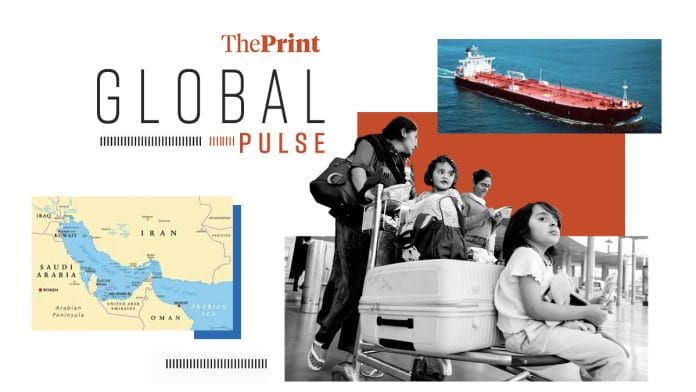



New Delhi: The US-Israeli strikes on Iran have now escalated into a full-blown war entering its fifth day. With the Gulf being home to 9.3 million Indians, the expatriate population’s livelihood stands threatened. While many countries depend on the Middle East for oil, for India, it is more than that.
Alex Travelli of The New York Times reports how ‘9 Million Indians Live in the Persian Gulf. The Money They Send Home Is a Lifeline.’
The largest share of India’s migrant workers lives in the Gulf. “Altogether, more Indians live in the Persian Gulf than there are citizens of Kuwait, Qatar and Bahrain combined,” Travelli writes. “India’s overseas workers send home more money, as remittances, than any other country.”Indians, as the report argues, pour 125 billion dollars into India’s economy every year, which plays a crucial role in boosting the value of the rupee.
There is an imbalance in India’s import and export, and inflow of money from the Gulf helps in compensating for the deficit in export. “India buys more foreign goods than it exports—especially crude oil, with imports satisfying 90 percent of its total needs.” Thus, as Travelli writes, “it is critical that Indian overseas workers earn in dollars and other hard currencies and send a lot of it back home.”
“With oil prices surging, India needs to bring in dollars urgently. For that, its expatriate workers in the Persian Gulf are its most reliable emissaries. If anything forces them to reconsider their lives across the Arabian Sea, both sides will suffer.”
Veena Venugopal writes on how India is reeling with the effects of the war in the Middle East. As the war continues, oil prices are soaring, and India’s crude purchases “account for the lion’s share of the country’s import bill.” Brent crude, up 7 percent over the weekend, surged another 13 percent on Monday — a spike that is set to directly impact India’s balance of payment, FT ‘India Business Briefing’ newsletter says.
In the last few months, India is attempting to slowly reduce its reliance on Russian oil, pivoting to the Middle East for supplies. “Half of India’s oil now transits through the important Strait of Hormuz waterway, reportedly closed by Iran’s military at present,” Venugopal writes.
“Indian equities were deep in the red yesterday, trading 2 percent down. Energy, construction and travel companies were some of the worst affected. Adani Ports fell 3.3 percent, Reliance closed down 2.6 percent, while IndiGo Airlines and Larsen & Toubro lost more than 6 and 5 percent, respectively.”
As Venugopal writes, India’s geographical proximity to the Middle East has also affected its economy. With much of the Middle East’s airspace shut, Air India cancelled over 300 flights. The alternative westward route over Pakistan has remained off limits since Operation Sindoor last year. “Overnight, India’s connectivity to Europe and North America became longer, costlier and operationally uncertain.”
Venugopal points out that the situation remains precarious with India’s immediate neighbours too. Pakistan has declared war with Afghanistan, Bangladesh just elected a new government and India has to do the hard work to thaw ties with them since Sheikh Hasina sought refuge in New Delhi, while Nepal will head to the polls on Thursday.
Cricket fairy tale
Ayaz Memon writes in the BBC on Jammu and Kashmir’s journey to winning their first Ranji trophy despite being ensnared by political turmoil, in a report titled ‘Guns and curfews: How Jammu and Kashmir defied the odds to take India cricket crown’.
To win the Ranji Trophy, as Memon writes, is to “claim a place in the country’s cricketing mainstream; for Jammu and Kashmir, it marks a breakthrough that was decades in the making.”
In the final, “the underdogs” defeated eight-time champion Karnataka, a team that had four internationals playing for it. “They produced cricket of composure, skill and steel, outplaying their decorated opponents to claim India’s premier first-class title.”
Formed in 1959-60, the J&K Cricket Association (JKCA) crawled amidst “political turmoil, institutional neglect and chronic underinvestment”. Far from power centres such as Mumbai, Delhi, Kolkata, Chennai and Bengaluru, the region remained a sporting outpost, cut off from funding, infrastructure and influence.
The stagnation showed: Jammu and Kashmir won their first Ranji match only in 1982-83, more than two decades after gaining state association status, reports Memon.
He identifies three landmark points that pivoted J&K in the direction of winning their first Ranji. “The first came between 2011 and 2013, when former India captain Bishen Singh Bedi took charge as coach. He transformed a side burdened by diffidence into one that believed it belonged – urging players long overawed by reputation to compete as equals on the national stage.”
The second point, according to Memon, came in 2018-19, when JKCA brought in former India all-rounder Irfan Pathan as player-cum-mentor.
The next pivotal moment came five years ago, when the team came under the leadership of Mithun Manhas, “a former Delhi stalwart born in Jammu who had also played a season for J&K – blending administrative authority with local roots and top-tier experience.”
The team was also shaped with talents like Ajay Sharma as the coach, Paras Dogra as the captain, and Abdul Samad and Umran Malik, the senior sportswriter mentions.
“What is beyond doubt is the significance of Jammu and Kashmir’s surge as a cricketing force – a rise that, in its improbable sweep, recalls Afghanistan’s ascent in the global game.”
(Edited by Tony Rai)
Also Read: India’s ‘rise up the league table of economies’ & what its ‘changing hues’ signify