





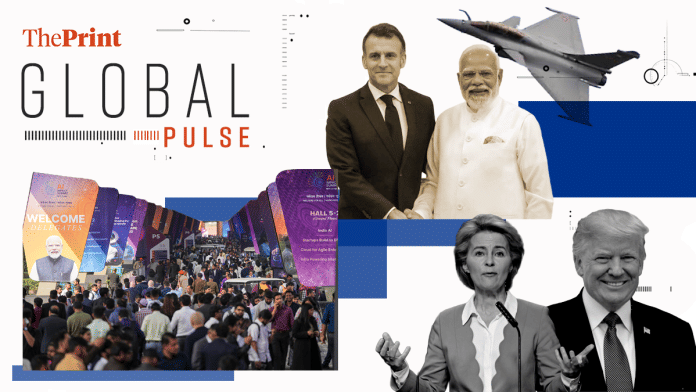



New Delhi: India grabbed global attention this month as New Delhi hosted the AI Impact Summit—the first developing country to do so, following Britain, South Korea and France.
The Economist described India as “tech-mad” but noted that what began as “an earnest discussion of risks has morphed into something like a giant trade show”.
The report added that on 16 February, “social media was awash with delegates complaining about three-hour queues, heavy-handed security and no Wi-Fi”.
Not all of it was critical. IT Minister Ashwini Vaishnaw, The Economist reported, referred to a study by Stanford University that ranks India third in the imaginative category of “AI vibrancy”—behind only the US and China, and ahead of the UK and Japan.
A separate survey, it said, found that 89 percent of Indian firms were using AI, compared with 62 percent globally. As countries race to design, develop, and build faster and improved AI models, the summit pitches India as “leader of the Global South”, it read.
Liu Wei, director of the Human-Machine Interaction and Cognitive Engineering Laboratory at Beijing University of Posts and Telecommunications, told the Global Times that the summit demonstrates “India’s efforts and momentum in actively participating in the global AI boom competition, marking a step in challenging the long-standing dominance in AI by developed countries”.
But The Economist was quick to flag constraints. “India has little aptitude in advanced manufacturing and cannot produce the chips on which AI depends,” it noted, adding that industry insiders concede that the country’s AI ecosystem “remains small”.
Nonetheless, OpenAI, Anthropic and Google are all competing for a share of India’s 900 million Internet users, who spend an average of seven hours a day online — making it an “unignorable market for AI companies looking to hoover up data on which to train models”, it said.
India’s articulated strategy, at least, is to sidestep the chip race. “We are not trying to burn millions of GPUs building artificial general intelligence,” IndiaAI boss Abhishek Singh told The Economist.
Rudra Chaudhuri of the ORF think tank elaborated: “India’s approach is bottom up. It’s not the model, it’s the use case that you have to build around.” The report cited Sarvam AI—which calls itself a “sovereign” model that functions in regional languages—as an example of this philosophy in practice.
Writing in the Financial Times, Veena Venugopal offered a sharper verdict. While India had organised the summit, “the actual business of AI” was where the country had been “far less successful”, she said
She noted that India’s spending on research and development had slipped over the past decade to under 0.7 percent of GDP—against China’s more than 2.5 percent and the US’s more than 3.5 percent—with much of its allocation directed at defence research.
“Although the government has set out an AI mission, much of it is still lip service,” Venugopal wrote, adding that until as recently as last year, senior industry figures were still questioning whether India needed sovereign language models and dismissing the AI surge as “chip-driven hype”.
The report added, “If the AI Impact Summit is to be more than diplomatic theatre, India must follow it up with domestic action: a central coordinating body with authority; a credible plan, more funding and a countrywide skills drive. India cannot credibly aspire to be an AI leader in the Global South while remaining dependent on external tech ecosystems.”
Away from the summit, media reports took note of India’s busy diplomatic calendar. Following declaration of trade agreements with the US and the European Union, New Delhi has agreed to begin negotiations with the six-nation Gulf Cooperation Council bloc—which accounts for 15 percent of India’s global trade — BBC’s Nikhil Inamdar reported.
Yet Inamdar flagged a persistent concern: India’s historically poor record of capitalising on trade agreements. “The success of any FTA lies in how it is utilised, and India has historically exhibited a low utilisation rate of only about 25 percent, in contrast to a level of 70 percent–80 percent among developed economies,” Sumedha Dasgupta of the Economist Intelligence Unit told the BBC.
The problem, the report explained, is that for many Indian exporters — particularly smaller firms — the compliance burden, audit risks and limited understanding of FTA provisions often end up outweighing the tariff advantages. The India-EU deal, for instance, requires exporters to self-certify their product’s origin, replacing the previous system of government-issued certificates of origin; proving eligibility for tariff waivers is far from straightforward.
BBC also noted a structural gap in India’s export profile: while the country has worked to secure a foothold in hi-tech manufacturing — assembling iPhones for Apple, for instance — it lags behind competitors in textiles, footwear, furniture and other labour-intensive, low value-added goods.
Completing what has been a consequential few weeks for Indian diplomacy, the Financial Times reported that French President Emmanuel Macron held talks with Prime Minister Narendra Modi as the two countries close in on India’s largest-ever defence deal — the purchase of 114 Rafale fighter jets worth $35 billion. According to the report, officials in New Delhi said that last-minute negotiations over details, including price, were still ongoing.
A key element of the agreement, French and Indian officials indicated, will involve assembling a significant share of the jets and components in India, in line with New Delhi’s ambitions to develop its domestic weapons manufacturing industry. The Financial Times noted the talks come at a pivotal moment: with US President Donald Trump casting doubt on NATO commitments and Europe “trying to revitalise its arms industries”.
(Edited by Prerna Madan)
Also Read: AI more than just ‘tech’ for India—global media, adds Bangladesh ‘reset’ may depend less on rhetoric