





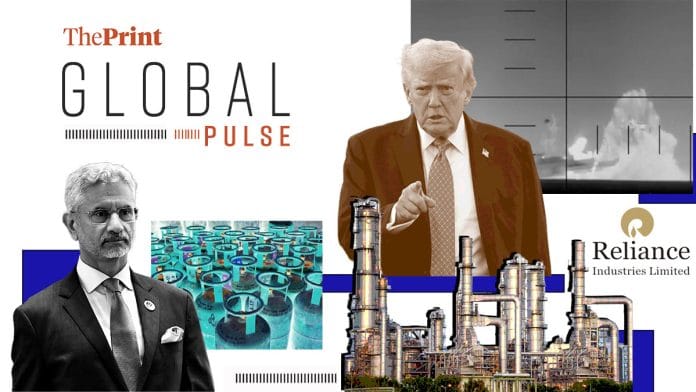



New Delhi: President Donald Trump announced a new crude refinery backed by India’s Reliance Industries, in what is set to become the US’ first new major oil refinery built from scratch in nearly 50 years.
The refinery will be set up in Brownsville, Texas. President Trump made the announcement in a post on his social media platform Truth Social.
Announcing the USD 300 billion deal, Trump unveiled the project by “a little known group” called America First Refinery (AFR), Myles McCormick and Jamie Smyth report for Financial Times.
Trump called the refinery a “A MASSIVE WIN for American Workers, Energy, and the GREAT People of South Texas!”
AFR said the announcement followed a nine-figure investment from a global supermajor at a 10-figure valuation, though the company did not disclose the investor’s identity. On Truth Social, Trump thanked India’s Reliance for what he called a “tremendous investment”, the FT report notes.
AFR said the facility would be capable of refining about 60mn barrels a year of American light crude and construction would begin in the coming months.
AFR added that the oil refinery’s production will “improve” the US trade balance by 300 billion dollars. The project itself would cost 4 billion dollars to build.
Also Read: PM reviews oil, gas supply as analysts warn reliance on imports leaves India open to war disruptions
Handling unpredictable America
The Economist writes that India has much to lose from a world in chaos.
“Since President Donald Trump was first elected and again as he returned to office last year, Indian officials mocked Western allies for lamenting his transactional ways and America First rhetoric. As Indians put it, Mr Trump represented the true and eternal face of America—with the mask off,” the publication says.
It says that while India’s External Affairs Minister S. Jaishankar is still touting this message of “Life moves on”, Delhi’s foreign policy and security establishment “does not buy Mr Jaishankar’s sangfroid”.
The White House recently announced that it would allow India to buy oil from Russia for 30 days to keep the flow intact in the global market as imports from Iran get choked at the Strait of Hormuz.
“Rather than inspiring gratitude, American talk of India being allowed to buy Russian oil for 30 days provoked grumbles about India being handed a ‘chit’ by its master.”
Several people expressed anger over the sinking of an Iranian warship by an American submarine in international waters near Sri Lanka. The torpedo attack, which Trump later said was more “fun” than capturing the frigate, was seen as a slight to India, which had recently hosted the vessel at a naval exercise, the column says.
The angst was only aggravated by India not condemning the sinking.
“The explanation is fear of Mr Trump,” writes the column.
It adds that “senior figures in Delhi questioned whether India’s balancing-act offers it autonomy, as Mr Jaishankar and other cheerleaders claim. Insiders suggest that the country is instead dangerously dependent on lots of different places at once”.
The gas squeeze
Abhishek Dey of the BBC reports on how Indian firms feel the squeeze as Iran war disrupts gas supplies.
With oil supplies through the Strait of Hormuz being disrupted due to the US and Israel’s war against Iran, India has begun to experience a fuel crunch, given it imports more than half of its energy requirements.
“Restaurant owners are scrambling to keep kitchens running and entrepreneurs in industries like ceramics and fertilisers say they are unable to maintain their production and are warning of shutdowns,” BBC writes.
India says there is no gas shortage, but has activated emergency measures to ensure supplies reach households and other priority users.
About 40-50 percent of Indian crude imports pass through the Strait. It also carries roughly 50-60 percent of the country’s liquefied natural gas (LNG) imports and about 80-85 percent of its liquefied petroleum gas (LPG) shipments.
“Most restaurants hardly have two days of LPG buffer with them currently. Many of them may have to close business in the next few days if the LPG shortage continues,” Manpreet Singh, treasurer of the National Restaurants Association of India, told the BBC.
Many restaurant owners believe they will have to switch entirely to electric ovens and stoves in the coming days if the shortage continues, Dey reports.
And the supply disruptions are not limited to restaurants.
“The fertiliser sector – natural gas being its main feedstock – has been affected. Some manufacturers have announced planned production cuts as gas supplies tighten.”
Where China stands
Meanwhile, Leading Asia expert Evan A. Feigenbaum writes for Carnegie Endowment for International Peace that too many commentators lean into geopolitical terms like “ally” and “axis” and miss China’s broader strategic intent.
China’s approach to the Middle East, Latin America, and other regions is more akin to the market strategy of “portfolio diversification,” he said.
“It avoids binding security agreements, viewing them as a vulnerability that could signal weakness and lead to entrapment. Instead, it has leaned into multiple partners and diverse offerings to anchor its position for the long term. This approach will now get a fresh test in two regions. But I predict that China will still have plenty of opportunities in both of them because of demand-side “pull,” not just China-side “push”.
(Edited by Ajeet Tiwari)
Also Read: Is India’s economy as big as it seems? Global media reads the fine print of GDP revamp