





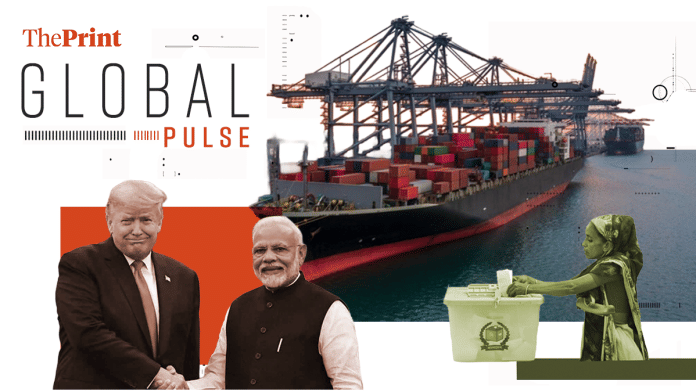



New Delhi: After a year of back-and-forth on negotiations, India and the US have reached a trade deal. But the devil was in the details.
When details of the trade deal emerged, the market that earlier rejoiced in the US lowering the tariffs on India to 18 percent, was not exactly heartened. Statements from the White House turned that deal into a cluster headache for Modi, reports Alex Travelli in The New York Times.
What stood out in the landmark deal was India’s “commitment” to buying $500 billion worth of American goods over the next five years. However, as Travelli reports, the discrepancies only became clearer when the two nations put out statements that followed the initial announcement.
While Trump was eager to announce India’s reduced oil dependence on Russia, as Travelli points out, India’s formal statement made no mention of it.
The ‘fact sheet’ from the US said that the 25 percent punitive tariff imposed on India was lowered “in recognition of India’s commitment to stop purchasing Russian Federation oil”.
“The closest it [India] came was to promise ‘economic security alignment’, and that energy products would be included in the $500 billion worth of American goods India had pledged to buy over the next five years,” read the report by The New York Times.
The Economist argued that India negotiated a “middling deal from a position of limited dependence, offering targeted liberalisation rather than sweeping concessions”.
The report was a comparative analysis, essentially looking at who got the better deal since Trump went on the “90 deals in 90 days” spree last April.
“It [India] secured a reciprocal tariff rate of 18 percent, plus conditional exemptions for generic drugs, and aircraft and car parts. In return it will ease market access for American industrial goods and some politically sensitive exports, such as genetically modified corn products,” it read.
While the report argued that Cambodia and Malaysia got the worst end of the bargain, Argentina and Britain secured prized deals. However, the report also warned against the “mercantilist” mindset that sees high exports as good, and high imports as bad. “America’s higher tariffs impose costs on consumers and reduce competition. Its trading partners, by contrast, are being forced to open up. In the end, the countries that made the largest concessions may be the ones which gain the most,” it added.
Writing on the Bangladesh general election for The Wall Street Journal, Sadanand Dhume pointed out that the parliamentary polls come with much historical and diplomatic baggage.
“Instability in Bangladesh would also affect the region’s largest economy, India, which has battled both Bangladesh-based terrorist groups and insurgents in India’s sensitive northeastern states,” writes Dhume.
Moreover, he argues that Bangladesh is the fourth-largest Muslim majority nation, and its political stature could very well determine the mood of other Muslim-mjority nations: Indonesia, Pakistan and Nigeria. “A radicalized Bangladesh would be a setback for moderate Islam worldwide.”
Menaka Doshi, in a report for Bloomberg, looks at how Tamil Nadu could empower India’s shipbuilding industry. “India owns just over 1,500 ships, about 1.2 percent of the global shipping fleet. It spends an estimated $90 billion a year on freight, moved mostly by foreign vessels,” Doshi writes, citing a report from credit rating agency ICRA.
“In Kattupalli in Tamil Nadu, things are finally looking up,” writes Doshi, adding that in a manufacturing sector largely producing for the Navy and Coast Guard, commercial vessel numbers have remained stagnant.
But, a visit to Thoothikudi by executives of South Korean shipping major HD Hyundai last year, could open new doors for commercial vessel building.
“In Thoothukudi, the federal and state governments (run by opposing political parties) are working in tandem to make that happen. A joint venture between them will build breakwaters, dry docks and other supporting facilities so that Hyundai can focus on setting up the yard speedily,” reports Doshi. While China, South Korea and Japan built most of the ships traversing the oceans, the US is trying to make its own comeback. And India is making attempts to expand, she adds.
(Edited by Amrtansh Arora)
Also Read: Amendments in White House’s India-US trade factsheet reflect joint statement, says MEA